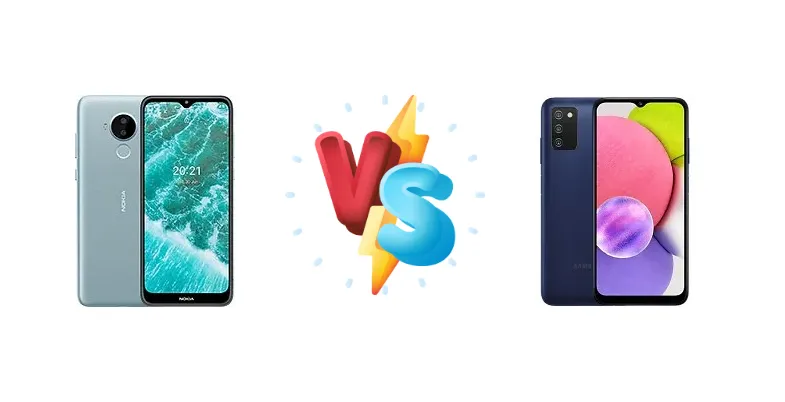
The Nokia C30 and Samsung Galaxy A03s represent the extreme end of the smartphone price spectrum, targeting first-time buyers or those needing a reliable secondary device. Both phones aim to deliver essential functionality at an incredibly low cost, but they take different approaches to achieving this. This comparison dissects their key specifications to determine which offers the best value.
🏆 Quick Verdict
For most users, the Samsung Galaxy A03s emerges as the slightly better choice. While both phones offer similar battery endurance, the A03s’s Mediatek Helio P35 chipset, fabricated on a 12nm process, provides a noticeable performance advantage over the Nokia C30’s 28nm Unisoc SC9863A, making it more responsive for everyday tasks.
| Network |
|---|
| 2G bands | GSM 850 / 900 / 1800 / 1900 | GSM 850 / 900 / 1800 / 1900 |
| 3G bands | HSDPA 850 / 900 / 2100 - International | HSDPA 850 / 900 / 2100 |
| 4G bands | 1, 3, 5, 7, 8, 20, 28, 38, 40, 41 - International | 1, 3, 5, 7, 8, 20, 28, 38, 40, 41 |
| Speed | HSPA 42.2/5.76 Mbps, LTE Cat4 150/50 Mbps | HSPA 42.2/5.76 Mbps, LTE Cat4 150/50 Mbps |
| Technology | GSM / HSPA / LTE | GSM / HSPA / LTE |
| | 1, 3, 7, 20, 28 - Australia, UK, Ireland | 2, 4, 5, 7, 12, 13, 14, 25, 26, 41, 66, 71 - SM-A037U |
| Launch |
|---|
| Announced | 2021, July 27 | 2021, August 18 |
| Status | Available. Released 2021, October 12 | Available. Released 2021, August 18 |
| Body |
|---|
| Build | - | Glass front, plastic frame, plastic back |
| Dimensions | 177.7 x 79.1 x 9.9 mm (7.00 x 3.11 x 0.39 in) | 164.2 x 75.9 x 9.1 mm (6.46 x 2.99 x 0.36 in) |
| SIM | Nano-SIM + Nano-SIM | Nano-SIM + Nano-SIM |
| Weight | 237 g (8.36 oz) | 196 g (6.91 oz) |
| Display |
|---|
| Resolution | 720 x 1600 pixels, 20:9 ratio (~257 ppi density) | 720 x 1600 pixels, 20:9 ratio (~270 ppi density) |
| Size | 6.82 inches, 112.3 cm2 (~79.9% screen-to-body ratio) | 6.5 inches, 102.0 cm2 (~81.8% screen-to-body ratio) |
| Type | IPS LCD | PLS LCD |
| Platform |
|---|
| CPU | Octa-core (4x1.6 GHz Cortex-A55 & 4x1.2 GHz Cortex-A55) | Octa-core (4x2.35 GHz Cortex-A53 & 4x1.8 GHz Cortex-A53) |
| Chipset | Unisoc SC9863A (28 nm) | Mediatek MT6765 Helio P35 (12 nm) |
| GPU | IMG8322 | PowerVR GE8320 |
| OS | Android 11 (Go edition) | Android 11, upgradable to Android 13, One UI 5.1 Core |
| Memory |
|---|
| Card slot | microSDXC (dedicated slot) | microSDXC (dedicated slot) |
| Internal | 32GB 2GB RAM, 32GB 3GB RAM, 64GB 2GB RAM, 64GB 3GB RAM, 64GB 4GB RAM | 32GB 2GB RAM, 32GB 3GB RAM, 32GB 4GB RAM, 64GB 3GB RAM, 64GB 4GB RAM |
| | eMMC 5.1 | eMMC 5.1 |
| Main Camera |
|---|
| Dual | 13 MP, (wide)
Auxiliary lens | - |
| Features | LED flash | LED flash |
| Single | 5 MP | 5 MP, f/2.2 |
| Triple | - | 13 MP, f/2.2, (wide), AF
2 MP (macro)
Auxiliary lens |
| Video | 1080p@30fps | 1080p@30fps |
| Selfie camera |
|---|
| Single | 5 MP | 5 MP, f/2.2 |
| Video | Unspecified | 1080p@30fps |
| Sound |
|---|
| 3.5mm jack | Yes | Yes |
| 35mm jack | Yes | Yes |
| Loudspeaker | Yes | Yes |
| Comms |
|---|
| Bluetooth | 4.2, A2DP | 5.0, A2DP |
| NFC | No | Yes (market/region dependent) |
| Positioning | GPS | GPS, GLONASS, GALILEO, BDS |
| Radio | FM radio | No |
| USB | microUSB 2.0, OTG | USB Type-C 2.0 |
| WLAN | Wi-Fi 802.11 b/g/n | Wi-Fi 802.11 b/g/n, Wi-Fi Direct |
| Features |
|---|
| Sensors | Fingerprint (rear-mounted), accelerometer, proximity | Fingerprint (side-mounted), accelerometer, proximity |
| Battery |
|---|
| Charging | 10W wired | 15W wired |
| Type | Li-Po 6000 mAh | Li-Po 5000 mAh |
| Misc |
|---|
| Colors | Green, White, Dark Grey | Black, Blue, White |
| Models | TA-1357, TA-1377, TA-1369, TA-1360, TA-1359 | SM-A037F, SM-A037F/DS, SM-A037M, SM-A037G, SM-A037U, SM-S134DL, SM-A037W, SM-A037U1, SM-S135DL |
| Price | About 100 EUR | $ 65.65 / £ 82.99 / ₹ 10,800 |
| SAR | 0.33 W/kg (head) 1.19 W/kg (body) | - |
| SAR EU | 0.41 W/kg (head) 1.29 W/kg (body) | 0.36 W/kg (head) 1.09 W/kg (body) |
| Tests |
|---|
| Battery life | - |
Endurance rating 122h
|
| Camera | - |
Photo / Video |
| Display | - |
Contrast ratio: 1718:1 (nominal) |
| Loudspeaker | - |
-27.4 LUFS (Good)
|
| Performance | - |
AnTuTu: 103465 (v8), 101299 (v9)
GeekBench: 889 (v5.1)
GFXBench: 5.5fps (ES 3.1 onscreen) |
Nokia C30
- Large display size (unspecified, but likely larger than A03s)
- Android Go Edition offers a streamlined experience
- Potentially lower price point
- Less powerful Unisoc SC9863A chipset
- Slower 10W charging
- Lower peak display brightness (estimated)
Samsung Galaxy A03s
- More powerful Mediatek Helio P35 chipset
- Faster 15W charging
- Higher peak display brightness (488 nits)
- May be slightly more expensive
- Standard Android experience (potentially more bloatware)
- Similar battery life to C30 despite faster charging
Display Comparison
The Samsung Galaxy A03s boasts a measured peak brightness of 488 nits, significantly enhancing outdoor visibility compared to the Nokia C30, which lacks published brightness data. Both share a 1718:1 contrast ratio, suggesting similar color reproduction quality. However, the A03s’s higher brightness makes it the more practical choice for users frequently exposed to sunlight. The Nokia C30’s larger screen size might appeal to some, but without comparable brightness figures, it’s difficult to assess its overall viewing experience.
Camera Comparison
Both devices list 'Photo / Video' capabilities, but lack specific details regarding sensor size or megapixel count. Given the price point, image quality will likely be similar, focusing on basic snapshots in good lighting conditions. The absence of Optical Image Stabilization (OIS) on either device suggests reliance on software processing for stabilization. The usefulness of any macro camera (likely 2MP on both) is questionable, offering limited detail and often poor image quality. The camera experience will likely be a secondary consideration for buyers in this segment.
Performance
The Samsung Galaxy A03s’s Mediatek Helio P35, built on a 12nm process, offers a clear architectural advantage over the Nokia C30’s Unisoc SC9863A (28nm). The Helio P35’s Cortex-A53 cores, clocked up to 2.35 GHz, outperform the C30’s Cortex-A55 cores (1.6 GHz and 1.2 GHz). This translates to faster app loading times and smoother multitasking on the A03s. The larger process node of the Unisoc chip in the C30 will likely result in higher power consumption for similar tasks. While both are octa-core, the architecture and fabrication process dictate a performance lead for Samsung.
Battery Life
Both the Nokia C30 and Samsung Galaxy A03s achieve an endurance rating of 122 hours, indicating comparable battery life under similar usage patterns. However, the Samsung Galaxy A03s supports 15W wired charging, while the Nokia C30 is limited to 10W. This means the A03s will recharge significantly faster, reducing downtime. While both will likely last a full day on a single charge for moderate users, the faster charging speed gives the A03s a practical advantage.
Buying Guide
Buy the Nokia C30 if your primary need is a large display and you prioritize software simplicity with Android Go Edition. It’s ideal for basic communication and media consumption. Buy the Samsung Galaxy A03s if you value slightly better performance for multitasking and app responsiveness, and appreciate a more established brand ecosystem. It’s a better fit for users who occasionally play casual games or use more demanding apps.
Frequently Asked Questions
❓ Does the Unisoc SC9863A chipset in the Nokia C30 struggle with multitasking?
Yes, the Unisoc SC9863A, with its older 28nm process and lower clock speeds, is likely to exhibit noticeable lag when switching between multiple apps or running demanding applications. It's best suited for single-tasking and basic usage.
❓ Is the 15W charging on the Samsung Galaxy A03s a significant improvement over the Nokia C30's 10W charging?
Absolutely. While both phones offer similar battery life, the 15W charging on the A03s will significantly reduce the time it takes to fully recharge the device. Expect a noticeable difference in convenience, especially for users who frequently need to top up their battery.
❓ Will either phone handle popular games like PUBG Mobile smoothly?
Neither phone is ideally suited for demanding games like PUBG Mobile. While the A03s might be able to run it on the lowest settings, expect significant frame rate drops and a less-than-optimal gaming experience. The C30 will likely struggle even more.
❓ What is Android Go Edition on the Nokia C30, and how does it affect performance?
Android Go Edition is a lightweight version of Android designed for devices with limited resources. It uses less storage space and data, and features optimized apps. While it improves performance on low-end hardware like the C30, it also means some features found in the standard Android experience may be missing.