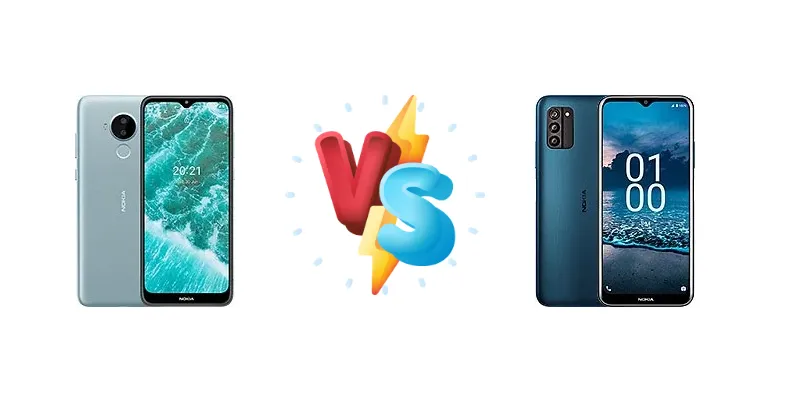
Nokia's C-series and G-series represent their entry into the highly competitive budget smartphone market. The C30 and G100, while both aiming for affordability, take distinctly different approaches to achieving it. The C30 relies on a Unisoc chipset, while the G100 opts for Qualcomm's Snapdragon 662. This comparison dissects these choices, revealing which phone delivers the best experience for your money.
🏆 Quick Verdict
For most users, the Nokia G100 is the superior choice. Its Snapdragon 662 chipset, built on a more efficient 11nm process, provides a noticeable performance advantage over the C30’s Unisoc SC9863A. While the C30 is cheaper, the G100’s improved processing power and slightly faster charging justify the price difference.
| Network |
|---|
| 2G bands | GSM 850 / 900 / 1800 / 1900 | GSM 850 / 900 / 1800 / 1900 |
| 3G bands | HSDPA 850 / 900 / 2100 - International | HSDPA 850 / 1700(AWS) / 1900 |
| 4G bands | 1, 3, 5, 7, 8, 20, 28, 38, 40, 41 - International | 2, 4, 5, 7, 12, 13, 17, 44, 66, 71 |
| Speed | HSPA 42.2/5.76 Mbps, LTE Cat4 150/50 Mbps | HSPA, LTE |
| Technology | GSM / HSPA / LTE | GSM / HSPA / LTE |
| | 1, 3, 7, 20, 28 - Australia, UK, Ireland | - |
| Launch |
|---|
| Announced | 2021, July 27 | 2022, September 22 |
| Status | Available. Released 2021, October 12 | Available. Released 2022, October |
| Body |
|---|
| Build | - | Glass front, plastic frame, plastic back |
| Dimensions | 177.7 x 79.1 x 9.9 mm (7.00 x 3.11 x 0.39 in) | 166.6 x 76.7 x 8.9 mm (6.56 x 3.02 x 0.35 in) |
| SIM | Nano-SIM + Nano-SIM | Nano-SIM |
| Weight | 237 g (8.36 oz) | 195.1 g (6.88 oz) |
| Display |
|---|
| Resolution | 720 x 1600 pixels, 20:9 ratio (~257 ppi density) | 720 x 1600 pixels, 20:9 ratio (~269 ppi density) |
| Size | 6.82 inches, 112.3 cm2 (~79.9% screen-to-body ratio) | 6.52 inches, 102.6 cm2 (~80.3% screen-to-body ratio) |
| Type | IPS LCD | IPS LCD |
| Platform |
|---|
| CPU | Octa-core (4x1.6 GHz Cortex-A55 & 4x1.2 GHz Cortex-A55) | Octa-core (4x2.0 GHz Kryo 260 Gold & 4x1.8 GHz Kryo 260 Silver) |
| Chipset | Unisoc SC9863A (28 nm) | Qualcomm SM6115 Snapdragon 662 (11 nm) |
| GPU | IMG8322 | Adreno 610 |
| OS | Android 11 (Go edition) | Android 12 |
| Memory |
|---|
| Card slot | microSDXC (dedicated slot) | microSDXC |
| Internal | 32GB 2GB RAM, 32GB 3GB RAM, 64GB 2GB RAM, 64GB 3GB RAM, 64GB 4GB RAM | 32GB 3GB RAM, 128GB 4GB RAM |
| | eMMC 5.1 | - |
| Main Camera |
|---|
| Dual | 13 MP, (wide)
Auxiliary lens | - |
| Features | LED flash | LED flash, HDR, panorama |
| Single | 5 MP | - |
| Triple | - | 13 MP, f/1.8, (wide), AF
5 MP, f/2.2, 115˚ (ultrawide), 1/5.0"
Auxiliary lens |
| Video | 1080p@30fps | 1080p@30fps |
| Selfie camera |
|---|
| Single | 5 MP | 8 MP, f/2.0, (wide), 1/4.0", 1.12µm |
| Video | Unspecified | 1080p@30fps |
| Sound |
|---|
| 3.5mm jack | Yes | - |
| 35mm jack | Yes | Yes |
| Loudspeaker | Yes | Yes |
| Comms |
|---|
| Bluetooth | 4.2, A2DP | 5.0, A2DP, LE |
| NFC | No | No |
| Positioning | GPS | GPS |
| Radio | FM radio | FM radio |
| USB | microUSB 2.0, OTG | USB Type-C 2.0, OTG |
| WLAN | Wi-Fi 802.11 b/g/n | Wi-Fi 802.11 b/g/n/ac, dual-band |
| Features |
|---|
| Sensors | Fingerprint (rear-mounted), accelerometer, proximity | Fingerprint (side-mounted), accelerometer, gyro, proximity, barometer |
| Battery |
|---|
| Charging | 10W wired | 15W wired |
| Type | Li-Po 6000 mAh | Li-Po 5000 mAh |
| Misc |
|---|
| Colors | Green, White, Dark Grey | Nordic Blue |
| Models | TA-1357, TA-1377, TA-1369, TA-1360, TA-1359 | - |
| Price | About 100 EUR | About 60 EUR |
| SAR | 0.33 W/kg (head) 1.19 W/kg (body) | - |
| SAR EU | 0.41 W/kg (head) 1.29 W/kg (body) | - |
Nokia C30
- Most affordable option
- Simple and easy-to-use interface
- Acceptable for basic tasks
- Slow performance due to Unisoc chipset
- Less efficient 28nm process
- Slower 10W charging
Nokia G100
- Faster Snapdragon 662 processor
- More efficient 11nm process
- Faster 15W charging
- Slightly higher price point
- May still struggle with very demanding games
- Limited detailed specifications
Display Comparison
Neither Nokia provides detailed display specifications beyond resolution. However, the difference in processing power suggests the G100 is more likely to handle higher refresh rates (if present) smoothly. The panel technology is likely IPS LCD on both, typical for this price range. The real differentiator will be color calibration and brightness, which are not specified, but the G100’s more powerful GPU could potentially drive a slightly brighter display.
Camera Comparison
Without detailed camera specs beyond the main sensor, a direct comparison is difficult. However, the Snapdragon 662’s image signal processor (ISP) is generally more capable than the one found in the Unisoc SC9863A. This means the G100 is likely to produce better-quality photos, particularly in challenging lighting conditions. Image processing algorithms on the G100 will likely be more refined, resulting in more accurate colors and better dynamic range. The presence of a more powerful GPU also aids in post-processing tasks.
Performance
The core difference lies in the chipsets. The Nokia G100’s Qualcomm Snapdragon 662 (11nm) significantly outperforms the Nokia C30’s Unisoc SC9863A (28nm). The 11nm process node of the Snapdragon 662 is far more efficient, leading to better thermal management and sustained performance. The Snapdragon’s Kryo 260 Gold cores, clocked at 2.0 GHz, are architecturally superior to the Cortex-A55 cores in the C30, resulting in faster app loading times and smoother multitasking. The C30’s CPU, while octa-core, is split into slower clusters, limiting its peak performance. This translates to a more sluggish experience on the C30, especially when switching between apps or running demanding applications.
Battery Life
Both phones offer adequate battery life for basic usage. The G100’s 15W charging is a clear advantage over the C30’s 10W charging. While neither is particularly fast by modern standards, the 5W difference translates to a noticeably quicker top-up time. The Snapdragon 662’s improved efficiency also contributes to better battery life during active use, offsetting any potential capacity differences (which are not specified). Users who frequently find themselves needing to charge throughout the day will benefit from the G100’s faster charging and more efficient chipset.
Buying Guide
Buy the Nokia C30 if you prioritize absolute affordability and basic smartphone functionality – checking email, light social media, and occasional calls. It’s a suitable option for first-time smartphone users or those on a very tight budget. Buy the Nokia G100 if you value smoother multitasking, a more responsive user experience, and the ability to handle moderately demanding apps and games. The G100 is the better choice for users who want a phone that feels more capable and future-proof.
Frequently Asked Questions
❓ Will the Nokia G100 handle popular games like PUBG Mobile or Call of Duty?
The Snapdragon 662 in the G100 can run PUBG Mobile and Call of Duty, but likely at medium graphics settings and frame rates. Don't expect a flagship gaming experience, but it's significantly more capable than the C30 for gaming. The C30 will struggle with these titles, even on the lowest settings.
❓ Is the difference in charging speed between 10W and 15W really noticeable?
Yes, the 5W difference is noticeable. While neither is fast charging, 15W will top up the G100's battery considerably faster than the C30's 10W. Expect roughly a 30-60 minute difference for a full charge, depending on battery capacity (which isn't specified).
❓ How much of a performance difference will I see in everyday tasks like browsing and social media?
You'll notice a significant difference. The G100's Snapdragon 662 will make browsing, scrolling through social media, and opening apps feel much smoother and more responsive compared to the C30's Unisoc chipset. The C30 may exhibit noticeable lag when multitasking.