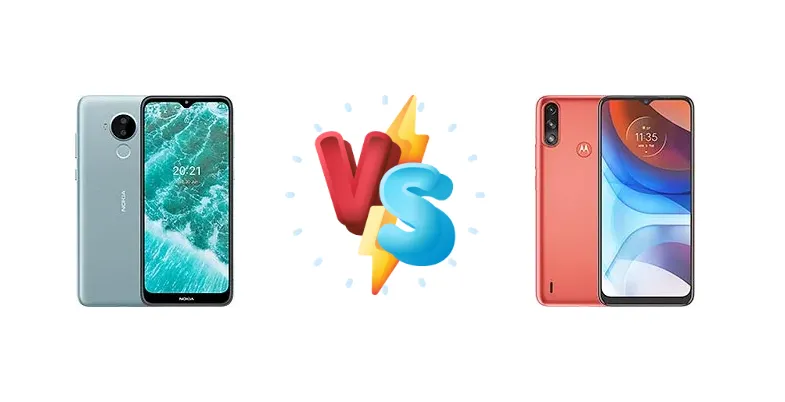
The Nokia C30 and Motorola Moto E7i Power occupy the ultra-budget smartphone segment, a space where incremental differences can be crucial. Surprisingly, both devices share the exact same core hardware – the Unisoc SC9863A chipset. This comparison dives deep to uncover where, if anywhere, these phones diverge and which one delivers the best experience for the price.
🏆 Quick Verdict
For the average user, the Motorola Moto E7i Power edges out the Nokia C30. While performance is identical due to the shared Unisoc SC9863A, Motorola’s typically more streamlined software and potentially better availability make it the slightly more practical choice.
| Network |
|---|
| 2G bands | GSM 850 / 900 / 1800 / 1900 | GSM 850 / 900 / 1800 / 1900 |
| 3G bands | HSDPA 850 / 900 / 2100 - International | HSDPA 850 / 900 / 1700(AWS) / 1900 / 2100 |
| 4G bands | 1, 3, 5, 7, 8, 20, 28, 38, 40, 41 - International | LTE |
| Speed | HSPA 42.2/5.76 Mbps, LTE Cat4 150/50 Mbps | HSPA, LTE |
| Technology | GSM / HSPA / LTE | GSM / HSPA / LTE |
| | 1, 3, 7, 20, 28 - Australia, UK, Ireland | - |
| Launch |
|---|
| Announced | 2021, July 27 | 2021, February 23 |
| Status | Available. Released 2021, October 12 | Available. Released 2021, March 15 |
| Body |
|---|
| Build | - | Glass front, plastic back, plastic frame |
| Dimensions | 177.7 x 79.1 x 9.9 mm (7.00 x 3.11 x 0.39 in) | 165.1 x 75.9 x 9.2 mm (6.5 x 2.99 x 0.36 in) |
| SIM | Nano-SIM + Nano-SIM | Nano-SIM + Nano-SIM |
| Weight | 237 g (8.36 oz) | 200 g (7.05 oz) |
| | - | Water-repellent design |
| Display |
|---|
| Resolution | 720 x 1600 pixels, 20:9 ratio (~257 ppi density) | 720 x 1600 pixels, 20:9 ratio (~270 ppi density) |
| Size | 6.82 inches, 112.3 cm2 (~79.9% screen-to-body ratio) | 6.51 inches, 102.3 cm2 (~81.7% screen-to-body ratio) |
| Type | IPS LCD | IPS LCD, 380 nits (typ) |
| Platform |
|---|
| CPU | Octa-core (4x1.6 GHz Cortex-A55 & 4x1.2 GHz Cortex-A55) | Octa-core (4x1.6 GHz Cortex-A55 & 4x1.2 GHz Cortex-A55) |
| Chipset | Unisoc SC9863A (28 nm) | Unisoc SC9863A (28 nm) |
| GPU | IMG8322 | IMG8322 |
| OS | Android 11 (Go edition) | Android 10 (Go edition) |
| Memory |
|---|
| Card slot | microSDXC (dedicated slot) | microSDXC (uses shared SIM slot) |
| Internal | 32GB 2GB RAM, 32GB 3GB RAM, 64GB 2GB RAM, 64GB 3GB RAM, 64GB 4GB RAM | 32GB 2GB RAM |
| | eMMC 5.1 | eMMC 5.1 |
| Main Camera |
|---|
| Dual | 13 MP, (wide)
Auxiliary lens | 13 MP, f/2.0, 26mm (wide), 1/3.1", 1.12µm, PDAF
2 MP (macro) |
| Features | LED flash | LED flash, HDR, panorama |
| Single | 5 MP | - |
| Video | 1080p@30fps | 1080p@30fps |
| Selfie camera |
|---|
| Features | - | HDR |
| Single | 5 MP | 5 MP, f/2.2, 27mm (wide), 1.12µm |
| Video | Unspecified | 1080p@30fps |
| Sound |
|---|
| 3.5mm jack | Yes | Yes |
| 35mm jack | Yes | Yes |
| Loudspeaker | Yes | Yes |
| Comms |
|---|
| Bluetooth | 4.2, A2DP | 4.2, A2DP |
| NFC | No | No |
| Positioning | GPS | GPS, GLONASS, GALILEO |
| Radio | FM radio | Unspecified |
| USB | microUSB 2.0, OTG | USB Type-C 2.0 |
| WLAN | Wi-Fi 802.11 b/g/n | Wi-Fi 802.11 b/g/n |
| Features |
|---|
| Sensors | Fingerprint (rear-mounted), accelerometer, proximity | Fingerprint (rear-mounted), accelerometer, proximity |
| Battery |
|---|
| Charging | 10W wired | 10W wired |
| Type | Li-Po 6000 mAh | Li-Ion 5000 mAh |
| Misc |
|---|
| Colors | Green, White, Dark Grey | Tahiti Blue, Coral Red |
| Models | TA-1357, TA-1377, TA-1369, TA-1360, TA-1359 | XT2097-13 |
| Price | About 100 EUR | About 120 EUR |
| SAR | 0.33 W/kg (head) 1.19 W/kg (body) | - |
| SAR EU | 0.41 W/kg (head) 1.29 W/kg (body) | - |
Nokia C30
- Potential for cleaner Android Go experience
- Nokia’s brand reputation for reliability
- May receive more consistent (though limited) software updates
- Potentially limited availability in some markets
- Identical performance to Moto E7i Power
Motorola Moto E7i Power
- Generally wider availability than Nokia
- Motorola’s software is often optimized for performance
- Identical performance to Nokia C30
- Motorola’s software update commitment is often shorter than Nokia’s
- Identical performance to Nokia C30
Display Comparison
Both the Nokia C30 and Moto E7i Power lack detailed display specifications in the provided data. Given their price point, we can assume both utilize LCD panels with resolutions likely around 720p+. The absence of information regarding peak brightness, color gamut coverage, or PWM dimming rates suggests neither phone will excel in outdoor visibility or color accuracy. Users sensitive to screen flicker should research independent reviews for PWM frequency data, as this is a common area of concern in this price bracket.
Camera Comparison
Camera details are sparse. Both phones likely feature a primary camera alongside potentially a depth or macro sensor. Without sensor size or aperture information, it’s difficult to assess image quality. The Unisoc SC9863A’s image signal processor (ISP) is basic, so image processing will likely prioritize speed over detail. Expect acceptable results in good lighting conditions, but poor performance in low light. The inclusion of a 2MP macro camera (common in this segment) is unlikely to provide significant value due to its low resolution and fixed focus.
Performance
The core of both devices is the Unisoc SC9863A, a 28nm octa-core processor featuring four Cortex-A55 cores clocked at 1.6 GHz and four at 1.2 GHz. This configuration is geared towards basic tasks like calling, texting, and light web browsing. The identical chipset guarantees virtually identical performance in everyday use. The 28nm manufacturing process, however, is relatively dated, suggesting limited thermal headroom and potential for throttling under sustained load. Gamers should expect only the most basic Android titles to be playable, even at low settings. RAM capacity, not provided, will significantly impact multitasking performance; more RAM is always preferable.
Battery Life
Both the Nokia C30 and Motorola Moto E7i Power utilize 10W wired charging. This is a slow charging standard by today’s standards, meaning a full charge will take several hours. Battery capacity, also unspecified, is a critical factor. Given the power-efficient Unisoc SC9863A and basic display technology, both phones should achieve at least a full day of light use. However, heavy users will likely need to top up the battery during the day. The slow charging speed means minimizing battery drain is crucial.
Buying Guide
Buy the Nokia C30 if you prioritize a potentially cleaner Android Go experience and value Nokia’s brand reputation for software updates (though limited). Buy the Motorola Moto E7i Power if you prefer a more readily available device with a potentially more optimized software experience, and are less concerned with long-term software support. Both are ideal for first-time smartphone users or those needing a very basic, reliable device.
Frequently Asked Questions
❓ Will the Unisoc SC9863A struggle with popular social media apps like Facebook and Instagram?
While the Unisoc SC9863A can run these apps, expect a somewhat sluggish experience, especially with multiple apps open. The processor is designed for basic tasks, and these apps can be resource-intensive. Limiting background app activity will help improve performance.
❓ Is Android Go a benefit or a limitation on these devices?
Android Go is a stripped-down version of Android designed for low-end hardware. It’s a benefit because it reduces system resource usage, resulting in smoother performance on the limited hardware. However, it also means some features found in the full Android experience are missing. It's ideal for users who prioritize simplicity and speed over advanced features.
❓ Can I play games like PUBG Mobile or Call of Duty Mobile on either of these phones?
Playing PUBG Mobile or Call of Duty Mobile is not recommended. While you might be able to launch the games, the Unisoc SC9863A lacks the processing power and graphics capabilities to deliver a playable experience, even at the lowest settings. Expect significant lag and frame rate drops.