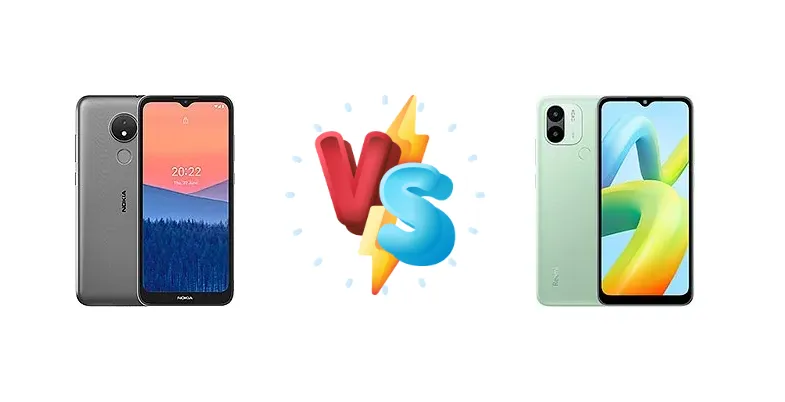
The Nokia C21 and Xiaomi Redmi A1+ represent the absolute entry point into the Android ecosystem. Both aim to deliver smartphone functionality at the lowest possible price, but they take different approaches to achieving this. The Nokia C21 prioritizes an octa-core CPU, while the Redmi A1+ opts for a newer, albeit quad-core, chipset with faster clock speeds and the convenience of 10W charging.
🏆 Quick Verdict
For the average user prioritizing basic functionality and slightly faster charging, the Xiaomi Redmi A1+ is the better choice. Its Mediatek Helio A22, despite having fewer cores, operates at a higher clock speed, offering a snappier experience for everyday tasks. However, the Nokia C21’s octa-core processor may offer better multitasking capabilities.
| Network |
|---|
| 2G bands | GSM 850 / 900 / 1800 / 1900 | GSM 850 / 900 / 1800 / 1900 - SIM 1 & SIM 2 |
| 3G bands | HSDPA 850 / 900 / 2100 - International | HSDPA 850 / 900 / 2100 |
| 4G bands | LTE | 1, 3, 5, 7, 8, 20, 28, 38, 40, 41 |
| Speed | HSPA 42.2/5.76 Mbps, LTE Cat4 150/50 Mbps | HSPA, LTE |
| Technology | GSM / HSPA / LTE | GSM / HSPA / LTE |
| | HSDPA 850 / 900 / 1700(AWS) / 1900 / 2100 - LATAM, Brazil | - |
| Launch |
|---|
| Announced | 2022, February 28 | 2022, September 23 |
| Status | Available. Released 2022, May 03 | Available. Released 2022, September 23 |
| Body |
|---|
| Build | Glass front, aluminum frame, plastic back | - |
| Dimensions | 169.9 x 77.9 x 8.8 mm (6.69 x 3.07 x 0.35 in) | 164.9 x 76.8 x 9.1 mm (6.49 x 3.02 x 0.36 in) |
| SIM | · Nano-SIM· Nano-SIM + Nano-SIM | Dual SIM (Nano-SIM, dual stand-by) |
| Weight | 195 g (6.88 oz) | 192 g (6.77 oz) |
| Display |
|---|
| Resolution | 720 x 1600 pixels, 20:9 ratio (~269 ppi density) | 720 x 1600 pixels, 20:9 ratio (~269 ppi density) |
| Size | 6.52 inches, 102.6 cm2 (~77.5% screen-to-body ratio) | 6.52 inches, 102.6 cm2 (~81.0% screen-to-body ratio) |
| Type | IPS LCD | IPS LCD, 400 nits (typ) |
| Platform |
|---|
| CPU | Octa-core (4x1.6 GHz Cortex-A55 & 4x1.2 GHz Cortex-A55) | Quad-core 2.0 GHz Cortex-A53 |
| Chipset | Unisoc SC9863A (28 nm) | Mediatek MT6761 Helio A22 (12 nm) |
| GPU | IMG8322 | PowerVR GE8320 |
| OS | Android 11 (Go edition) | Android 12 (Go edition), MIUI 12 |
| Memory |
|---|
| Card slot | microSDXC (dedicated slot) | microSDXC (dedicated slot) |
| Internal | 32GB 2GB RAM, 32GB 3GB RAM, 64GB 3GB RAM | 32GB 2GB RAM, 32GB 3GB RAM |
| | eMMC 5.1 | eMMC 5.1 |
| Main Camera |
|---|
| Dual | - | 8 MP, f/2.0, (wide)
0.08 MP (depth) |
| Features | LED flash, HDR | Dual-LED flash, HDR |
| Single | 8 MP | - |
| Video | 720p@30fps | 1080p@30fps |
| Selfie camera |
|---|
| Features | LED flash | - |
| Single | 5 MP | 5 MP, f/2.2 |
| Video | 720p | 1080p@30fps |
| Sound |
|---|
| 3.5mm jack | Yes | Yes |
| 35mm jack | Yes | - |
| Loudspeaker | Yes | Yes |
| Comms |
|---|
| Bluetooth | 4.2, A2DP | 5.0, A2DP, LE |
| NFC | No | No |
| Positioning | GPS | GPS, GLONASS, GALILEO, BDS |
| Radio | FM radio | FM radio |
| USB | microUSB 2.0 | microUSB 2.0 |
| WLAN | Wi-Fi 802.11 b/g/n | Wi-Fi 802.11 a/b/g/n |
| Features |
|---|
| Sensors | Fingerprint (rear-mounted), accelerometer, proximity | Fingerprint (rear-mounted), accelerometer |
| Battery |
|---|
| Charging | - | 10W wired |
| Type | Li-Ion 3000 mAh, removable | Li-Po 5000 mAh, non-removable |
| Misc |
|---|
| Colors | Dark Blue, Warm Gray | Light Green, Light Blue, Black |
| Models | TA-1356, TA-1352 | 220733SFG |
| Price | About 70 EUR | € 78.30 / £ 72.30 / ₹ 6,670 |
| SAR | - | 1.00 W/kg (head) 1.10 W/kg (body) |
| SAR EU | 0.43 W/kg (head) 1.55 W/kg (body) | 0.91 W/kg (head) 1.00 W/kg (body) |
Nokia C21
- Octa-core processor may handle multitasking better.
- Nokia's reputation for software updates (though limited).
- Potentially lower operating temperatures due to less aggressive clock speeds.
- Older 28nm process node is less efficient.
- Likely slower charging speeds.
- Lower clock speeds on some cores.
Xiaomi Redmi A1+
- Faster 2.0 GHz quad-core processor for snappier UI.
- More efficient 12nm process node.
- 10W charging for quicker top-ups.
- Fewer cores may limit multitasking performance.
- Mediatek chipsets sometimes have less consistent software support.
- Potentially higher operating temperatures under sustained load.
Display Comparison
Neither device boasts a standout display. Both are expected to feature basic LCD panels with resolutions likely around 720x1600. The lack of detailed display specifications necessitates focusing on the chipset impact on UI rendering. A faster chipset, like the Redmi A1+'s Helio A22, will contribute more to perceived smoothness than a marginal difference in display quality at this price point.
Camera Comparison
Both devices are expected to feature basic camera setups, likely with a primary sensor around 8MP. Detailed camera specs are unavailable, so analysis focuses on processing power. The Helio A22 in the Redmi A1+ has a slight edge in image signal processing (ISP) capabilities, potentially resulting in marginally better image quality, especially in well-lit conditions. However, the difference will be minimal, and both cameras will struggle in low light.
Performance
The core difference lies in the chipsets. The Nokia C21’s Unisoc SC9863A utilizes an octa-core configuration with a split core design (4x1.6 GHz Cortex-A55 & 4x1.2 GHz Cortex-A55). This means it has more cores, but they are split between higher and lower performance tiers. The Xiaomi Redmi A1+’s Mediatek Helio A22, conversely, features a quad-core 2.0 GHz Cortex-A53 setup. While fewer in number, the Cortex-A53 cores operate at a significantly higher clock speed. The Helio A22’s 12nm process node is also more efficient than the SC9863A’s 28nm node, potentially leading to better battery life under load. This translates to a more responsive experience for launching apps and navigating the UI on the Redmi A1+.
Battery Life
Battery capacity is not specified for either device, but both are likely to house batteries around 5000mAh, typical for this segment. The key differentiator is charging speed. The Xiaomi Redmi A1+ supports 10W wired charging, a significant advantage over the likely 5W or slower charging on the Nokia C21. This means the Redmi A1+ can be topped up much faster, reducing downtime and improving usability.
Buying Guide
Buy the Nokia C21 if you frequently switch between multiple apps and need a device that can handle light multitasking without significant slowdown. Its octa-core processor, while based on older architecture, provides more processing threads. Buy the Xiaomi Redmi A1+ if you value faster charging and a slightly more responsive user interface for single-app usage. The 10W charging is a significant advantage in this price bracket, and the higher clock speed of the Helio A22 provides a smoother experience for basic tasks.
Frequently Asked Questions
❓ Will the Helio A22 in the Redmi A1+ get uncomfortably hot during prolonged use of apps like WhatsApp or Facebook?
While the Helio A22 isn't a powerhouse, its 12nm process node helps manage thermal output. For typical social media usage, overheating is unlikely. However, demanding tasks like gaming will likely push the chip to its limits and result in noticeable heat.
❓ Is the difference in core count (octa-core vs quad-core) significant for everyday tasks like browsing and checking email?
For basic tasks, the difference is minimal. The higher clock speed of the Helio A22 in the Redmi A1+ will have a more noticeable impact on responsiveness than the additional cores of the Unisoc SC9863A in the Nokia C21. The A53 cores are more efficient at handling single-threaded tasks.
❓ Can either of these phones handle popular mobile games like PUBG Mobile or Call of Duty Mobile?
Both phones will struggle with demanding games like PUBG Mobile or Call of Duty Mobile. They lack the processing power and graphics capabilities to run these games smoothly, even at the lowest settings. Expect significant lag and frame rate drops.
❓ How does the software experience differ between Nokia and Xiaomi on these entry-level devices?
Nokia typically offers a cleaner, closer-to-stock Android experience with a promise of security updates (though limited in frequency). Xiaomi's MIUI is more heavily customized, offering more features but potentially feeling bloated. Both experiences will be optimized for lower-end hardware.