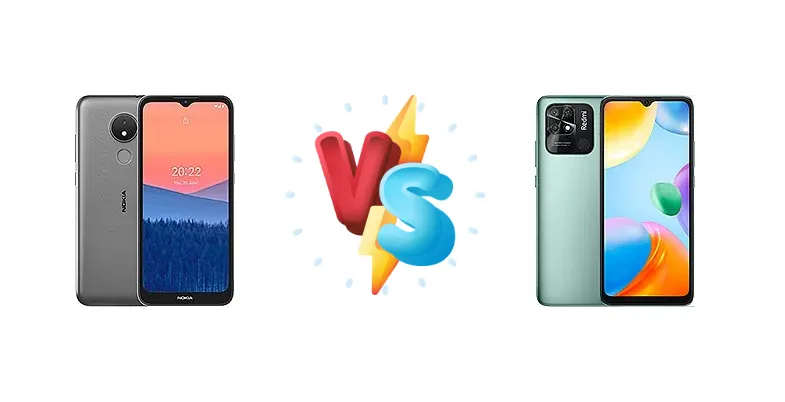
The Nokia C21 and Xiaomi Redmi 10C represent two compelling options in the ultra-budget smartphone space. While both aim to deliver essential smartphone functionality at a low price point, they diverge significantly in their core hardware, particularly in the chipset department. This comparison will dissect those differences, helping you determine which device best suits your needs.
🏆 Quick Verdict
For the average user, the Xiaomi Redmi 10C emerges as the superior choice. Its Qualcomm Snapdragon 680, built on a more efficient 6nm process, delivers noticeably better performance and responsiveness compared to the Nokia C21’s Unisoc SC9863A. While the Nokia C21 offers a clean Android experience, the Redmi 10C’s performance advantage justifies its slight price premium.
| Network |
|---|
| 2G bands | GSM 850 / 900 / 1800 / 1900 | GSM 850 / 900 / 1800 / 1900 |
| 3G bands | HSDPA 850 / 900 / 2100 - International | HSDPA 850 / 900 / 1700(AWS) / 1900 / 2100 |
| 4G bands | LTE | 1, 2, 3, 4, 5, 7, 8, 20, 28, 38, 40, 41 |
| Speed | HSPA 42.2/5.76 Mbps, LTE Cat4 150/50 Mbps | HSPA, LTE |
| Technology | GSM / HSPA / LTE | GSM / HSPA / LTE |
| | HSDPA 850 / 900 / 1700(AWS) / 1900 / 2100 - LATAM, Brazil | - |
| Launch |
|---|
| Announced | 2022, February 28 | 2022, March 21 |
| Status | Available. Released 2022, May 03 | Available. Released 2022, March 23 |
| Body |
|---|
| Build | Glass front, aluminum frame, plastic back | - |
| Dimensions | 169.9 x 77.9 x 8.8 mm (6.69 x 3.07 x 0.35 in) | 169.6 x 76.6 x 8.3 mm (6.68 x 3.02 x 0.33 in) |
| SIM | · Nano-SIM· Nano-SIM + Nano-SIM | Nano-SIM + Nano-SIM |
| Weight | 195 g (6.88 oz) | 190 g (6.70 oz) |
| Display |
|---|
| Protection | - | Corning Gorilla Glass |
| Resolution | 720 x 1600 pixels, 20:9 ratio (~269 ppi density) | 720 x 1650 pixels (~268 ppi density) |
| Size | 6.52 inches, 102.6 cm2 (~77.5% screen-to-body ratio) | 6.71 inches, 106.5 cm2 (~82.0% screen-to-body ratio) |
| Type | IPS LCD | IPS LCD |
| Platform |
|---|
| CPU | Octa-core (4x1.6 GHz Cortex-A55 & 4x1.2 GHz Cortex-A55) | Octa-core (4x2.4 GHz Kryo 265 Gold & 4x1.9 GHz Kryo 265 Silver) |
| Chipset | Unisoc SC9863A (28 nm) | Qualcomm SM6225 Snapdragon 680 4G (6 nm) |
| GPU | IMG8322 | Adreno 610 |
| OS | Android 11 (Go edition) | Android 11, MIUI 13 |
| Memory |
|---|
| Card slot | microSDXC (dedicated slot) | microSDXC (dedicated slot) |
| Internal | 32GB 2GB RAM, 32GB 3GB RAM, 64GB 3GB RAM | 64GB 3GB RAM, 64GB 4GB RAM, 128GB 3GB RAM, 128GB 4GB RAM |
| | eMMC 5.1 | UFS 2.2 |
| Main Camera |
|---|
| Dual | - | 50 MP, f/1.8, 26mm (wide), PDAF
Auxiliary lens |
| Features | LED flash, HDR | LED flash, HDR, panorama |
| Single | 8 MP | 5 MP, f/2.2 |
| Video | 720p@30fps | 1080p@30fps |
| Selfie camera |
|---|
| Features | LED flash | - |
| Single | 5 MP | 5 MP, f/2.2 |
| Video | 720p | 1080p@30fps |
| Sound |
|---|
| 3.5mm jack | Yes | Yes |
| 35mm jack | Yes | Yes |
| Loudspeaker | Yes | Yes |
| Comms |
|---|
| Bluetooth | 4.2, A2DP | 5.0, A2DP, LE |
| NFC | No | Yes (market/region dependent) |
| Positioning | GPS | GPS, GLONASS, BDS, GALILEO |
| Radio | FM radio | FM radio |
| USB | microUSB 2.0 | USB Type-C 2.0, OTG |
| WLAN | Wi-Fi 802.11 b/g/n | Wi-Fi 802.11 a/b/g/n/ac, dual-band, Wi-Fi Direct |
| Features |
|---|
| Sensors | Fingerprint (rear-mounted), accelerometer, proximity | Fingerprint (rear-mounted), accelerometer, proximity |
| Battery |
|---|
| Charging | - | 18W wired |
| Type | Li-Ion 3000 mAh, removable | Li-Po 5000 mAh |
| Misc |
|---|
| Colors | Dark Blue, Warm Gray | Graphite Gray, Ocean Blue, Mint Green |
| Models | TA-1356, TA-1352 | 220333QAG, 220333QBI, 220333QNY, 220333QL |
| Price | About 70 EUR | £ 99.00 / € 109.86 |
| SAR | - | 0.96 W/kg (head) 1.02 W/kg (body) |
| SAR EU | 0.43 W/kg (head) 1.55 W/kg (body) | 0.57 W/kg (head) 0.96 W/kg (body) |
Nokia C21
- Potential for longer software support from Nokia.
- Clean Android experience with minimal bloatware.
- Generally lower price point.
- Significantly weaker processor performance.
- Less efficient chipset leading to potential throttling.
- Slower charging speeds.
Xiaomi Redmi 10C
- Faster and more efficient Snapdragon 680 processor.
- 18W fast charging for quicker top-ups.
- Improved multitasking and app responsiveness.
- Xiaomi’s MIUI software can include bloatware.
- Potentially shorter software update commitment.
- Slightly higher price.
Display Comparison
Neither device boasts a standout display. Both likely utilize LCD panels, a common cost-saving measure in this segment. However, details like peak brightness and color gamut coverage are unavailable. The focus here is on the internal hardware, as display quality is likely similar. Bezels are expected to be substantial on both, maximizing screen real estate within their respective budgets.
Camera Comparison
Camera performance is likely to be similar, with both devices featuring basic camera setups geared towards casual photography. Without specific sensor details, it’s difficult to make a definitive judgment. However, the Redmi 10C’s processor likely offers more sophisticated image processing capabilities, potentially resulting in slightly better image quality in various lighting conditions. The presence of a dedicated image signal processor (ISP) within the Snapdragon 680 is a key advantage. Expect both to struggle in low-light scenarios.
Performance
The performance gap is the most significant differentiator. The Xiaomi Redmi 10C’s Qualcomm Snapdragon 680 (6nm) is a substantial upgrade over the Nokia C21’s Unisoc SC9863A (28nm). The 6nm process node inherently provides better power efficiency and thermal characteristics, meaning the Redmi 10C will likely sustain peak performance for longer periods without throttling. The Snapdragon 680’s CPU configuration – 4x2.4 GHz Kryo 265 Gold & 4x1.9 GHz Kryo 265 Silver – also offers a clock speed advantage over the C21’s 4x1.6 GHz Cortex-A55 & 4x1.2 GHz Cortex-A55. This translates to faster app launches, smoother scrolling, and a more responsive user experience. The Redmi 10C is the clear winner for users who demand more than basic functionality.
Battery Life
While the exact battery capacities are unknown, the Redmi 10C’s 18W wired charging is a significant advantage. Faster charging reduces downtime and provides greater convenience. The Snapdragon 680’s 6nm efficiency also contributes to better battery life, potentially offsetting any capacity differences. The Nokia C21 likely charges at a slower rate, requiring more time to reach a full charge.
Buying Guide
Buy the Nokia C21 if you prioritize a guaranteed software update schedule and a minimalist Android experience, and your usage is limited to very basic tasks like calls, texts, and light social media. Buy the Xiaomi Redmi 10C if you value smoother multitasking, faster app loading times, and a more capable processor for occasional gaming or demanding applications. The Redmi 10C is the better all-rounder for most users.
Frequently Asked Questions
❓ Will the Redmi 10C’s Snapdragon 680 handle popular games like PUBG Mobile?
The Snapdragon 680 is capable of running PUBG Mobile, but expect to play at medium settings to maintain a stable frame rate. While not a gaming powerhouse, it offers a significantly better gaming experience than the Unisoc SC9863A in the Nokia C21.
❓ How does Xiaomi’s MIUI software affect the Redmi 10C’s performance?
MIUI, while feature-rich, can sometimes consume more system resources than a stock Android experience. However, the Snapdragon 680’s processing power is sufficient to handle MIUI’s overhead without significant performance degradation. Users can also disable or uninstall some pre-installed apps to optimize performance.
❓ Is the Nokia C21 a good choice for elderly users who primarily make calls and send texts?
Yes, the Nokia C21 is a suitable option for basic use cases. Its clean Android interface and guaranteed software updates provide a stable and secure experience for users who prioritize simplicity and reliability over performance.
❓ What type of charging port do both phones use?
Both the Nokia C21 and Xiaomi Redmi 10C are expected to use a micro-USB port for charging and data transfer, a common feature in this price segment. This is slower than USB-C, but more widely compatible with existing chargers.