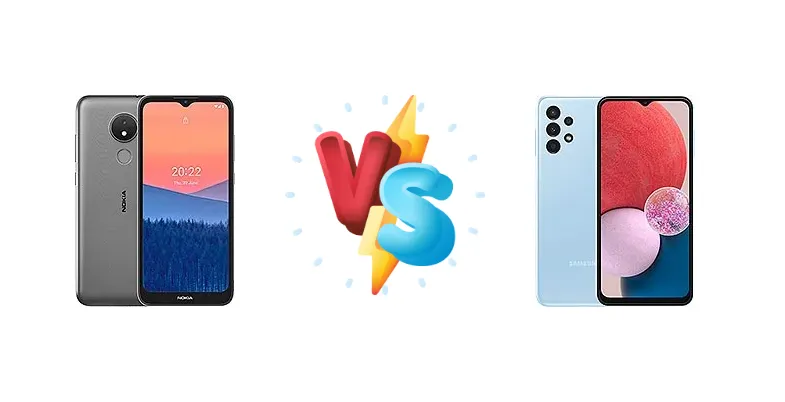
The sub-$150 smartphone market is fiercely competitive. Both the Nokia C21 and Samsung Galaxy A13 (SM-A137) aim to deliver essential smartphone functionality at an accessible price point. However, they take different approaches to achieving this, with significant differences in chipset architecture and overall performance capabilities. This comparison will break down those differences to help you choose the right device.
🏆 Quick Verdict
For most users, the Samsung Galaxy A13 emerges as the better choice. Its Mediatek Helio G80 chipset, built on a more efficient 12nm process, provides a noticeable performance advantage over the Nokia C21’s Unisoc SC9863A. While the Nokia C21 offers a slightly simpler software experience, the A13’s superior processing power justifies the small price difference.
| Network |
|---|
| 2G bands | GSM 850 / 900 / 1800 / 1900 | GSM 850 / 900 / 1800 / 1900 |
| 3G bands | HSDPA 850 / 900 / 2100 - International | HSDPA 850 / 900 / 2100 |
| 4G bands | LTE | 1, 3, 5, 7, 8, 20, 28, 38, 40, 41 |
| Speed | HSPA 42.2/5.76 Mbps, LTE Cat4 150/50 Mbps | HSPA, LTE |
| Technology | GSM / HSPA / LTE | GSM / HSPA / LTE |
| | HSDPA 850 / 900 / 1700(AWS) / 1900 / 2100 - LATAM, Brazil | - |
| Launch |
|---|
| Announced | 2022, February 28 | 2022, June |
| Status | Available. Released 2022, May 03 | Available. Released 2022, July |
| Body |
|---|
| Build | Glass front, aluminum frame, plastic back | Glass front (Gorilla Glass 5), plastic frame, plastic back |
| Dimensions | 169.9 x 77.9 x 8.8 mm (6.69 x 3.07 x 0.35 in) | 165.1 x 76.4 x 8.8 mm (6.5 x 3.01 x 0.35 in) |
| SIM | · Nano-SIM· Nano-SIM + Nano-SIM | · Nano-SIM· Nano-SIM + Nano-SIM |
| Weight | 195 g (6.88 oz) | 195 g (6.88 oz) |
| Display |
|---|
| Protection | - | Corning Gorilla Glass 5 |
| Resolution | 720 x 1600 pixels, 20:9 ratio (~269 ppi density) | 1080 x 2408 pixels, 20:9 ratio (~400 ppi density) |
| Size | 6.52 inches, 102.6 cm2 (~77.5% screen-to-body ratio) | 6.6 inches, 104.9 cm2 (~83.2% screen-to-body ratio) |
| Type | IPS LCD | PLS LCD |
| Platform |
|---|
| CPU | Octa-core (4x1.6 GHz Cortex-A55 & 4x1.2 GHz Cortex-A55) | Octa-core (2x2.0 GHz Cortex-A75 & 6x1.8 GHz Cortex-A55) |
| Chipset | Unisoc SC9863A (28 nm) | Mediatek MT6769V/CU Helio G80 (12 nm) |
| GPU | IMG8322 | Mali-G52 MC2 |
| OS | Android 11 (Go edition) | Android 12, upgradable to Android 14, One UI 6.1 |
| Memory |
|---|
| Card slot | microSDXC (dedicated slot) | microSDXC (dedicated slot) |
| Internal | 32GB 2GB RAM, 32GB 3GB RAM, 64GB 3GB RAM | 32GB 3GB RAM, 32GB 4GB RAM, 64GB 4GB RAM, 128GB 4GB RAM |
| | eMMC 5.1 | eMMC 5.1 |
| Main Camera |
|---|
| Features | LED flash, HDR | LED flash, panorama, HDR |
| Quad | - | 50 MP, f/1.8, (wide), PDAF
5 MP, f/2.2, 123˚ (ultrawide), 1/5.0", 1.12µm
2 MP (macro)
Auxiliary lens |
| Single | 8 MP | 8 MP, f/2.2, (wide) |
| Video | 720p@30fps | 1080p@30fps |
| Selfie camera |
|---|
| Features | LED flash | - |
| Single | 5 MP | 8 MP, f/2.2, (wide) |
| Video | 720p | 1080p@30fps |
| Sound |
|---|
| 3.5mm jack | Yes | Yes |
| 35mm jack | Yes | Yes |
| Loudspeaker | Yes | Yes |
| Comms |
|---|
| Bluetooth | 4.2, A2DP | 5.2, A2DP, LE |
| NFC | No | Yes |
| Positioning | GPS | GPS, GLONASS, GALILEO, BDS |
| Radio | FM radio | No |
| USB | microUSB 2.0 | USB Type-C 2.0, OTG |
| WLAN | Wi-Fi 802.11 b/g/n | Wi-Fi 802.11 a/b/g/n/ac, dual-band, Wi-Fi Direct |
| Features |
|---|
| Sensors | Fingerprint (rear-mounted), accelerometer, proximity | Fingerprint (side-mounted), accelerometer, compass |
| | - | Virtual proximity sensing |
| Battery |
|---|
| Charging | - | 15W wired |
| Type | Li-Ion 3000 mAh, removable | Li-Po 5000 mAh |
| Misc |
|---|
| Colors | Dark Blue, Warm Gray | Black, White, Blue |
| Models | TA-1356, TA-1352 | SM-A137F, SM-A137F/DSN, SM-A137F/DS |
| Price | About 70 EUR | About 180 EUR |
| SAR EU | 0.43 W/kg (head) 1.55 W/kg (body) | 0.35 W/kg (head) 1.22 W/kg (body) |
Nokia C21
- Extremely affordable price point
- Simple and uncluttered Android experience
- Potentially longer standby time due to less demanding processor
- Significantly slower performance
- Limited multitasking capabilities
- Poor gaming performance
Samsung Galaxy A13 (SM-A137)
- Faster and more responsive performance
- Better multitasking and app loading times
- 15W fast charging support
- Slightly higher price
- Samsung’s One UI can be resource-intensive
- May include bloatware
Display Comparison
Neither device boasts a standout display. Both likely utilize LCD panels, a common cost-saving measure in this segment. However, details like peak brightness and color gamut are unavailable. The focus here is on processing power, not visual fidelity. Bezels are expected to be substantial on both, maximizing screen real estate within a budget. The absence of high refresh rates or advanced panel technologies like LTPO is standard for this price bracket.
Camera Comparison
Camera performance is likely to be similar in real-world usage, given the limitations of both sensors. Details on sensor size and aperture are missing, but both phones likely feature a primary camera paired with basic auxiliary lenses (potentially a 2MP macro on the A13). Image processing will be a key differentiator, and Samsung’s typically more aggressive algorithms may yield slightly more vibrant, though potentially less accurate, results. The A13’s processor has more headroom for image processing tasks. The Nokia C21’s camera will likely be adequate for casual snapshots in good lighting conditions, but will struggle in low light.
Performance
The core difference lies in the chipsets. The Samsung Galaxy A13’s Mediatek Helio G80 (12nm) is a significant step up from the Nokia C21’s Unisoc SC9863A (28nm). The Helio G80’s architecture – featuring 2x2.0 GHz Cortex-A75 and 6x1.8 GHz Cortex-A55 cores – provides a more powerful and efficient CPU configuration compared to the C21’s 4x1.6 GHz Cortex-A55 and 4x1.2 GHz Cortex-A55 setup. This translates to faster app loading times, smoother multitasking, and a more enjoyable gaming experience on the A13. The 12nm fabrication process of the Helio G80 also contributes to better thermal management, reducing the likelihood of performance throttling under sustained load. The Unisoc SC9863A, while adequate for basic tasks, will struggle with demanding applications.
Battery Life
Battery life will depend heavily on usage patterns. While the exact mAh capacity of the Nokia C21 is not specified, it's reasonable to assume a capacity similar to the A13's 5000mAh. However, the Helio G80’s greater efficiency, combined with the A13’s 15W wired charging, gives it an edge. The 15W charging on the A13 will allow for faster top-ups compared to the C21, which likely has a slower charging rate. The more efficient processor means the A13 will draw less power during typical use, potentially extending battery life despite having a similar capacity.
Buying Guide
Buy the Nokia C21 if you prioritize extreme affordability and a very basic, uncluttered Android experience. It’s ideal for first-time smartphone users or those needing a secondary device for calls and light messaging. Buy the Samsung Galaxy A13 (SM-A137) if you value smoother multitasking, occasional gaming, and a more responsive user interface. The A13 is better suited for users who actively use apps and expect a more modern smartphone experience.
Frequently Asked Questions
❓ Does the Mediatek Helio G80 in the Samsung Galaxy A13 get noticeably hot during extended gaming sessions?
While the Helio G80 is a capable processor, it can generate heat under sustained load. However, the 12nm fabrication process and Samsung’s thermal management design should prevent significant throttling. Expect some warmth, but not to the point of severely impacting performance during typical gaming sessions. The Nokia C21’s Unisoc chip will likely throttle more aggressively.
❓ Is the software experience on the Nokia C21 truly 'cleaner' than on the Samsung Galaxy A13?
Yes, the Nokia C21, running a near-stock version of Android, offers a less cluttered software experience. Samsung’s One UI, while feature-rich, often includes pre-installed apps (bloatware) and a more customized interface. This can impact performance on lower-end devices like the A13, though Samsung has been improving One UI’s efficiency in recent iterations.
❓ How much of a performance difference will I see between the two phones when simply browsing the web and checking email?
For basic tasks like web browsing and email, the difference won't be dramatic. However, the Samsung Galaxy A13 will feel noticeably snappier when opening multiple tabs or switching between apps. The Nokia C21 may exhibit slight lag or delays in these scenarios due to its less powerful processor.