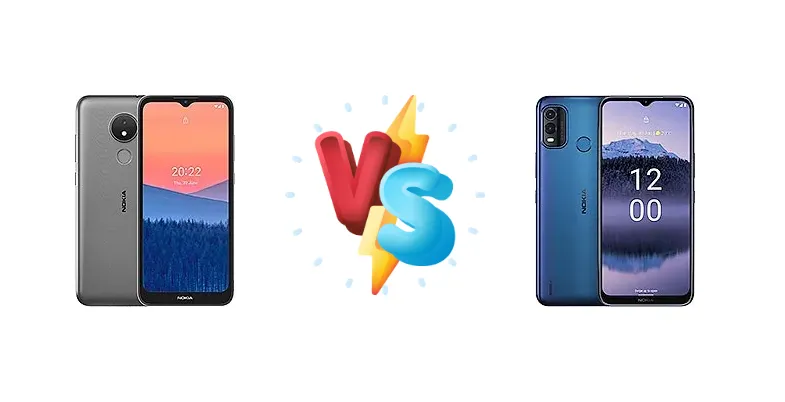
Nokia's C-series and G-series represent their entry-level and value-focused smartphone offerings, respectively. The C21 and G11 Plus both aim to deliver affordability, but diverge in their internal hardware. This comparison dissects the key differences – particularly the chipset – to determine which phone offers the best experience for the price-conscious consumer.
🏆 Quick Verdict
For most users, the Nokia G11 Plus is the better choice. Its Unisoc T606 chipset, built on a more efficient 12nm process, provides a noticeable performance uplift over the C21’s SC9863A. While the C21 is cheaper, the G11 Plus’s improved processing power justifies the slight price increase for those needing more than basic functionality.
| Network |
|---|
| 2G bands | GSM 850 / 900 / 1800 / 1900 | GSM 850 / 900 / 1800 / 1900 |
| 3G bands | HSDPA 850 / 900 / 2100 - International | HSDPA 850 / 900 / 2100 - International |
| 4G bands | LTE | 1, 3, 5, 7, 8, 20, 28, 38, 40, 41 - International |
| Speed | HSPA 42.2/5.76 Mbps, LTE Cat4 150/50 Mbps | HSPA 42.2/5.76 Mbps, LTE Cat4 150/50 Mbps |
| Technology | GSM / HSPA / LTE | GSM / HSPA / LTE |
| | HSDPA 850 / 900 / 1700(AWS) / 1900 / 2100 - LATAM, Brazil | 1, 3, 5, 8, 40, 41 - India |
| Launch |
|---|
| Announced | 2022, February 28 | 2022, June 29 |
| Status | Available. Released 2022, May 03 | Available. Released 2022, July 20 |
| Body |
|---|
| Build | Glass front, aluminum frame, plastic back | Glass front, plastic frame, plastic back |
| Dimensions | 169.9 x 77.9 x 8.8 mm (6.69 x 3.07 x 0.35 in) | 164.8 x 75.9 x 8.6 mm (6.49 x 2.99 x 0.34 in) |
| SIM | · Nano-SIM· Nano-SIM + Nano-SIM | · Nano-SIM· Nano-SIM + Nano-SIM |
| Weight | 195 g (6.88 oz) | 192 g (6.77 oz) |
| | - | Splash protection |
| Display |
|---|
| Resolution | 720 x 1600 pixels, 20:9 ratio (~269 ppi density) | 720 x 1600 pixels, 20:9 ratio (~269 ppi density) |
| Size | 6.52 inches, 102.6 cm2 (~77.5% screen-to-body ratio) | 6.52 inches, 102.6 cm2 (~82.1% screen-to-body ratio) |
| Type | IPS LCD | IPS LCD, 90Hz, 400 nits (typ) |
| Platform |
|---|
| CPU | Octa-core (4x1.6 GHz Cortex-A55 & 4x1.2 GHz Cortex-A55) | Octa-core (2x1.6 GHz Cortex-A75 & 6x1.6 GHz Cortex-A55) |
| Chipset | Unisoc SC9863A (28 nm) | Unisoc T606 (12 nm) |
| GPU | IMG8322 | Mali-G57 MP1 |
| OS | Android 11 (Go edition) | Android 12, upgradable to Android 13 |
| Memory |
|---|
| Card slot | microSDXC (dedicated slot) | microSDXC (dedicated slot) |
| Internal | 32GB 2GB RAM, 32GB 3GB RAM, 64GB 3GB RAM | 32GB 3GB RAM, 64GB 3GB RAM, 64GB 4GB RAM, 128GB 3GB RAM |
| | eMMC 5.1 | eMMC 5.1 |
| Main Camera |
|---|
| Dual | - | 50 MP, f/1.8, (wide), 1/2.67", PDAF
Auxiliary lens |
| Features | LED flash, HDR | LED flash |
| Single | 8 MP | 8 MP, f/2.0, (wide), 1/4.0" |
| Video | 720p@30fps | 1080p@30fps |
| Selfie camera |
|---|
| Features | LED flash | - |
| Single | 5 MP | 8 MP, f/2.0, (wide), 1/4.0" |
| Video | 720p | 1080p@30fps |
| Sound |
|---|
| 3.5mm jack | Yes | Yes |
| 35mm jack | Yes | Yes |
| Loudspeaker | Yes | Yes |
| Comms |
|---|
| Bluetooth | 4.2, A2DP | 5.0, A2DP, LE |
| NFC | No | No |
| Positioning | GPS | GPS |
| Radio | FM radio | FM radio |
| USB | microUSB 2.0 | USB Type-C 2.0, OTG |
| WLAN | Wi-Fi 802.11 b/g/n | Wi-Fi 802.11 a/b/g/n/ac, dual-band, Wi-Fi Direct |
| Features |
|---|
| Sensors | Fingerprint (rear-mounted), accelerometer, proximity | Fingerprint (rear-mounted), accelerometer, proximity |
| Battery |
|---|
| Charging | - | 10W wired |
| Type | Li-Ion 3000 mAh, removable | Li-Ion 5000 mAh |
| Misc |
|---|
| Colors | Dark Blue, Warm Gray | Lake Blue, Charcoal Grey |
| Models | TA-1356, TA-1352 | - |
| Price | About 70 EUR | About 130 EUR |
| SAR EU | 0.43 W/kg (head) 1.55 W/kg (body) | - |
Nokia C21
- Lower price point makes it highly accessible.
- Decent battery life for basic usage.
- Simple and easy-to-use interface.
- Significantly slower performance compared to the G11 Plus.
- Older, less efficient chipset.
- Limited multitasking capabilities.
Nokia G11 Plus
- More powerful Unisoc T606 chipset.
- Improved performance for everyday tasks and light gaming.
- More efficient 12nm process for better battery life.
- Slightly higher price.
- Slow 10W charging.
- Still a budget device with limitations.
Display Comparison
Neither device boasts a standout display. Both likely utilize LCD panels, typical for this price bracket. The focus here isn't on visual fidelity, but on functionality. Without specific display specs, it's reasonable to assume similar resolutions and brightness levels. The G11 Plus’s slightly higher price *could* indicate a marginally better panel, but this is speculative. Bezels are likely substantial on both, prioritizing cost reduction over a premium aesthetic.
Camera Comparison
Camera performance is likely to be similar on both devices, with both likely featuring a primary sensor and potentially a depth or macro lens. Without specific sensor details, it’s difficult to make a definitive judgment. However, the G11 Plus’s more capable chipset *could* offer slightly better image processing capabilities, resulting in marginally improved image quality. The focus on these devices isn’t photography, and users shouldn’t expect flagship-level results. Any secondary cameras (likely 2MP) will offer limited utility.
Performance
The core difference lies in the chipsets. The Nokia C21’s Unisoc SC9863A, fabricated on a 28nm process, features a split-core CPU configuration: four Cortex-A55 cores clocked at 1.6GHz and four at 1.2GHz. This architecture prioritizes power efficiency over raw performance. The G11 Plus, however, utilizes the Unisoc T606, a 12nm chip with a more potent configuration: two Cortex-A75 cores at 1.6GHz and six Cortex-A55 cores at 1.6GHz. The inclusion of the A75 cores provides a significant boost in single-core performance, translating to snappier app launches and smoother multitasking. The 12nm process also contributes to better thermal efficiency, potentially reducing throttling under sustained load. This means the G11 Plus will handle demanding apps and light gaming more effectively.
Battery Life
Battery capacity is not specified, but both phones likely feature batteries in the 4000-5000mAh range, common for this segment. The G11 Plus includes 10W wired charging, while the C21’s charging speed is unknown but likely similar. The T606’s improved efficiency in the G11 Plus could translate to slightly longer battery life despite potentially similar capacity. The 10W charging on the G11 Plus will result in relatively slow charging times, requiring several hours to reach a full charge.
Buying Guide
Buy the Nokia C21 if you prioritize absolute affordability and only need a phone for extremely basic tasks like calls, texts, and light social media. It’s ideal for first-time smartphone users or as a simple backup device. Buy the Nokia G11 Plus if you want a smoother, more responsive experience for everyday tasks, occasional gaming, and a slightly more future-proof device. The G11 Plus is better suited for users who want a phone that can handle a bit more than the bare minimum.
Frequently Asked Questions
❓ Will the Nokia G11 Plus handle popular games like PUBG Mobile?
The Unisoc T606 in the G11 Plus can run PUBG Mobile, but expect to play at lower graphics settings and frame rates. It's not a gaming phone, but it offers a playable experience, unlike the C21 which would struggle significantly.
❓ Is the difference in chipset performance noticeable in everyday use?
Yes, the difference is quite noticeable. The G11 Plus’s Cortex-A75 cores provide a significant boost in responsiveness when opening apps, browsing the web, and multitasking. The C21 will feel sluggish in comparison, especially with multiple apps open.
❓ How long will it take to fully charge the Nokia G11 Plus with the 10W charger?
Expect a full charge from 0% to 100% to take approximately 3-4 hours with the included 10W charger. It's a relatively slow charging speed, so overnight charging is recommended.
❓ Does either phone support software updates beyond the initial Android release?
Nokia generally provides a reasonable level of software support for its devices, including security updates. However, the longevity of updates for these budget models is limited compared to their higher-end offerings. Expect at least one major Android update, but don't anticipate long-term support.