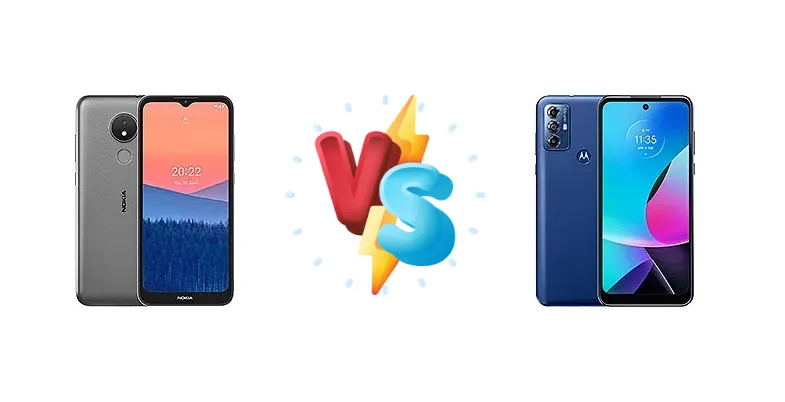
The sub-$150 smartphone market is fiercely competitive. Both the Nokia C21 and the Motorola Moto G Play (2023) aim to deliver essential smartphone functionality at an accessible price. However, they take different approaches to achieving this, with the Motorola leveraging a newer, albeit still entry-level, chipset while the Nokia relies on a more established, but older, platform. This comparison will dissect their key differences to help you choose the right device.
🏆 Quick Verdict
For most users, the Motorola Moto G Play (2023) is the better choice. Its Mediatek Helio G37 chipset, built on a 12nm process, provides a noticeable performance uplift over the Nokia C21’s Unisoc SC9863A (28nm), translating to smoother multitasking and app loading. While both phones are limited, the Moto G Play offers a more responsive experience.
| Network |
|---|
| 2G bands | GSM 850 / 900 / 1800 / 1900 | GSM 850 / 900 / 1800 / 1900 |
| 3G bands | HSDPA 850 / 900 / 2100 - International | HSDPA 850 / 900 / 1700(AWS) / 1900 / 2100 |
| 4G bands | LTE | 1, 2, 3, 4, 5, 7, 8, 12, 13, 14, 17, 18, 19, 20, 25, 26, 29, 30, 38, 39, 40, 41, 66, 71 |
| Speed | HSPA 42.2/5.76 Mbps, LTE Cat4 150/50 Mbps | HSPA, LTE |
| Technology | GSM / HSPA / LTE | GSM / CDMA / HSPA / LTE |
| | HSDPA 850 / 900 / 1700(AWS) / 1900 / 2100 - LATAM, Brazil | CDMA 800 / 1900 |
| Launch |
|---|
| Announced | 2022, February 28 | 2022, December 08 |
| Status | Available. Released 2022, May 03 | Available. Released 2022, December 12 |
| Body |
|---|
| Build | Glass front, aluminum frame, plastic back | Plastic frame, plastic back |
| Dimensions | 169.9 x 77.9 x 8.8 mm (6.69 x 3.07 x 0.35 in) | 167.2 x 76.5 x 9.4 mm (6.58 x 3.01 x 0.37 in) |
| SIM | · Nano-SIM· Nano-SIM + Nano-SIM | Nano-SIM |
| Weight | 195 g (6.88 oz) | 203 g (7.20 oz) |
| | - | Water-repellent coating |
| Display |
|---|
| Resolution | 720 x 1600 pixels, 20:9 ratio (~269 ppi density) | 720 x 1600 pixels, 20:9 ratio (~270 ppi density) |
| Size | 6.52 inches, 102.6 cm2 (~77.5% screen-to-body ratio) | 6.5 inches, 102.0 cm2 (~79.7% screen-to-body ratio) |
| Type | IPS LCD | IPS LCD, 90Hz |
| Platform |
|---|
| CPU | Octa-core (4x1.6 GHz Cortex-A55 & 4x1.2 GHz Cortex-A55) | Octa-core (4x2.3 GHz Cortex-A53 & 4x1.8 GHz Cortex-A53) |
| Chipset | Unisoc SC9863A (28 nm) | Mediatek MT6765 Helio G37 (12 nm) |
| GPU | IMG8322 | PowerVR GE8320 |
| OS | Android 11 (Go edition) | Android 12 |
| Memory |
|---|
| Card slot | microSDXC (dedicated slot) | microSDXC (dedicated slot) |
| Internal | 32GB 2GB RAM, 32GB 3GB RAM, 64GB 3GB RAM | 32GB 3GB RAM |
| | eMMC 5.1 | eMMC 5.1 |
| Main Camera |
|---|
| Features | LED flash, HDR | LED flash, HDR, panorama |
| Single | 8 MP | - |
| Triple | - | 16 MP, f/2.2, (wide), 1.12µm, PDAF
2 MP (macro)
Auxiliary lens |
| Video | 720p@30fps | 1080p@30/60fps |
| Selfie camera |
|---|
| Features | LED flash | HDR |
| Single | 5 MP | 5 MP, f/2.4, (wide), 1.12µm |
| Video | 720p | 1080p@30fps |
| Sound |
|---|
| 3.5mm jack | Yes | Yes |
| 35mm jack | Yes | Yes |
| Loudspeaker | Yes | Yes |
| Comms |
|---|
| Bluetooth | 4.2, A2DP | 5.0, A2DP, LE |
| NFC | No | No |
| Positioning | GPS | GPS, GLONASS |
| Radio | FM radio | No |
| USB | microUSB 2.0 | USB Type-C 2.0 |
| WLAN | Wi-Fi 802.11 b/g/n | Wi-Fi 802.11 a/b/g/n/ac, dual-band |
| Features |
|---|
| Sensors | Fingerprint (rear-mounted), accelerometer, proximity | Fingerprint (rear-mounted), accelerometer, proximity, barometer |
| Battery |
|---|
| Charging | - | 10W wired |
| Type | Li-Ion 3000 mAh, removable | Li-Po 5000 mAh |
| Misc |
|---|
| Colors | Dark Blue, Warm Gray | Deep Indigo |
| Models | TA-1356, TA-1352 | XT2271-1, XT2271-3, XT2271-5, XT2271-4 |
| Price | About 70 EUR | $ 54.00 / C$ 129.00 |
| SAR EU | 0.43 W/kg (head) 1.55 W/kg (body) | - |
Nokia C21
- Potential for longer software support from Nokia.
- Simple and straightforward user experience.
- Potentially lower price point.
- Significantly weaker performance due to older chipset.
- Less efficient 28nm process leads to potentially shorter battery life.
- Outdated CPU architecture.
Motorola Moto G Play (2023)
- More powerful Mediatek Helio G37 chipset for smoother performance.
- More efficient 12nm process for better battery life.
- Faster CPU clock speeds for quicker app loading.
- Potentially shorter software update commitment from Motorola.
- 10W charging is relatively slow.
- May be slightly more expensive than the Nokia C21.
Display Comparison
Neither phone boasts a standout display. Both are likely to feature LCD panels, typical for this price bracket. However, the lack of detailed display specs necessitates focusing on the chipset's ability to drive the UI smoothly. The more powerful GPU in the Moto G Play (2023) should result in slightly smoother scrolling and animations, even if the resolution and panel quality are similar. Bezels are expected to be substantial on both devices, reflecting their budget nature.
Camera Comparison
Camera performance is likely to be similar, with both phones probably featuring a primary sensor around 13MP. However, the image signal processor (ISP) within the Helio G37 chipset may offer slightly better image processing capabilities, potentially resulting in more detailed and vibrant photos. The Nokia C21’s ISP is likely less sophisticated. Both phones will likely include lower-resolution secondary cameras (depth or macro) that offer limited practical value. Focusing on the primary sensor and ISP differences is key, as these will have the biggest impact on image quality.
Performance
The core difference lies in the chipsets. The Motorola Moto G Play (2023) utilizes the Mediatek Helio G37, fabricated on a 12nm process, featuring a CPU clocked up to 2.3 GHz. This contrasts sharply with the Nokia C21’s Unisoc SC9863A, built on a significantly older 28nm process, and peaking at 1.6 GHz. The 12nm process inherently offers better power efficiency and transistor density, leading to improved performance. While both are octa-core, the Cortex-A53 cores in the Moto G Play are generally more efficient than the mixed A55/A53 configuration in the Nokia. This translates to faster app launches and a more fluid multitasking experience on the Motorola.
Battery Life
Battery capacity is not specified, but both phones likely house batteries in the 4000-5000 mAh range. The Motorola Moto G Play (2023) includes 10W wired charging, while the Nokia C21’s charging speed is unknown but likely similar. The more efficient Helio G37 chipset in the Moto G Play should translate to slightly better battery life under similar usage conditions, despite potentially having a similar capacity battery. The 12nm process reduces power consumption, extending usage time between charges.
Buying Guide
Buy the Nokia C21 if you prioritize a potentially longer software support lifespan from Nokia and are comfortable with a very basic user experience. It’s suitable for users who primarily need a phone for calls, texts, and light app usage. Buy the Motorola Moto G Play (2023) if you value a more responsive user interface, slightly better performance for social media and streaming, and don't mind potentially shorter software updates. It’s ideal for users who want a bit more from their budget smartphone.
Frequently Asked Questions
❓ Will the Motorola Moto G Play (2023) struggle with demanding games like PUBG Mobile?
Yes, the Helio G37 is an entry-level chipset. While it can run PUBG Mobile, you'll likely need to play at the lowest graphics settings and may experience occasional frame drops. It's not designed for intensive gaming.
❓ How does the Unisoc SC9863A in the Nokia C21 handle multitasking with several apps open?
The Unisoc SC9863A is a relatively weak chipset. Multitasking with more than a few apps open simultaneously will likely result in noticeable slowdowns and app reloading. It's best suited for running one app at a time.
❓ Is the 10W charging on the Moto G Play (2023) significantly slow compared to other phones?
Yes, 10W charging is quite slow by today's standards. Expect a full charge to take around 3-4 hours. However, given the likely smaller battery capacity, it's sufficient for overnight charging.
❓ Which phone is more likely to receive Android updates?
Nokia generally has a better track record for providing software updates, even on its budget devices. While neither phone is guaranteed frequent updates, the Nokia C21 has a slightly higher probability of receiving at least one major Android version update.