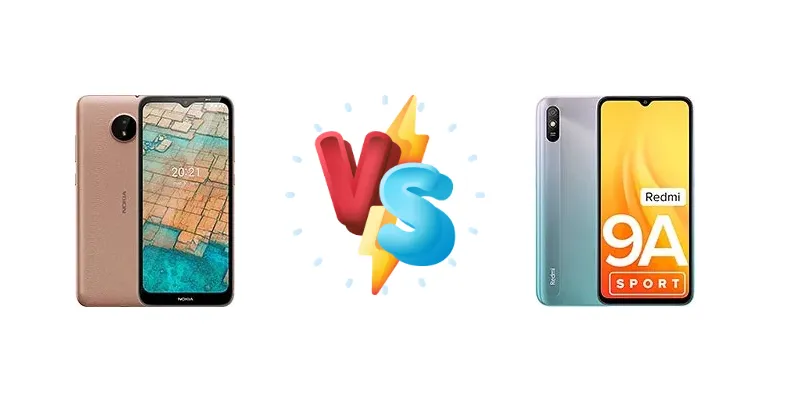
The Nokia C20 and Xiaomi Redmi 9A Sport represent the extreme end of the smartphone price spectrum. Both aim to deliver essential smartphone functionality at an incredibly affordable price point, but they take different approaches to achieving this. This comparison dissects their core components to determine which device offers the best value for users prioritizing basic connectivity and reliability.
🏆 Quick Verdict
For the average user needing a basic, reliable smartphone for calls, messaging, and light app usage, the Xiaomi Redmi 9A Sport emerges as the better choice. Its Mediatek Helio G25 chipset, built on a more efficient 12nm process, provides a noticeable performance advantage over the Nokia C20’s Unisoc SC9863A, despite both utilizing Cortex-A53/A55 cores.
| Network |
|---|
| 2G bands | GSM 850 / 900 / 1800 / 1900 | GSM 850 / 900 / 1800 / 1900 |
| 3G bands | HSDPA 850 / 900 / 2100 - International | HSDPA 850 / 900 / 2100 |
| 4G bands | 1, 3, 5, 7, 8, 20, 28, 38, 40, 41 - International | 1, 3, 5, 8, 40, 41 |
| Speed | HSPA 42.2/5.76 Mbps, LTE Cat4 150/50 Mbps | HSPA, LTE |
| Technology | GSM / HSPA / LTE | GSM / HSPA / LTE |
| | 1, 2, 3, 4, 5, 7, 8, 12, 17, 28, 66 - LATAM, Brazil | - |
| Launch |
|---|
| Announced | 2021, April 08 | 2021, September 28 |
| Status | Available. Released 2021, June 06 | Available. Released 2021, September 28 |
| Body |
|---|
| Dimensions | 169.9 x 77.9 x 8.8 mm (6.69 x 3.07 x 0.35 in) | 164.9 x 77.1 x 9 mm (6.49 x 3.04 x 0.35 in) |
| SIM | · Nano-SIM· Nano-SIM + Nano-SIM | Nano-SIM + Nano-SIM |
| Weight | 191 g (6.74 oz) | 194 g (6.84 oz) |
| | - | Water-repellent coating |
| Display |
|---|
| Resolution | 720 x 1600 pixels, 20:9 ratio (~269 ppi density) | 720 x 1600 pixels, 20:9 ratio (~269 ppi density) |
| Size | 6.52 inches, 102.6 cm2 (~77.5% screen-to-body ratio) | 6.53 inches, 102.9 cm2 (~81.0% screen-to-body ratio) |
| Type | IPS LCD | IPS LCD, 400 nits (typ) |
| Platform |
|---|
| CPU | Octa-core (4x1.6 GHz Cortex-A55 & 4x1.2 GHz Cortex-A55) | Octa-core (4x2.0 GHz Cortex-A53 & 4x1.5 GHz Cortex-A53) |
| Chipset | Unisoc SC9863A (28 nm) | Mediatek MT6762G Helio G25 (12 nm) |
| GPU | IMG8322 | PowerVR GE8320 |
| OS | Android 11 (Go edition) | Android 10, MIUI 12 |
| Memory |
|---|
| Card slot | microSDXC (dedicated slot) | microSDXC (dedicated slot) |
| Internal | 16GB 1GB RAM, 16GB 2GB RAM, 32GB 2GB RAM | 32GB 2GB RAM, 32GB 3GB RAM |
| | eMMC 5.1 | eMMC 5.1 |
| Main Camera |
|---|
| Features | LED flash, HDR | LED flash, HDR |
| Single | 5 MP | 13 MP, f/2.2, 28mm (wide), 1.0µm, PDAF |
| Video | 720p@30fps | 1080p@30/60fps |
| Selfie camera |
|---|
| Features | LED flash | HDR |
| Single | 5 MP | 5 MP, f/2.2, (wide), 1.12µm |
| Video | 720p | 1080p@30fps |
| Sound |
|---|
| 3.5mm jack | Yes | Yes |
| 35mm jack | Yes | Yes |
| Loudspeaker | Yes | Yes |
| Comms |
|---|
| Bluetooth | 4.2, A2DP | 5.0, A2DP, LE |
| NFC | No | No |
| Positioning | GPS | GPS, GLONASS, BDS |
| Radio | FM radio | FM radio |
| USB | microUSB 2.0 | microUSB 2.0, OTG |
| WLAN | Wi-Fi 802.11 b/g/n | Wi-Fi 802.11 a/b/g/n, Wi-Fi Direct |
| Features |
|---|
| Sensors | Accelerometer, proximity | Accelerometer, proximity |
| Battery |
|---|
| Charging | - | 10W wired |
| Type | Li-Ion 3000 mAh, removable | Li-Po 5000 mAh |
| Misc |
|---|
| Colors | Sand, Dark Blue | Carbon Black, Coral Green, Metallic Blue |
| Models | TA-1339, TA-1348, TA-1352, TA-1356 | - |
| Price | About 80 EUR | About 100 EUR |
| SAR | 0.74 W/kg (head) 1.16 W/kg (body) | - |
| SAR EU | 0.43 W/kg (head) 1.55 W/kg (body) | - |
Nokia C20
- Clean Android Go Edition experience
- Nokia’s reputation for software reliability
- Potentially longer software support (though updates are infrequent)
- Less powerful Unisoc SC9863A chipset
- Larger 28nm manufacturing process leads to lower efficiency
- No fast charging support
Xiaomi Redmi 9A Sport
- More powerful Mediatek Helio G25 chipset
- 12nm manufacturing process for better efficiency
- 10W wired charging for faster top-ups
- Xiaomi’s MIUI software can be resource-intensive
- Potential for more bloatware
- Software update support may be less consistent than Nokia
Display Comparison
Neither device boasts a standout display. Both likely feature LCD panels, though specific details like resolution and brightness are not provided. However, the focus here isn't display quality, but rather efficiency. The lack of high refresh rates or advanced panel technologies is expected at this price point. The real-world impact will be similar – adequate for basic viewing, but not ideal for media consumption.
Camera Comparison
Camera performance on both devices will be limited. Without specific sensor details, it’s safe to assume both feature basic sensors capable of capturing acceptable photos in good lighting conditions. The Redmi 9A Sport *may* have a slight edge due to Mediatek’s image signal processing capabilities, but don’t expect flagship-level results. The focus should be on capturing memories, not creating professional-quality images. Any secondary cameras (often 2MP macro lenses) are likely to be of limited utility on both devices.
Performance
The core difference lies in the chipsets. The Xiaomi Redmi 9A Sport’s Mediatek Helio G25 (12nm) has a clear architectural advantage over the Nokia C20’s Unisoc SC9863A (28nm). While both are octa-core CPUs, the Helio G25 utilizes faster Cortex-A53 cores (2.0 GHz vs 1.6 GHz) and a more modern manufacturing process. This translates to better performance per watt, meaning the Redmi 9A Sport will likely handle multitasking and app launches more smoothly. The Unisoc chip, being older and on a larger node, will struggle with demanding tasks. The Redmi 9A Sport’s GPU will also offer a more playable experience in light gaming scenarios.
Battery Life
Battery life will be heavily dependent on usage patterns. While the exact battery capacities aren't specified, both devices likely house batteries in the 4000-5000 mAh range. The Redmi 9A Sport benefits from 10W wired charging, a feature absent on the Nokia C20. This means significantly faster charging times, reducing downtime and making the Redmi 9A Sport more convenient for users who need to quickly top up their battery.
Buying Guide
Buy the Nokia C20 if you prioritize a clean Android Go Edition experience and brand reputation for software updates, even if those updates are infrequent. It’s a solid choice for first-time smartphone users or those needing a very simple device. Buy the Xiaomi Redmi 9A Sport if you prefer a slightly more responsive user experience, faster app loading times, and the convenience of 10W wired charging, making it better suited for users who actively use apps like WhatsApp or browse the web.
Frequently Asked Questions
❓ Will the Redmi 9A Sport struggle with popular apps like WhatsApp or Facebook?
While the Helio G25 isn't a powerhouse, it's sufficient for running apps like WhatsApp and Facebook smoothly. The 12nm process and faster Cortex-A53 cores provide enough headroom for these everyday applications. However, expect some slowdown with multiple apps open simultaneously.
❓ Is the Android Go Edition on the Nokia C20 a significant benefit for performance?
Android Go Edition is designed for devices with limited resources. It uses less storage space and data, and offers optimized versions of Google apps. While it helps mitigate the limitations of the Unisoc SC9863A, it can't overcome the chipset's inherent performance constraints. It's a good solution for basic usage, but won't deliver a snappy experience.
❓ How long will it take to fully charge the Xiaomi Redmi 9A Sport with the 10W charger?
With a 10W charger, expect a full charge from 0% to 100% to take approximately 3-4 hours, depending on battery capacity and usage during charging. While not the fastest charging available, it's a significant improvement over the Nokia C20's lack of fast charging support.
❓ Can either of these phones handle basic mobile gaming?
The Redmi 9A Sport is the better choice for basic gaming. The Helio G25’s GPU offers a slightly more playable experience in less demanding titles. The Nokia C20 will struggle with even simple games, experiencing significant frame rate drops and lag.