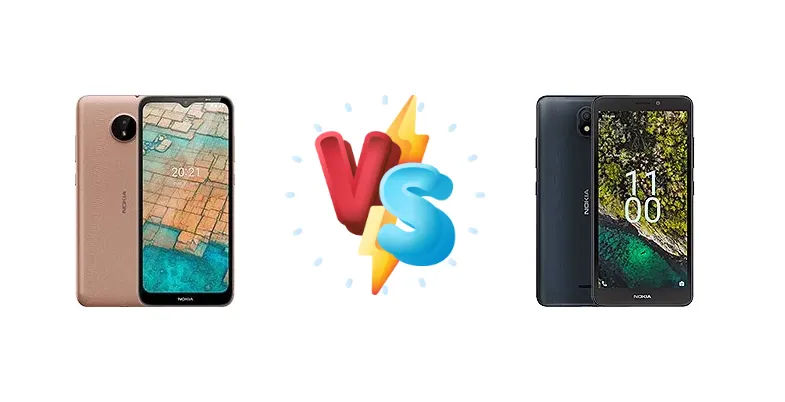
The Nokia C20 and C100 represent the very bottom end of the smartphone market, targeting first-time buyers or those needing a reliable secondary device. While both offer a basic Android experience, significant differences in their chipsets dictate real-world performance. This comparison dissects those differences to determine which phone delivers the most value for its price.
🏆 Quick Verdict
For most users, the Nokia C100 offers a slightly better experience due to its more modern, albeit still entry-level, Mediatek Helio A22 chipset. The higher clock speed of the A53 cores provides a noticeable boost in responsiveness compared to the C20’s SC9863A, making it the preferable choice for basic tasks.
| Network |
|---|
| 2G bands | GSM 850 / 900 / 1800 / 1900 | GSM 850 / 900 / 1800 / 1900 |
| 3G bands | HSDPA 850 / 900 / 2100 - International | HSDPA 850 / 1700(AWS) / 1900 |
| 4G bands | 1, 3, 5, 7, 8, 20, 28, 38, 40, 41 - International | 2, 4, 5, 12, 13, 41, 66, 71 |
| Speed | HSPA 42.2/5.76 Mbps, LTE Cat4 150/50 Mbps | HSPA, LTE |
| Technology | GSM / HSPA / LTE | GSM / HSPA / LTE |
| | 1, 2, 3, 4, 5, 7, 8, 12, 17, 28, 66 - LATAM, Brazil | - |
| Launch |
|---|
| Announced | 2021, April 08 | 2022, January 05 |
| Status | Available. Released 2021, June 06 | Available. Released 2022, Q2 |
| Body |
|---|
| Dimensions | 169.9 x 77.9 x 8.8 mm (6.69 x 3.07 x 0.35 in) | 149.6 x 71.9 x 9.7 mm (5.89 x 2.83 x 0.38 in) |
| SIM | · Nano-SIM· Nano-SIM + Nano-SIM | Nano-SIM |
| Weight | 191 g (6.74 oz) | - |
| | - | Splash protection |
| Display |
|---|
| Resolution | 720 x 1600 pixels, 20:9 ratio (~269 ppi density) | 720 x 1440 pixels, 18:9 ratio (~295 ppi density) |
| Size | 6.52 inches, 102.6 cm2 (~77.5% screen-to-body ratio) | 5.45 inches, 76.7 cm2 (~71.3% screen-to-body ratio) |
| Type | IPS LCD | IPS LCD |
| Platform |
|---|
| CPU | Octa-core (4x1.6 GHz Cortex-A55 & 4x1.2 GHz Cortex-A55) | Quad-core 2.0 GHz Cortex-A53 |
| Chipset | Unisoc SC9863A (28 nm) | Mediatek MT6761 Helio A22 (12 nm) |
| GPU | IMG8322 | PowerVR GE8320 |
| OS | Android 11 (Go edition) | Android 12 |
| Memory |
|---|
| Card slot | microSDXC (dedicated slot) | microSDXC (dedicated slot) |
| Internal | 16GB 1GB RAM, 16GB 2GB RAM, 32GB 2GB RAM | 32GB 3GB RAM |
| | eMMC 5.1 | eMMC 5.1 |
| Main Camera |
|---|
| Features | LED flash, HDR | LED flash |
| Single | 5 MP | 8 MP, AF |
| Video | 720p@30fps | 1080p@30fps |
| Selfie camera |
|---|
| Features | LED flash | - |
| Single | 5 MP | 5 MP |
| Video | 720p | 720p |
| Sound |
|---|
| 3.5mm jack | Yes | Yes |
| 35mm jack | Yes | Yes |
| Loudspeaker | Yes | Yes |
| Comms |
|---|
| Bluetooth | 4.2, A2DP | 5.0, A2DP, LE |
| NFC | No | No |
| Positioning | GPS | GPS |
| Radio | FM radio | No |
| USB | microUSB 2.0 | USB Type-C 2.0 |
| WLAN | Wi-Fi 802.11 b/g/n | Wi-Fi 802.11 b/g/n/ac |
| Features |
|---|
| Sensors | Accelerometer, proximity | Accelerometer, proximity, barometer |
| Battery |
|---|
| Type | Li-Ion 3000 mAh, removable | Li-Ion 3000 mAh, removable |
| Misc |
|---|
| Colors | Sand, Dark Blue | Blue |
| Models | TA-1339, TA-1348, TA-1352, TA-1356 | TA-1484, TA-1520, N152DL |
| Price | About 80 EUR | About 50 EUR |
| SAR | 0.74 W/kg (head) 1.16 W/kg (body) | 1.03 W/kg (head) 1.35 W/kg (body) |
| SAR EU | 0.43 W/kg (head) 1.55 W/kg (body) | - |
Nokia C20
- Potentially longer software support from Nokia.
- Octa-core CPU (though less performant cores).
- May be slightly cheaper depending on retailer.
- Slower overall performance due to less capable Cortex-A55 cores.
- Less efficient 28nm manufacturing process.
- Likely slower app launch times.
Nokia C100
- More responsive user experience thanks to faster Cortex-A53 cores.
- More efficient 12nm manufacturing process.
- Better suited for light multitasking.
- Quad-core CPU.
- Potentially shorter software support lifecycle.
- May be slightly more expensive.
Display Comparison
Neither device is expected to boast a high-quality display. Details on panel technology (IPS, TFT) and resolution are missing, but both will likely feature low-resolution panels suitable only for basic viewing. The focus here is on chipset impact, not display fidelity. Bezels are likely substantial on both, contributing to a larger overall device size for the screen real estate offered.
Camera Comparison
Both devices are expected to feature basic camera setups. Given the target price point, image quality will be limited. Details on sensor sizes and apertures are unavailable, but it’s safe to assume both will struggle in low-light conditions. Any marketing around 'macro' lenses should be viewed with skepticism, as the 2MP sensors typically found in this segment offer minimal detail. The image processing capabilities of each chipset will likely be similar, focusing on basic noise reduction and sharpening.
Performance
The core difference lies in the chipsets. The Nokia C20’s Unisoc SC9863A utilizes an octa-core configuration, split between 1.6 GHz and 1.2 GHz Cortex-A55 cores. While having more cores sounds impressive, the Cortex-A55 is a relatively low-power, efficiency-focused core. The Nokia C100, conversely, employs a Mediatek Helio A22 with four 2.0 GHz Cortex-A53 cores. The A53, despite being fewer in number, is architecturally more capable than the A55, and the higher clock speed translates to faster single-core performance – crucial for app launch times and general responsiveness. The Helio A22’s 12nm process also offers a slight efficiency advantage over the SC9863A’s 28nm node, potentially leading to better thermal management under sustained load.
Battery Life
Battery capacity details are missing for both devices. However, given the low-power chipsets and basic displays, both should achieve at least a full day of light use. Charging wattage is also unknown, but likely to be slow (5W or 10W) via micro-USB. The slightly more efficient 12nm process of the Helio A22 in the C100 *could* translate to marginally longer battery life, but the difference will likely be minimal in real-world scenarios.
Buying Guide
Buy the Nokia C20 if you prioritize a potentially longer software support lifecycle from Nokia, and are willing to accept slower performance for extremely basic tasks like calls and messaging. Buy the Nokia C100 if you prefer a more responsive user experience, even for simple operations, and are comfortable with a potentially shorter software support window. Both are suitable for users needing a very affordable smartphone, but the C100 offers a slight edge in usability.
Frequently Asked Questions
❓ Will the Mediatek Helio A22 in the Nokia C100 struggle with popular apps like WhatsApp or Facebook?
While the Helio A22 is an entry-level chipset, it should be sufficient for running lightweight apps like WhatsApp and Facebook. However, expect some lag when switching between apps or loading media-heavy content. It's not designed for demanding applications or heavy multitasking.
❓ Is the Nokia C20 a good choice for someone who primarily uses their phone for calls and texts?
Yes, the Nokia C20 is a viable option for basic communication. Its Unisoc SC9863A chipset is adequate for making calls and sending texts, but it will feel noticeably slower than the C100 when navigating the interface or opening apps. If responsiveness is a concern, even for basic tasks, the C100 is a better choice.
❓ Can either of these phones handle any mobile games?
Both phones will struggle with most modern mobile games. Simple, 2D games might be playable at low settings, but demanding 3D titles will likely be unplayable due to the limited processing power and graphics capabilities of both chipsets. Expect significant frame rate drops and long loading times.
❓ What Android version do these phones ship with, and will they receive updates?
Both devices likely ship with Android Go Edition, a lightweight version of Android designed for low-end hardware. Software update support is limited in this price segment. Nokia generally provides better software support than many competitors, but even the C20 and C100 may only receive one major Android version update, if any.