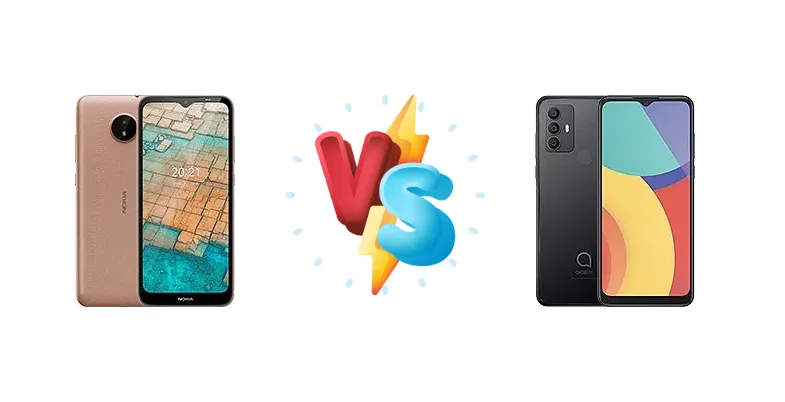
The Nokia C20 and Alcatel 1V (2021) represent the absolute entry point into smartphone ownership. Both devices target users prioritizing affordability above all else, but significant differences in their underlying hardware dictate which offers a smoother, more efficient experience. This comparison dissects those differences, focusing on the core components that impact daily usability.
🏆 Quick Verdict
For the average user seeking a basic smartphone experience, the Alcatel 1V (2021) is the better choice. Its Mediatek Helio A22, fabricated on a 12nm process, delivers superior efficiency and a higher clock speed compared to the Nokia C20’s Unisoc SC9863A, resulting in snappier responsiveness for everyday tasks.
| Network |
|---|
| 2G bands | GSM 850 / 900 / 1800 / 1900 | GSM 850 / 900 / 1800 / 1900 |
| 3G bands | HSDPA 850 / 900 / 2100 - International | HSDPA 850 / 900 / 1700(AWS) / 1900 / 2100 - 6002A |
| 4G bands | 1, 3, 5, 7, 8, 20, 28, 38, 40, 41 - International | 2, 3, 4, 5, 7, 8, 12, 13, 17, 26, 28, 66 - 6002A |
| Speed | HSPA 42.2/5.76 Mbps, LTE Cat4 150/50 Mbps | HSPA 42.2/11.5 Mbps, LTE Cat4 150/50 Mbps |
| Technology | GSM / HSPA / LTE | GSM / HSPA / LTE |
| | 1, 2, 3, 4, 5, 7, 8, 12, 17, 28, 66 - LATAM, Brazil | 1, 3, 5, 7, 8, 20, 28, 38, 40, 41 - 6002D |
| Launch |
|---|
| Announced | 2021, April 08 | 2021, February |
| Status | Available. Released 2021, June 06 | Available. Released 2021, April |
| Body |
|---|
| Build | - | Glass front, plastic back, plastic frame |
| Dimensions | 169.9 x 77.9 x 8.8 mm (6.69 x 3.07 x 0.35 in) | 165.2 x 75.5 x 8.9 mm (6.50 x 2.97 x 0.35 in) |
| SIM | · Nano-SIM· Nano-SIM + Nano-SIM | · Nano-SIM· Nano-SIM + Nano-SIM |
| Weight | 191 g (6.74 oz) | 190 g (6.70 oz) |
| Display |
|---|
| Resolution | 720 x 1600 pixels, 20:9 ratio (~269 ppi density) | 720 x 1600 pixels, 20:9 ratio (~269 ppi density) |
| Size | 6.52 inches, 102.6 cm2 (~77.5% screen-to-body ratio) | 6.52 inches, 102.6 cm2 (~82.3% screen-to-body ratio) |
| Type | IPS LCD | IPS LCD |
| Platform |
|---|
| CPU | Octa-core (4x1.6 GHz Cortex-A55 & 4x1.2 GHz Cortex-A55) | Quad-core 2.0 GHz Cortex-A53 |
| Chipset | Unisoc SC9863A (28 nm) | Mediatek MT6761 Helio A22 (12 nm) |
| GPU | IMG8322 | PowerVR GE8320 |
| OS | Android 11 (Go edition) | Android 11 (Go edition) |
| Memory |
|---|
| Card slot | microSDXC (dedicated slot) | microSDXC (dedicated slot) |
| Internal | 16GB 1GB RAM, 16GB 2GB RAM, 32GB 2GB RAM | 32GB 2GB RAM, 64GB 2GB RAM |
| | eMMC 5.1 | eMMC 5.1 |
| Main Camera |
|---|
| Dual | - | 13 MP, f/2.2, (wide), 1/3.0", 1.12µm, AF
2 MP (macro)
Auxiliary lens |
| Features | LED flash, HDR | LED flash, HDR, panorama |
| Single | 5 MP | 5 MP, f/2.2, (wide), 1/5", 1.12µm |
| Video | 720p@30fps | 1080p@30fps |
| Selfie camera |
|---|
| Features | LED flash | HDR |
| Single | 5 MP | 5 MP, f/2.2, (wide), 1/5.0", 1.12µm |
| Video | 720p | 1080p@30fps |
| Sound |
|---|
| 3.5mm jack | Yes | Yes |
| 35mm jack | Yes | Yes |
| Loudspeaker | Yes | Yes |
| Comms |
|---|
| Bluetooth | 4.2, A2DP | 5.0, A2DP, LE |
| NFC | No | No |
| Positioning | GPS | GPS, GLONASS, GALILEO, BDS |
| Radio | FM radio | FM radio (market/operator dependent) |
| USB | microUSB 2.0 | USB Type-C 2.0 |
| WLAN | Wi-Fi 802.11 b/g/n | Wi-Fi 802.11 b/g/n, Wi-Fi Direct |
| Features |
|---|
| Sensors | Accelerometer, proximity | Fingerprint (rear-mounted), accelerometer, proximity, compass |
| Battery |
|---|
| Charging | - | 10W wired |
| Type | Li-Ion 3000 mAh, removable | Li-Ion 5000 mAh |
| Misc |
|---|
| Colors | Sand, Dark Blue | Space Gray, Atlantic Blue |
| Models | TA-1339, TA-1348, TA-1352, TA-1356 | 6002A, 6002D |
| Price | About 80 EUR | About 100 EUR |
| SAR | 0.74 W/kg (head) 1.16 W/kg (body) | - |
| SAR EU | 0.43 W/kg (head) 1.55 W/kg (body) | - |
Nokia C20
- Potentially longer software support (Nokia's reputation)
- Octa-core processor (more cores, though less efficient)
- Brand recognition
- Less efficient Unisoc SC9863A chipset (28nm)
- Lower CPU clock speeds
- Likely slower performance in real-world tasks
alcatel 1V (2021)
- More efficient Mediatek Helio A22 chipset (12nm)
- Higher CPU clock speed (2.0 GHz)
- 10W wired charging
- Snappier responsiveness for everyday tasks
- Quad-core processor (fewer cores)
- Less established brand reputation
- Potentially shorter software support
Display Comparison
Neither device boasts a standout display. Both are likely to feature low-resolution panels, typical of this price segment. However, specifics are missing. The focus here is on the internal hardware, as display quality is unlikely to be a deciding factor. Expect similar levels of color accuracy and brightness, with neither offering features like high refresh rates or HDR support.
Camera Comparison
Both devices are expected to feature basic camera setups. Details are scarce, but it’s safe to assume image quality will be limited. The absence of information regarding sensor size and aperture makes a direct comparison difficult. Any macro or depth sensors are likely to be low resolution and offer minimal benefit. The image processing capabilities of both chipsets are also likely to be basic, resulting in images that lack detail and dynamic range.
Performance
The core difference lies in the chipsets. The Alcatel 1V’s Mediatek Helio A22 (12nm) utilizes a quad-core Cortex-A53 configuration clocked at 2.0 GHz. This contrasts sharply with the Nokia C20’s Unisoc SC9863A (28nm) which employs an octa-core setup with a split configuration (4x1.6 GHz Cortex-A55 & 4x1.2 GHz Cortex-A55). While the Nokia C20 has more cores, the older 28nm process and the lower peak clock speeds of its A55 cores mean it’s less efficient and generally slower than the A22. The 12nm process of the Helio A22 allows for better power efficiency, translating to less heat generation and potentially longer battery life under load. The Cortex-A53 cores in the Alcatel 1V, despite being fewer in number, are generally more capable than the A55 cores in the Nokia C20 at the same clock speed.
Battery Life
Battery capacity details are missing for both devices. However, the Alcatel 1V’s more efficient chipset will likely result in longer battery life, even with a similar capacity battery. The 10W wired charging on the Alcatel 1V is standard for this price point, and neither device is expected to offer fast charging capabilities. The efficiency gains of the Helio A22 will be more noticeable in real-world usage, allowing for more screen-on time between charges.
Buying Guide
Buy the Nokia C20 if you prioritize brand reputation and a potentially longer software support lifecycle, even if it means sacrificing some performance. It's suitable for users who primarily need a device for calls, texts, and very light app usage. Buy the Alcatel 1V (2021) if you prefer a more responsive user experience, even within the constraints of a budget device. Its more efficient processor translates to smoother multitasking and quicker app loading times, making it ideal for users who want a bit more from their smartphone.
Frequently Asked Questions
❓ Will the Alcatel 1V (2021) struggle with multitasking?
While the Alcatel 1V has only four cores, the Mediatek Helio A22’s efficiency and 2.0 GHz clock speed allow for reasonably smooth multitasking with a limited number of apps. Expect some slowdown with more demanding applications or numerous apps open simultaneously, but it will outperform the Nokia C20 in this area.
❓ Is the Unisoc SC9863A in the Nokia C20 suitable for playing games?
The Unisoc SC9863A is not designed for gaming. While it can handle very basic 2D games, more demanding titles will likely experience significant lag and stuttering. The GPU is underpowered, and the processor’s efficiency limitations will lead to thermal throttling, further reducing performance.
❓ How does the software experience differ between the two devices?
Both devices likely run Android Go Edition, a lightweight version of Android designed for low-end hardware. Nokia has a reputation for providing timely software updates, even for its budget devices, which could give the C20 an edge in long-term software support. However, the Alcatel 1V’s more capable processor may provide a smoother overall software experience.