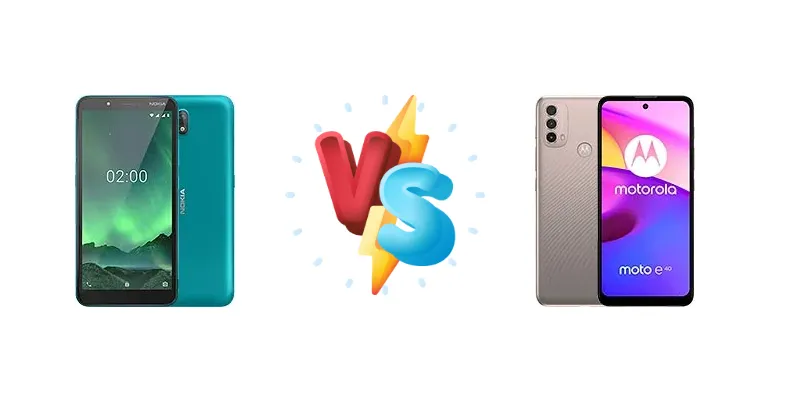
The Nokia C2 and Motorola Moto E40 represent the ultra-budget end of the smartphone spectrum. Both devices aim to deliver essential smartphone functionality at the lowest possible price point, but they take different approaches to achieving this. The key differentiator lies in their chipsets, with the Moto E40 boasting a more modern, octa-core processor compared to the Nokia C2’s quad-core offering. This comparison will dissect these differences and determine which phone provides the best user experience.
🏆 Quick Verdict
For the average user prioritizing responsiveness and multitasking, the Motorola Moto E40 is the clear winner. Its Unisoc T700 chipset, with its octa-core CPU, provides a significantly smoother experience than the Nokia C2’s Unisoc-powered quad-core processor. While the Nokia C2 offers a basic smartphone experience, the Moto E40 delivers a more capable and future-proofed device.
| Network |
|---|
| 2G bands | GSM 850 / 900 / 1800 / 1900 | GSM 850 / 900 / 1800 / 1900 |
| 3G bands | HSDPA 850 / 900 / 2100 - Africa, ME, APAC | HSDPA 850 / 900 / 1700(AWS) / 1900 / 2100 |
| 4G bands | 1, 3, 5, 7, 8, 20, 28, 38, 40, 41 - Africa, ME, APAC | 1, 2, 3, 4, 5, 7, 8, 19, 28, 40, 66 - Brazil |
| Speed | HSPA 42.2/5.76 Mbps, LTE Cat4 150/50 Mbps | HSPA 42.2/5.76 Mbps, LTE Cat4 150/50 Mbps |
| Technology | GSM / HSPA / LTE | GSM / HSPA / LTE |
| | 1, 3, 5, 8, 28, 38, 40, 41 - Saudi Arabia | - |
| Launch |
|---|
| Announced | 2020, March 16. Released 2020, March 22 | 2021, October 07 |
| Status | Discontinued | Available. Released 2021, October 11 |
| Body |
|---|
| Build | Glass front, plastic back, plastic frame | Glass front, plastic frame, plastic back |
| Dimensions | 154.8 x 75.6 x 8.9 mm (6.09 x 2.98 x 0.35 in) | 165.1 x 75.7 x 9.1 mm (6.5 x 2.98 x 0.36 in) |
| SIM | · Nano-SIM· Nano-SIM + Nano-SIM | · Nano-SIM· Nano-SIM + Nano-SIM |
| Weight | 161 g (5.68 oz) | 198 g (6.98 oz) |
| Display |
|---|
| Resolution | 720 x 1440 pixels, 18:9 ratio (~282 ppi density) | 720 x 1600 pixels, 20:9 ratio (~270 ppi density) |
| Size | 5.7 inches, 83.8 cm2 (~71.6% screen-to-body ratio) | 6.5 inches, 102.0 cm2 (~81.6% screen-to-body ratio) |
| Type | IPS LCD | IPS LCD, 90Hz |
| Platform |
|---|
| CPU | Quad-core 1.4 GHz | Octa-core 1.8 GHz |
| Chipset | Unisoc (28 nm) | Unisoc T700 |
| GPU | - | Mali G52 |
| OS | Android 9.0 Pie (Go edition) | Android 11 |
| Memory |
|---|
| Card slot | microSDXC (dedicated slot) | microSDXC (dedicated slot) |
| Internal | 16GB 1GB RAM | 64GB 4GB RAM |
| | eMMC 5.1 | eMMC 5.1 |
| Main Camera |
|---|
| Features | LED flash, HDR | LED flash, HDR, panorama |
| Single | 5 MP, f/2.2, AF | - |
| Triple | - | 48 MP, f/2.0, 26mm (wide), PDAF
2 MP (macro)
Auxiliary lens |
| Video | 720p@30fps | 1080p@30fps |
| Selfie camera |
|---|
| Features | LED flash | HDR |
| Single | 5 MP | 8 MP, f/2.0 |
| Video | 720p@30fps | 1080p@30fps |
| Sound |
|---|
| 3.5mm jack | Yes | Yes |
| 35mm jack | Yes | Yes |
| Loudspeaker | Yes | Yes |
| Comms |
|---|
| Bluetooth | 4.2, A2DP, LE | 5.0, A2DP, LE |
| NFC | No | No |
| Positioning | GPS | GPS, GLONASS, GALILEO |
| Radio | FM radio | FM radio |
| USB | microUSB 2.0 | USB Type-C 2.0 |
| WLAN | Wi-Fi 802.11 b/g/n | Wi-Fi 802.11 b/g/n |
| Features |
|---|
| Sensors | Accelerometer, proximity | Fingerprint (rear-mounted), accelerometer, proximity |
| Battery |
|---|
| Charging | - | 10W wired |
| Type | Li-Ion 2800 mAh, removable | Li-Po 5000 mAh |
| Misc |
|---|
| Colors | Cyan, Black | Carbon Gray, Pink Clay |
| Price | - | About 90 EUR |
Nokia C2
- Potentially more durable build quality (Nokia's reputation)
- Simpler user interface for beginners
- Lower price point (potentially)
- Significantly slower processor
- Less responsive user experience
- Limited multitasking capabilities
Motorola Moto E40
- Faster octa-core processor for smoother performance
- 10W wired charging for quicker top-ups
- More capable for social media and streaming
- May have a less durable build quality
- Potentially higher price point
- Software updates may be less frequent
Display Comparison
Neither Nokia nor Motorola provide display specifications beyond the basic panel size. Given the price point, both likely utilize LCD panels with modest resolutions (likely 720p+). The lack of detailed specs makes a direct comparison difficult, but the overall user experience will likely be similar – adequate for basic tasks but lacking vibrancy and sharpness compared to higher-end displays. Bezels are expected to be substantial on both devices, maximizing screen real estate within a compact form factor.
Camera Comparison
Both devices are likely to feature basic camera setups focused on affordability. Without detailed sensor information, it’s safe to assume both will struggle in low-light conditions. The Moto E40 may have a slight edge due to its more powerful processor enabling better image processing algorithms, but the difference will likely be minimal. Focusing on megapixel counts alone is misleading at this price point; sensor size and lens quality are far more important, and neither manufacturer provides this data. Expect acceptable results in well-lit conditions, but don’t anticipate flagship-level image quality.
Performance
The Motorola Moto E40’s Unisoc T700 chipset is the defining advantage here. Its octa-core CPU, clocked at 1.8 GHz, represents a substantial leap in processing power compared to the Nokia C2’s quad-core 1.4 GHz Unisoc processor. This translates to faster app loading times, smoother multitasking, and a more responsive user interface. While neither chipset is designed for demanding gaming, the Moto E40 will handle casual games significantly better. The 28nm process node of the Nokia C2’s chipset is also less efficient than the T700, potentially leading to more heat generation under load. The Moto E40’s processor architecture is also more modern, offering improved instruction set efficiency.
Battery Life
Battery capacity is not specified for either device. However, given their target market, both likely house batteries in the 4000-5000 mAh range. The Moto E40’s 10W wired charging is a notable feature, allowing for a reasonable recharge time. The Nokia C2’s charging speed is unknown, but it’s likely to be slower. The more efficient Unisoc T700 in the Moto E40 will also contribute to better battery life, allowing users to go longer between charges, even with similar battery capacities.
Buying Guide
Buy the Nokia C2 if you need a supremely basic smartphone for calls, texts, and very light app usage, and prioritize simplicity above all else. It’s a good option for first-time smartphone users or those needing a durable, no-frills device. Buy the Motorola Moto E40 if you prefer a phone capable of handling more demanding tasks like social media browsing, streaming video, and light gaming, and value a more responsive user interface. The Moto E40 offers a better balance of performance and features for the price.
Frequently Asked Questions
❓ Will the Motorola Moto E40 struggle with popular apps like Facebook and WhatsApp?
While the Unisoc T700 isn't a powerhouse, it's more than capable of running Facebook and WhatsApp smoothly. The octa-core processor and likely 2-3GB of RAM will provide a usable experience, though heavy multitasking with these apps and others simultaneously may cause some slowdown.
❓ Is the Nokia C2 a good choice for someone who primarily uses their phone for calls and texts?
Yes, the Nokia C2 is a perfectly adequate choice for basic communication. Its quad-core processor is sufficient for making calls, sending texts, and using simple contact apps. However, if you anticipate using any other apps, even light ones, the Moto E40 will provide a significantly better experience.
❓ Can the Motorola Moto E40 handle any mobile games?
The Moto E40 can handle casual mobile games like Candy Crush or Subway Surfers. However, it will struggle with more demanding titles like PUBG Mobile or Call of Duty Mobile, even on the lowest settings. Expect low frame rates and potential lag.
❓ How long will it take to fully charge the Motorola Moto E40 with the 10W charger?
With a 10W charger, expect the Motorola Moto E40 to take approximately 3-4 hours to fully charge from 0% to 100%, assuming a battery capacity around 4000-5000 mAh. This is typical for budget smartphones with slower charging speeds.