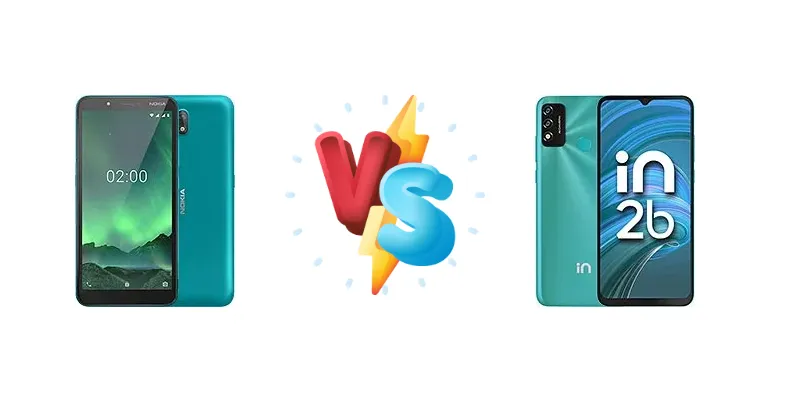
The sub-$150 smartphone market is fiercely competitive. Both the Nokia C2 and Micromax In 2b aim to deliver essential smartphone functionality at an accessible price point, relying on Unisoc chipsets to power the experience. However, a significant difference in chipset architecture separates these two, making a direct comparison crucial for budget-conscious buyers.
🏆 Quick Verdict
For most users, the Micromax In 2b is the superior choice. Its Unisoc T610, with its octa-core configuration and 12nm process, provides a noticeable performance uplift over the Nokia C2’s quad-core, 28nm Unisoc chip. While charging is limited to 10W, the improved processing power justifies the slight trade-off.
| Network |
|---|
| 2G bands | GSM 850 / 900 / 1800 / 1900 | GSM 850 / 900 / 1800 / 1900 |
| 3G bands | HSDPA 850 / 900 / 2100 - Africa, ME, APAC | HSDPA 850 / 2100 |
| 4G bands | 1, 3, 5, 7, 8, 20, 28, 38, 40, 41 - Africa, ME, APAC | 1, 3, 5, 8, 38, 40, 41 |
| Speed | HSPA 42.2/5.76 Mbps, LTE Cat4 150/50 Mbps | HSPA, LTE |
| Technology | GSM / HSPA / LTE | GSM / HSPA / LTE |
| | 1, 3, 5, 8, 28, 38, 40, 41 - Saudi Arabia | - |
| Launch |
|---|
| Announced | 2020, March 16. Released 2020, March 22 | 2021, July 30. Released 2021, August 06 |
| Status | Discontinued | Discontinued |
| Body |
|---|
| Build | Glass front, plastic back, plastic frame | - |
| Dimensions | 154.8 x 75.6 x 8.9 mm (6.09 x 2.98 x 0.35 in) | 164.3 x 75.7 x 8.6 mm (6.47 x 2.98 x 0.34 in) |
| SIM | · Nano-SIM· Nano-SIM + Nano-SIM | Nano-SIM + Nano-SIM |
| Weight | 161 g (5.68 oz) | 190 g (6.70 oz) |
| Display |
|---|
| Resolution | 720 x 1440 pixels, 18:9 ratio (~282 ppi density) | 720 x 1600 pixels, 20:9 ratio (~269 ppi density) |
| Size | 5.7 inches, 83.8 cm2 (~71.6% screen-to-body ratio) | 6.52 inches, 102.6 cm2 (~82.5% screen-to-body ratio) |
| Type | IPS LCD | IPS LCD, 400 nits (typ) |
| Platform |
|---|
| CPU | Quad-core 1.4 GHz | Octa-core (2x1.8 GHz Cortex-A75 & 6x1.8 GHz Cortex-A55) |
| Chipset | Unisoc (28 nm) | Unisoc T610 (12 nm) |
| GPU | - | Mali-G52 MP2 |
| OS | Android 9.0 Pie (Go edition) | Android 11 |
| Memory |
|---|
| Card slot | microSDXC (dedicated slot) | microSDXC (dedicated slot) |
| Internal | 16GB 1GB RAM | 64GB 4GB RAM, 64GB 6GB RAM |
| | eMMC 5.1 | eMMC 5.1 |
| Main Camera |
|---|
| Dual | - | 13 MP, f/1.8, 27mm (wide), 1/3.0", 1.12µm, PDAF
Auxiliary lens |
| Features | LED flash, HDR | LED flash, HDR, panorama |
| Single | 5 MP, f/2.2, AF | 5 MP, f/2.2 |
| Video | 720p@30fps | 1080p@30fps |
| Selfie camera |
|---|
| Features | LED flash | HDR |
| Single | 5 MP | 5 MP, f/2.2 |
| Video | 720p@30fps | Unspecified |
| Sound |
|---|
| 3.5mm jack | Yes | Yes |
| 35mm jack | Yes | Yes |
| Loudspeaker | Yes | Yes |
| Comms |
|---|
| Bluetooth | 4.2, A2DP, LE | 5.0, A2DP, LE |
| NFC | No | No |
| Positioning | GPS | GPS, GLONASS, GALILEO, BDS |
| Radio | FM radio | Unspecified |
| USB | microUSB 2.0 | USB Type-C 2.0, OTG |
| WLAN | Wi-Fi 802.11 b/g/n | Wi-Fi 802.11 a/b/g/n/ac, Wi-Fi Direct |
| Features |
|---|
| Sensors | Accelerometer, proximity | Fingerprint (rear-mounted), accelerometer, proximity |
| Battery |
|---|
| Charging | - | 10W wired |
| Type | Li-Ion 2800 mAh, removable | Li-Po 5000 mAh |
| Misc |
|---|
| Colors | Cyan, Black | Blue, Black, Green |
| Models | - | E7544 |
| Price | - | About 90 EUR |
| SAR | - | 0.85 W/kg (head) 1.13 W/kg (body) |
Nokia C2
- Potentially simpler software experience (based on Nokia’s brand reputation)
- May have a slightly larger display due to physical size
- Reliable brand with a history of software updates (though limited)
- Significantly weaker processor performance
- Less efficient 28nm chipset
- Likely slower app loading times
Micromax In 2b
- Octa-core Unisoc T610 offers superior performance
- More efficient 12nm fabrication process
- Better multitasking capabilities
- 10W charging is relatively slow
- Software experience may be less refined than Nokia
- Potential for more bloatware
Display Comparison
Neither Nokia nor Micromax provide detailed display specifications. Given the price point, both likely utilize LCD panels. The absence of information regarding brightness nits suggests neither will excel in direct sunlight. The Nokia C2’s larger physical size *may* translate to a slightly larger display, but this is speculative. Color accuracy is expected to be standard for this segment, prioritizing power efficiency over fidelity.
Camera Comparison
Detailed camera specifications are lacking for both devices. It’s safe to assume both feature basic camera setups geared towards casual photography. Without sensor size or aperture information, a direct comparison is difficult. However, the Micromax In 2b’s more powerful processor could potentially enable slightly better image processing, leading to marginally improved image quality. The prevalence of low-resolution auxiliary cameras (often 2MP) in this segment suggests focusing on the main sensor’s capabilities is crucial, but details are unavailable.
Performance
The core difference lies in the chipsets. The Nokia C2’s Unisoc (28nm) is a quad-core processor, meaning it has four processing cores. The Micromax In 2b, however, boasts the Unisoc T610 (12nm) – an octa-core chip featuring two Cortex-A75 cores clocked at 1.8GHz for performance and six Cortex-A55 cores, also at 1.8GHz, for efficiency. The 12nm fabrication process of the T610 is significantly more efficient than the 28nm process of the C2’s chip, resulting in better performance per watt and reduced heat generation. This translates to a smoother experience when switching between apps and running more demanding applications. The T610’s architecture allows for better sustained performance, benefiting users who engage in light gaming or video streaming.
Battery Life
Battery capacity is not specified for either device. However, the Micromax In 2b’s more efficient Unisoc T610 chipset will likely result in longer battery life despite potentially having a similar capacity to the Nokia C2. The In 2b’s 10W wired charging is relatively slow, meaning a full charge will take a considerable amount of time. The Nokia C2’s charging speed is also likely similar, given its market positioning. Users prioritizing minimal downtime should consider this limitation.
Buying Guide
Buy the Nokia C2 if your primary need is a basic, reliable phone for calls, texts, and extremely light app usage, and you prioritize a potentially simpler software experience. Buy the Micromax In 2b if you want a phone capable of handling multitasking, occasional gaming, and a smoother overall user experience, even if it means accepting a slightly more complex software environment.
Frequently Asked Questions
❓ Will the Micromax In 2b struggle with popular apps like WhatsApp and Facebook?
While the Unisoc T610 isn't a powerhouse, it's more than capable of running apps like WhatsApp and Facebook smoothly. The octa-core configuration and efficient architecture provide enough headroom for these everyday applications, unlike the Nokia C2’s quad-core processor which may exhibit noticeable lag.
❓ Is the 10W charging on the Micromax In 2b a significant drawback?
Yes, 10W charging is relatively slow by today's standards. Expect a full charge to take several hours. However, the more efficient Unisoc T610 chipset means you may not need to charge as frequently, mitigating the impact of the slower charging speed. The Nokia C2 likely has similar charging speeds.
❓ Can the Micromax In 2b handle basic mobile games?
The Micromax In 2b can handle basic mobile games like Candy Crush or Subway Surfers without issue. More demanding titles may require lower graphics settings to maintain a playable frame rate, but the T610’s GPU is significantly more capable than the one found in the Nokia C2.
❓ What kind of software experience can I expect on the Nokia C2?
Nokia typically offers a cleaner Android experience with a commitment to software updates, even on their budget devices. However, the C2 is an entry-level phone, so the frequency and duration of updates will be limited compared to their higher-end models. Expect a relatively stock Android experience.