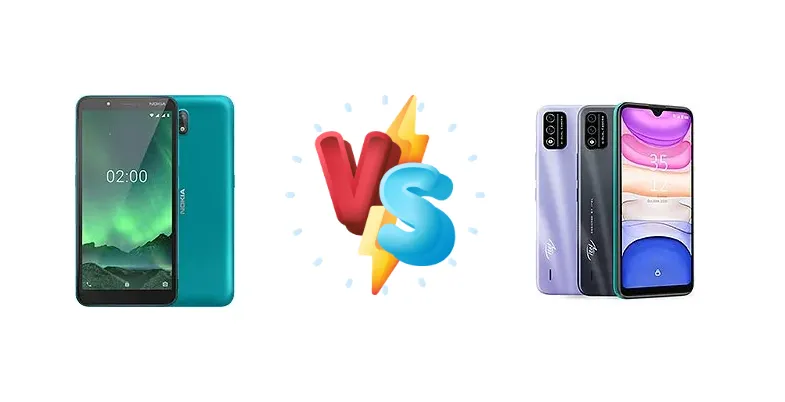
The Nokia C2 and itel A48 represent the absolute bottom end of the smartphone market, targeting first-time buyers or those needing a simple, reliable device. Both phones rely on Unisoc chipsets and Android Go edition to deliver a functional experience at an incredibly low price point. This comparison dissects their similarities and subtle differences to determine which offers the best value.
🏆 Quick Verdict
For the average user prioritizing a slightly more established brand and potentially better software support, the Nokia C2 edges out the itel A48. However, the itel A48 is a viable alternative if price is the absolute deciding factor, as both devices offer nearly identical performance.
| Network |
|---|
| 2G bands | GSM 850 / 900 / 1800 / 1900 | GSM 850 / 900 / 1800 / 1900 |
| 3G bands | HSDPA 850 / 900 / 2100 - Africa, ME, APAC | HSDPA 850 / 900 / 2100 |
| 4G bands | 1, 3, 5, 7, 8, 20, 28, 38, 40, 41 - Africa, ME, APAC | LTE |
| Speed | HSPA 42.2/5.76 Mbps, LTE Cat4 150/50 Mbps | HSPA, LTE |
| Technology | GSM / HSPA / LTE | GSM / HSPA / LTE |
| | 1, 3, 5, 8, 28, 38, 40, 41 - Saudi Arabia | - |
| Launch |
|---|
| Announced | 2020, March 16. Released 2020, March 22 | 2021 |
| Status | Discontinued | Available. Released 2021 |
| Body |
|---|
| Build | Glass front, plastic back, plastic frame | - |
| Dimensions | 154.8 x 75.6 x 8.9 mm (6.09 x 2.98 x 0.35 in) | - |
| SIM | · Nano-SIM· Nano-SIM + Nano-SIM | Dual SIM |
| Weight | 161 g (5.68 oz) | - |
| Display |
|---|
| Resolution | 720 x 1440 pixels, 18:9 ratio (~282 ppi density) | 720 x 1600 pixels, 20:9 ratio (~288 ppi density) |
| Size | 5.7 inches, 83.8 cm2 (~71.6% screen-to-body ratio) | 6.1 inches, 89.8 cm2 |
| Type | IPS LCD | IPS LCD |
| Platform |
|---|
| CPU | Quad-core 1.4 GHz | Quad-core 1.4 GHz |
| Chipset | Unisoc (28 nm) | Unisoc SC9832E (28 nm) |
| GPU | - | Mali-T820 MP1 |
| OS | Android 9.0 Pie (Go edition) | Android 10 (Go edition) |
| Memory |
|---|
| Card slot | microSDXC (dedicated slot) | microSDXC |
| Internal | 16GB 1GB RAM | 32GB 2GB RAM |
| | eMMC 5.1 | - |
| Main Camera |
|---|
| Features | LED flash, HDR | LED flash |
| Single | 5 MP, f/2.2, AF | 5 MP (wide)
Auxiliary lens |
| Video | 720p@30fps | Yes |
| Selfie camera |
|---|
| Features | LED flash | - |
| Single | 5 MP | 5 MP |
| Video | 720p@30fps | Yes |
| Sound |
|---|
| 3.5mm jack | Yes | - |
| 35mm jack | Yes | Yes |
| Loudspeaker | Yes | Yes |
| Comms |
|---|
| Bluetooth | 4.2, A2DP, LE | Yes |
| NFC | No | No |
| Positioning | GPS | GPS |
| Radio | FM radio | Unspecified |
| USB | microUSB 2.0 | microUSB |
| WLAN | Wi-Fi 802.11 b/g/n | Yes |
| Features |
|---|
| Sensors | Accelerometer, proximity | Fingerprint (rear-mounted), accelerometer |
| Battery |
|---|
| Type | Li-Ion 2800 mAh, removable | 3000 mAh |
| Misc |
|---|
| Colors | Cyan, Black | Black, Purple, Green |
Nokia C2
- Established brand reputation (Nokia)
- Potentially cleaner Android Go experience
- Slightly better chance of software updates
- Limited performance due to Unisoc chipset
- Basic camera capabilities
itel A48
- Lowest possible price point
- Functional for basic tasks
- Decent battery life (estimated)
- Less brand recognition (itel)
- Potentially limited software support
Display Comparison
Neither Nokia nor itel provide detailed display specifications beyond size. Given the price point, both likely utilize LCD panels with modest resolutions. The absence of information regarding brightness nits or color accuracy suggests both displays are geared towards basic visibility rather than media consumption. Bezels are expected to be substantial on both devices, maximizing screen real estate within a compact form factor. The user experience will be similar on both, focused on readability rather than visual fidelity.
Camera Comparison
Camera performance on both devices is expected to be extremely limited. Details are scarce, but given the target market, both likely feature basic sensors. Focusing on megapixel counts alone is misleading; image quality will be heavily dependent on software processing, which is likely minimal on both. Users should expect acceptable results in well-lit conditions for casual snapshots, but poor performance in low light. The absence of Optical Image Stabilization (OIS) on either device further limits low-light capabilities.
Performance
Both the Nokia C2 and itel A48 are powered by a Quad-core 1.4 GHz processor built on the 28nm Unisoc platform. While the itel A48 uses the Unisoc SC9832E, the core architecture and clock speed are identical to the Nokia C2’s Unisoc chipset. This means real-world performance will be virtually indistinguishable. Both phones will struggle with demanding applications and multitasking, but are adequate for calls, texts, and basic apps like WhatsApp. The 28nm process node indicates neither device will excel in thermal efficiency, but the low clock speeds mitigate the risk of significant throttling during sustained use.
Battery Life
Battery capacity details are not provided in the context data. However, given the low-power chipset and basic displays, both the Nokia C2 and itel A48 should offer all-day battery life with moderate usage. Charging wattage is also unspecified, suggesting both devices will charge relatively slowly. The focus is on longevity rather than rapid replenishment, catering to users who may not have frequent access to power outlets.
Buying Guide
Buy the Nokia C2 if you value brand recognition, a potentially cleaner software experience, and a slightly higher likelihood of receiving future software updates (even if limited). Buy the itel A48 if your primary concern is minimizing cost and you're comfortable with a less-known brand, accepting that software support may be minimal. Both are suitable for basic communication and light tasks.
Frequently Asked Questions
❓ Will either of these phones run popular games like PUBG or Call of Duty?
No. The Unisoc chipsets in both the Nokia C2 and itel A48 are not powerful enough to run graphically demanding games like PUBG or Call of Duty at playable frame rates. They are designed for basic tasks like calling, texting, and using lightweight apps.
❓ What version of Android do these phones run, and will they receive updates?
Both phones run Android Go edition, a lightweight version of Android designed for devices with limited processing power and storage. While updates are possible, they are not guaranteed and will likely be infrequent. Nokia generally offers slightly better software support than itel, but expectations should remain low.
❓ Is the camera quality good enough for social media photos?
The camera quality is sufficient for casual social media photos in well-lit conditions. However, expect limited detail and poor performance in low light. These cameras are best suited for quick snapshots rather than high-quality photography.