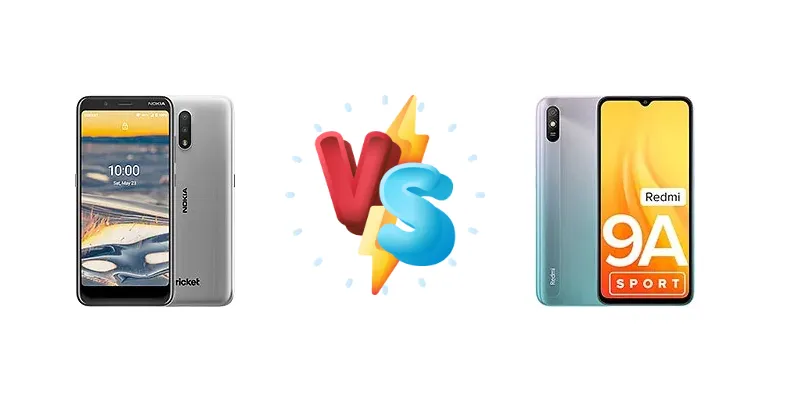
The Nokia C2 Tennen and Xiaomi Redmi 9A Sport represent the very bottom end of the smartphone market, targeting first-time buyers or those needing a reliable secondary device. Both offer basic functionality, but a closer look at their core components reveals a significant performance disparity driven by chipset architecture and manufacturing process.
🏆 Quick Verdict
For the average user, the Xiaomi Redmi 9A Sport is the better choice. Its Mediatek Helio G25, built on a 12nm process, delivers noticeably improved performance over the Nokia C2 Tennen’s Helio A22 (16nm), offering a smoother experience for everyday tasks and light gaming. While both charge at the same speed, the G25’s efficiency provides a slight edge in battery life.
| Network |
|---|
| 2G bands | GSM 850 / 900 / 1800 / 1900 | GSM 850 / 900 / 1800 / 1900 |
| 3G bands | HSDPA 850 / 1700(AWS) / 1900 | HSDPA 850 / 900 / 2100 |
| 4G bands | LTE | 1, 3, 5, 8, 40, 41 |
| EDGE | No | - |
| GPRS | Class 12 | - |
| Speed | HSPA 21.1/5.76 Mbps, LTE, Cat6 300/50 Mbps | HSPA, LTE |
| Technology | GSM / HSPA / LTE | GSM / HSPA / LTE |
| Launch |
|---|
| Announced | 2020, May 29. Released 2020, June 15 | 2021, September 28 |
| Status | Discontinued | Available. Released 2021, September 28 |
| Body |
|---|
| Build | Glass front, plastic back, plastic frame | - |
| Dimensions | 150.6 x 72.4 x 9.1 mm (5.93 x 2.85 x 0.36 in) | 164.9 x 77.1 x 9 mm (6.49 x 3.04 x 0.35 in) |
| Keyboard | QWERTY | - |
| SIM | Nano-SIM | Nano-SIM + Nano-SIM |
| Weight | 180 g (6.35 oz) | 194 g (6.84 oz) |
| | - | Water-repellent coating |
| Display |
|---|
| Resolution | 720 x 1440 pixels, 18:9 ratio (~295 ppi density) | 720 x 1600 pixels, 20:9 ratio (~269 ppi density) |
| Size | 5.45 inches, 76.7 cm2 (~70.3% screen-to-body ratio) | 6.53 inches, 102.9 cm2 (~81.0% screen-to-body ratio) |
| Type | IPS LCD | IPS LCD, 400 nits (typ) |
| Platform |
|---|
| CPU | Quad-core 2.0 GHz Cortex-A53 | Octa-core (4x2.0 GHz Cortex-A53 & 4x1.5 GHz Cortex-A53) |
| Chipset | Mediatek MT6761 Helio A22 (16 nm) | Mediatek MT6762G Helio G25 (12 nm) |
| GPU | PowerVR GE8320 | PowerVR GE8320 |
| OS | Android 10 | Android 10, MIUI 12 |
| Memory |
|---|
| Call records | Yes | - |
| Card slot | microSDXC | microSDXC (dedicated slot) |
| Internal | 16GB 2GB RAM, 32GB 2GB RAM | 32GB 2GB RAM, 32GB 3GB RAM |
| Phonebook | 500 entries | - |
| | eMMC 5.1 | eMMC 5.1 |
| Main Camera |
|---|
| Dual | 8 MP, AF
2 MP | - |
| Features | LED flash, HDR, panorama | LED flash, HDR |
| Single | VGA | 13 MP, f/2.2, 28mm (wide), 1.0µm, PDAF |
| Video | 1080p@30fps | 1080p@30/60fps |
| Selfie camera |
|---|
| Features | - | HDR |
| Single | 5 MP | 5 MP, f/2.2, (wide), 1.12µm |
| Video | 720p@30fps | 1080p@30fps |
| Sound |
|---|
| 3.5mm jack | Yes | Yes |
| 35mm jack | Yes | Yes |
| Loudspeaker | Yes | Yes |
| Comms |
|---|
| Bluetooth | 4.2, A2DP, LE | 5.0, A2DP, LE |
| NFC | No | No |
| Positioning | GPS | GPS, GLONASS, BDS |
| Radio | FM radio | FM radio |
| USB | USB Type-C 2.0 | microUSB 2.0, OTG |
| WLAN | Wi-Fi 802.11 b/g/n | Wi-Fi 802.11 a/b/g/n, Wi-Fi Direct |
| Features |
|---|
| Games | Yes | - |
| Messaging | SMS, MMS | - |
| Sensors | Accelerometer, proximity | Accelerometer, proximity |
| Battery |
|---|
| Charging | 10W wired | 10W wired |
| Stand-by | Up to 240 h | - |
| Talk time | Up to 3 h | - |
| Type | Li-Po 3000 mAh, removable | Li-Po 5000 mAh |
| Misc |
|---|
| Colors | Steel | Carbon Black, Coral Green, Metallic Blue |
| Price | About 60 EUR | About 100 EUR |
Nokia C2 Tennen
- Potentially better brand reputation for software updates (Nokia)
- Simple and straightforward user experience
- Reliable for basic communication tasks
- Significantly weaker processor performance
- Less efficient chipset leading to potential throttling
- Limited multitasking capabilities
Xiaomi Redmi 9A Sport
- More powerful and efficient Mediatek Helio G25 chipset
- Octa-core CPU for smoother multitasking
- Better performance for light gaming and streaming
- Xiaomi’s MIUI software can be resource-intensive
- Potentially less frequent software updates compared to Nokia
Display Comparison
Neither device boasts a standout display. Both are likely to feature LCD panels with 720p+ resolution, typical for this price bracket. However, display quality beyond resolution isn't specified. The Redmi 9A Sport's slightly higher processing power *could* translate to smoother scrolling and animations, but this is dependent on software optimization. Bezels are expected to be substantial on both devices, maximizing screen real estate within a compact form factor.
Camera Comparison
Camera performance is likely to be similar on both devices, relying on basic sensors and image processing. Given the market segment, both will likely feature a primary camera around 13MP, with a secondary depth sensor. The Redmi 9A Sport’s slightly more powerful processor *could* enable faster image processing, but image quality will largely depend on software algorithms. Expect acceptable results in good lighting conditions, but struggles in low light.
Performance
The core difference lies in the chipsets. The Xiaomi Redmi 9A Sport’s Mediatek Helio G25 (12nm) is a clear upgrade over the Nokia C2 Tennen’s Helio A22 (16nm). The G25’s octa-core configuration (4x2.0 GHz Cortex-A53 & 4x1.5 GHz Cortex-A53) provides significantly more processing power than the A22’s quad-core 2.0 GHz Cortex-A53. The 12nm process also contributes to better power efficiency, meaning the Redmi 9A Sport will likely experience less thermal throttling during sustained use. This translates to a more fluid user experience, especially when switching between apps or browsing the web.
Battery Life
Both phones feature 10W wired charging, indicating similar charging speeds – expect around 2.5-3 hours for a full charge. While battery capacity isn't specified, the Helio G25’s 12nm process is more power-efficient than the Helio A22’s 16nm process. This means the Redmi 9A Sport will likely extract more usage time from a similarly sized battery, offering a slight advantage in real-world battery life.
Buying Guide
Buy the Nokia C2 Tennen if you prioritize brand reliability and a simple, no-frills experience, and your usage is limited to basic communication and very light app use. Buy the Xiaomi Redmi 9A Sport if you prefer a more responsive device capable of handling multitasking, streaming, and casual gaming without significant lag, even if it means sacrificing some brand prestige.
Frequently Asked Questions
❓ Will the Redmi 9A Sport struggle with popular apps like WhatsApp and Facebook?
While not a powerhouse, the Redmi 9A Sport’s Helio G25 chipset and octa-core CPU are sufficient to run apps like WhatsApp and Facebook smoothly. You might experience some slowdown with multiple apps open simultaneously, but for typical social media usage, it should perform adequately.
❓ Is the Nokia C2 Tennen a good choice for elderly users who primarily make calls and send texts?
Yes, the Nokia C2 Tennen is a suitable option for elderly users with basic needs. Its simple interface and reliable performance for calls and texts make it a straightforward device. However, the slower processor might make it less responsive than the Redmi 9A Sport.
❓ Can the Redmi 9A Sport handle any mobile games?
The Redmi 9A Sport can handle light mobile games like Candy Crush or Subway Surfers. However, demanding titles like PUBG Mobile will likely require very low graphics settings and may still experience lag. The Helio G25 is not a gaming-focused chipset.
❓ How long will software updates be supported on each device?
Nokia generally offers a more predictable software update schedule, even for budget devices. Xiaomi’s update support can be less consistent. Expect at least one major Android update for both, but the Redmi 9A Sport may receive fewer security patches over its lifespan.