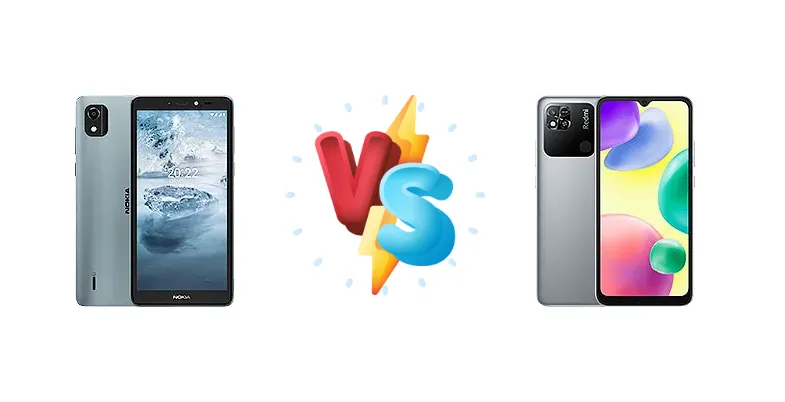
The ultra-budget smartphone segment is fiercely competitive, and the Nokia C2 2nd Edition and Xiaomi Redmi 10A represent two compelling options. While both aim to deliver essential smartphone functionality at the lowest possible price, they take different approaches to achieving this. This comparison dissects their key specifications to determine which device offers the best value for users prioritizing affordability.
🏆 Quick Verdict
For the average user seeking a slightly more responsive experience, the Xiaomi Redmi 10A emerges as the better choice. Its Mediatek Helio G25 chipset, with its octa-core configuration, provides a noticeable performance advantage over the Nokia C2 2nd Edition’s quad-core processor, making everyday tasks smoother.
| Network |
|---|
| 2G bands | GSM 850 / 900 / 1800 / 1900 | GSM 850 / 900 / 1800 / 1900 |
| 3G bands | HSDPA 850 / 900 / 2100 | HSDPA 850 / 900 / 2100 |
| 4G bands | LTE | 1, 3, 5, 8, 40, 41 - International |
| Speed | HSPA 42.2/5.76 Mbps, LTE Cat4 150/50 Mbps | HSPA, LTE |
| Technology | GSM / HSPA / LTE | GSM / HSPA / CDMA2000 / LTE |
| | - | 1, 3, 5, 8, 34, 38, 39, 40, 41 - China |
| Launch |
|---|
| Announced | 2022, February 28 | 2022, March 29 |
| Status | Available. Released 2022, April 19 | Available. Released 2022, March 31 |
| Body |
|---|
| Build | Glass front, plastic back, plastic frame | - |
| Dimensions | 154 x 75.9 x 10 mm (6.06 x 2.99 x 0.39 in) | 164.9 x 77.1 x 9 mm (6.49 x 3.04 x 0.35 in) |
| SIM | · Nano-SIM· Nano-SIM + Nano-SIM | Nano-SIM + Nano-SIM |
| Weight | 180 g (6.35 oz) | 194 g (6.84 oz) |
| Display |
|---|
| Resolution | 480 x 960 pixels, 18:9 ratio (~188 ppi density) | 720 x 1600 pixels, 20:9 ratio (~269 ppi density) |
| Size | 5.7 inches, 83.8 cm2 (~71.7% screen-to-body ratio) | 6.53 inches, 102.9 cm2 (~81.0% screen-to-body ratio) |
| Type | IPS LCD | IPS LCD, 400 nits (typ) |
| Platform |
|---|
| CPU | Quad-core 1.5 GHz | Octa-core (4x2.0 GHz Cortex-A53 & 4x1.5 GHz Cortex-A53) |
| Chipset | - | Mediatek MT6762G Helio G25 (12 nm) |
| GPU | - | PowerVR GE8320 |
| OS | Android 11 (Go edition) | Android 11, MIUI 12.5 |
| Memory |
|---|
| Card slot | microSDXC (dedicated slot) | microSDXC |
| Internal | 16GB 2GB RAM, 32GB 1GB RAM, 32GB 2GB RAM | 32GB 2GB RAM, 32GB 3GB RAM, 64GB 3GB RAM, 64GB 4GB RAM, 128GB 4GB RAM, 128GB 6GB RAM |
| | eMMC 5.1 | - |
| Main Camera |
|---|
| Features | LED flash, panorama | LED flash |
| Single | 5 MP | 13 MP, f/2.2, (wide), 1.0µm, AF |
| Video | 720p@30fps | 1080p@30fps |
| Selfie camera |
|---|
| Features | LED flash | HDR |
| Single | 2 MP | 5 MP |
| Video | 720p | 1080p@30fps |
| Sound |
|---|
| 3.5mm jack | Yes | Yes |
| 35mm jack | Yes | Yes |
| Loudspeaker | Yes | Yes |
| Comms |
|---|
| Bluetooth | 5.0, A2DP, LE | 5.0, A2DP, LE |
| NFC | No | No |
| Positioning | GPS | GPS, GLONASS, BDS |
| Radio | Wireless FM radio | No |
| USB | microUSB 2.0 | microUSB 2.0 |
| WLAN | Wi-Fi 802.11 b/g/n | Wi-Fi 802.11 a/b/g/n, Wi-Fi Direct |
| Features |
|---|
| Sensors | Accelerometer | Fingerprint (rear-mounted), accelerometer, proximity |
| Battery |
|---|
| Charging | - | 10W wired |
| Type | Li-Ion 2400 mAh, removable | Li-Ion 5000 mAh |
| Misc |
|---|
| Colors | Dark Blue, Warm Gray | Charcoal Black, Sea Blue, Slate Grey |
| Models | TA-1468, TA-1454 | 220233L2C, 220233L2G, 220233L2I |
| Price | About 240 EUR | € 60.00 / $ 66.55 |
| SAR | 0.52 W/kg (head) 0.68 W/kg (body) | 0.90 W/kg (head) 0.65 W/kg (body) |
| SAR EU | 0.42 W/kg (head) 1.14 W/kg (body) | 0.40 W/kg (head) 0.99 W/kg (body) |
Nokia C2 2nd Edition
- Potentially cleaner software experience with Android Go Edition
- Nokia’s reputation for build quality
- Simple and easy to use
- Significantly weaker processor performance
- Likely limited multitasking capabilities
- Display specifications are unknown and likely basic
Xiaomi Redmi 10A
- More powerful octa-core Mediatek Helio G25 processor
- 12nm process for improved efficiency
- 10W wired charging
- Xiaomi’s MIUI software can be resource-intensive
- Potential for bloatware
- Display details are limited
Display Comparison
Neither device boasts a standout display. The Nokia C2 2nd Edition’s display specifications are not provided, but given its market positioning, it likely features a basic LCD panel. The Redmi 10A also utilizes an LCD, but details regarding its brightness and color accuracy are absent. Both will likely struggle in direct sunlight. The key difference lies in the potential for software optimizations; Xiaomi’s MIUI often includes display calibration options, while Nokia’s Android Go Edition focuses on simplicity, potentially sacrificing display customization.
Camera Comparison
Camera performance on both devices is expected to be basic. Neither phone’s camera specifications are detailed enough to draw firm conclusions beyond the fact that they will likely struggle in low-light conditions. The absence of Optical Image Stabilization (OIS) on either device further limits their low-light capabilities. While the Redmi 10A may benefit from Xiaomi’s image processing algorithms, the fundamental limitations of the sensors will be apparent. Focusing on the main sensor is crucial, as any additional sensors (often 2MP macro lenses) are unlikely to deliver meaningful results.
Performance
The performance gap is the most significant differentiator. The Nokia C2 2nd Edition is equipped with a quad-core 1.5 GHz processor, suitable for basic tasks. In contrast, the Xiaomi Redmi 10A’s Mediatek Helio G25 is an octa-core chip (4x2.0 GHz Cortex-A53 & 4x1.5 GHz Cortex-A53) fabricated on a more efficient 12nm process. This means the Redmi 10A will handle multitasking, app loading, and general responsiveness with greater ease. The Helio G25’s architecture, while still entry-level, provides a substantial uplift in processing power compared to the Nokia’s simpler configuration. The Redmi 10A will be noticeably faster in almost all scenarios.
Battery Life
Battery life will depend heavily on usage patterns. The Redmi 10A includes 10W wired charging, which is slow by modern standards, but adequate for an entry-level device. The Nokia C2 2nd Edition’s battery capacity and charging speed are not specified, but it’s reasonable to assume similar or slightly lower charging speeds. The more efficient Helio G25 in the Redmi 10A may contribute to slightly better battery endurance, offsetting any potential capacity differences.
Buying Guide
Buy the Nokia C2 2nd Edition if you need a simple, reliable device primarily for calls, texts, and very light app usage, and prioritize a clean software experience. Buy the Xiaomi Redmi 10A if you prefer a phone capable of handling slightly more demanding tasks like social media browsing, light gaming, and multitasking, and don't mind Xiaomi's MIUI software.
Frequently Asked Questions
❓ Will the Redmi 10A struggle with popular apps like Facebook and WhatsApp?
While the Helio G25 is an entry-level chip, it should handle Facebook and WhatsApp without significant issues. However, running multiple apps simultaneously or using more demanding features within these apps may result in some slowdown. The Redmi 10A is better equipped to handle these tasks than the Nokia C2 2nd Edition.
❓ Is the Android Go Edition on the Nokia C2 2nd Edition a significant benefit?
Android Go Edition is designed for devices with limited resources. It offers a streamlined experience with optimized apps, but it also means fewer features and potentially slower performance compared to full Android. While it can be beneficial for users prioritizing simplicity, the Redmi 10A’s more powerful processor may provide a better overall experience even with a more feature-rich operating system.
❓ How long will it take to fully charge the Xiaomi Redmi 10A with the 10W charger?
With a 10W charger, expect the Redmi 10A to take approximately 3-4 hours to fully charge from 0% to 100%. This is a relatively slow charging speed compared to modern smartphones, but it's typical for devices in this price range.