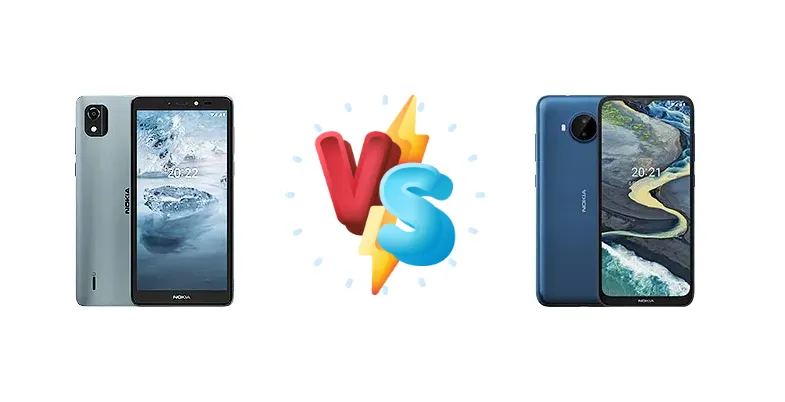
Nokia's C-series aims to deliver reliable smartphones at incredibly accessible price points. The C2 2nd Edition and C20 Plus represent two distinct approaches within this segment. The C2 2nd Edition focuses on simplicity, while the C20 Plus attempts to offer a more modern experience with a larger display and an octa-core processor. This comparison dissects the key differences to determine which device provides the best value.
🏆 Quick Verdict
For the average user prioritizing basic functionality and a slightly smoother experience, the Nokia C20 Plus is the better choice. Its Unisoc SC9863A chipset, featuring eight cores, provides a noticeable performance uplift over the C2 2nd Edition’s quad-core processor, making everyday tasks more responsive. However, both phones are firmly in the entry-level category.
| Network |
|---|
| 2G bands | GSM 850 / 900 / 1800 / 1900 | GSM 850 / 900 / 1800 / 1900 |
| 3G bands | HSDPA 850 / 900 / 2100 | HSDPA 850 / 900 / 1900 / 2100 |
| 4G bands | LTE | 1, 3, 5, 8, 34, 38, 29, 40, 41 |
| Speed | HSPA 42.2/5.76 Mbps, LTE Cat4 150/50 Mbps | HSPA 42.2/5.76 Mbps, LTE Cat4 150/50 Mbps |
| Technology | GSM / HSPA / LTE | GSM / HSPA / LTE |
| Launch |
|---|
| Announced | 2022, February 28 | 2021, June 11 |
| Status | Available. Released 2022, April 19 | Available. Released 2021, June 16 |
| Body |
|---|
| Build | Glass front, plastic back, plastic frame | - |
| Dimensions | 154 x 75.9 x 10 mm (6.06 x 2.99 x 0.39 in) | 165.4 x 75.9 x 9.4 mm (6.51 x 2.99 x 0.37 in) |
| SIM | · Nano-SIM· Nano-SIM + Nano-SIM | · Nano-SIM· Nano-SIM + Nano-SIM |
| Weight | 180 g (6.35 oz) | 204.7 g (7.23 oz) |
| Display |
|---|
| Resolution | 480 x 960 pixels, 18:9 ratio (~188 ppi density) | 720 x 1600 pixels, 20:9 ratio (~270 ppi density) |
| Size | 5.7 inches, 83.8 cm2 (~71.7% screen-to-body ratio) | 6.5 inches, 102.0 cm2 (~81.3% screen-to-body ratio) |
| Type | IPS LCD | IPS LCD |
| Platform |
|---|
| CPU | Quad-core 1.5 GHz | Octa-core (4x1.6 GHz Cortex-A55 & 4x1.2 GHz Cortex-A55) |
| Chipset | - | Unisoc SC9863A (28 nm) |
| GPU | - | IMG8322 |
| OS | Android 11 (Go edition) | Android 11 (Go edition) |
| Memory |
|---|
| Card slot | microSDXC (dedicated slot) | microSDXC |
| Internal | 16GB 2GB RAM, 32GB 1GB RAM, 32GB 2GB RAM | 32GB 3GB RAM |
| | eMMC 5.1 | eMMC 5.1 |
| Main Camera |
|---|
| Dual | - | 8 MP
Auxiliary lens |
| Features | LED flash, panorama | LED flash |
| Single | 5 MP | 5 MP |
| Video | 720p@30fps | 720p@30fps |
| Selfie camera |
|---|
| Features | LED flash | - |
| Single | 2 MP | 5 MP |
| Video | 720p | 720p |
| Sound |
|---|
| 3.5mm jack | Yes | Yes |
| 35mm jack | Yes | Yes |
| Loudspeaker | Yes | Yes |
| Comms |
|---|
| Bluetooth | 5.0, A2DP, LE | 4.2, A2DP |
| NFC | No | No |
| Positioning | GPS | GPS |
| Radio | Wireless FM radio | FM radio |
| USB | microUSB 2.0 | microUSB 2.0 |
| WLAN | Wi-Fi 802.11 b/g/n | Wi-Fi 802.11 b/g/n |
| Features |
|---|
| Sensors | Accelerometer | Accelerometer, proximity |
| Battery |
|---|
| Charging | - | 10W wired |
| Type | Li-Ion 2400 mAh, removable | Li-Ion 4950 mAh, removable |
| Misc |
|---|
| Colors | Dark Blue, Warm Gray | Ocean Blue, Graphite black |
| Models | TA-1468, TA-1454 | TA-1388, TA-1380 |
| Price | About 240 EUR | About 90 EUR |
| SAR | 0.52 W/kg (head) 0.68 W/kg (body) | - |
| SAR EU | 0.42 W/kg (head) 1.14 W/kg (body) | - |
Nokia C2 2nd Edition
- Potentially lower price point
- Simpler user experience
- Durable build quality (typical of Nokia)
- Significantly slower processor
- Limited multitasking capabilities
- Less responsive user interface
Nokia C20 Plus
- Octa-core processor for smoother performance
- Larger display for better media consumption
- More efficient processor potentially improving battery life
- May be slightly more expensive
- 10W charging is relatively slow
- Still limited by entry-level components
Display Comparison
Both devices likely feature similar LCD panels, given their price bracket. However, the Nokia C20 Plus benefits from a larger display size, which enhances media viewing. Neither specification details resolution or brightness, suggesting both are targeting the absolute minimum required for usability. The C20 Plus’s larger screen will be more immersive, but both will struggle in direct sunlight. Bezels are expected to be substantial on both models, reflecting their budget nature.
Camera Comparison
Camera performance on both devices is expected to be limited. Neither specification details sensor size or image processing capabilities. Given the market segment, both likely feature basic 5MP or 8MP main sensors. The C20 Plus may have a slight advantage due to potentially better image signal processing (ISP) integrated within the Unisoc chipset, but don't expect flagship-level results. Any secondary cameras (likely 2MP macro lenses) on either device are unlikely to provide significant value.
Performance
The core difference lies in the processors. The Nokia C2 2nd Edition utilizes a quad-core 1.5 GHz CPU, suitable for very basic tasks. The Nokia C20 Plus, however, boasts the Unisoc SC9863A, an octa-core processor with a heterogeneous core configuration (4x1.6 GHz Cortex-A55 & 4x1.2 GHz Cortex-A55). This means the C20 Plus can handle more complex operations and multitasking with greater ease. The Unisoc chip, built on a 28nm process, is more efficient than the likely older process node used in the C2 2nd Edition, potentially leading to slightly better battery life under load. The C20 Plus will offer a demonstrably smoother user experience.
Battery Life
Battery capacity isn't specified for either device, but both will likely feature batteries in the 3000-4000 mAh range. The C20 Plus includes 10W wired charging, which is standard for this price point. While charging speeds are slow, the more efficient Unisoc SC9863A processor may allow the C20 Plus to achieve a slightly longer runtime on a single charge, especially during moderate usage. Expect both phones to require daily charging with typical use.
Buying Guide
Buy the Nokia C2 2nd Edition if you need a truly minimal smartphone for essential communication – calls, texts, and very light app usage. Its simplicity and potentially lower price point make it ideal for first-time smartphone users or those seeking a durable, no-frills device. Buy the Nokia C20 Plus if you prefer a larger screen for media consumption and a more capable processor for handling multiple apps or slightly more demanding tasks. The octa-core chipset offers a tangible improvement in responsiveness and multitasking.
Frequently Asked Questions
❓ Will the Nokia C20 Plus handle popular social media apps like Facebook and WhatsApp smoothly?
Yes, the Unisoc SC9863A’s octa-core architecture provides enough processing power to run Facebook, WhatsApp, and similar apps without significant lag. While it won’t offer a high-end experience, it will be a usable and responsive experience for these core applications.
❓ Is the 10W charging on the Nokia C20 Plus a significant drawback?
10W charging is slow by modern standards, taking several hours to fully charge the device. However, given the likely smaller battery capacity (estimated 3000-4000 mAh) and the phone’s intended use case – basic communication and light tasks – it’s acceptable. Overnight charging is recommended.
❓ Can the Nokia C2 2nd Edition run Google Maps for navigation?
The Nokia C2 2nd Edition *can* run Google Maps, but the experience will likely be sluggish, especially with complex routes or live traffic updates. The quad-core processor may struggle to handle the app’s demands, leading to delays and potential crashes. The C20 Plus is a better choice for navigation.
❓ What type of storage does the Nokia C20 Plus use, and is it expandable?
While not specified, budget smartphones like the C20 Plus typically use eMMC storage, which is slower than UFS. Expandable storage via microSD card is highly likely, given the target market, allowing users to increase storage capacity for photos, videos, and apps.