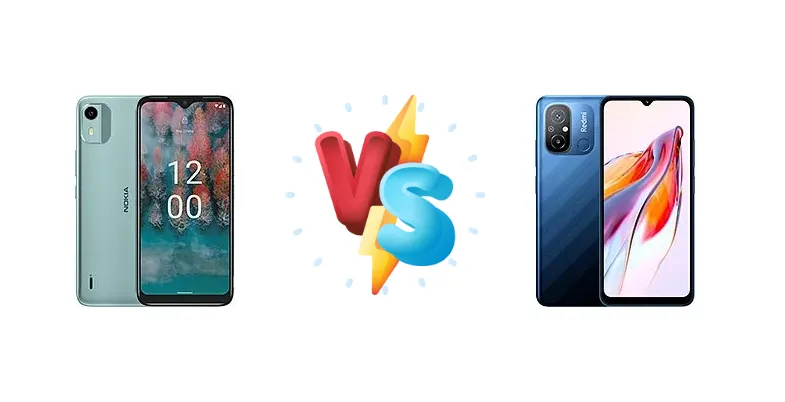
The sub-$150 smartphone market is fiercely competitive. Both the Nokia C12 and Xiaomi Redmi 12C aim to deliver essential smartphone functionality at an incredibly accessible price point. However, significant differences in their underlying hardware mean one offers a noticeably smoother and more capable experience than the other. This comparison breaks down those differences to help you choose the right device.
🏆 Quick Verdict
For most users, the Xiaomi Redmi 12C is the better choice. Its MediaTek Helio G85 chipset, built on a more efficient 12nm process, provides a substantial performance advantage over the Nokia C12’s Unisoc SC9863A1. While both phones prioritize affordability, the Redmi 12C offers a more responsive user experience and better potential for light gaming.
| Network |
|---|
| 2G bands | GSM 850 / 900 / 1800 / 1900 | GSM 850 / 900 / 1800 / 1900 |
| 3G bands | HSDPA 850 / 900 / 1900 / 2100 | HSDPA 850 / 900 / 2100 |
| 4G bands | LTE | 1, 3, 5, 7, 8, 20, 28, 38, 40, 41 - International |
| Speed | HSPA, LTE | HSPA, LTE |
| Technology | GSM / HSPA / LTE | GSM / CDMA / HSPA / EVDO / LTE |
| | - | CDMA2000 1xEV-DO |
| Launch |
|---|
| Announced | 2023, January 18 | 2022, December 31 |
| Status | Available. Released 2023, February 02 | Available. Released 2023, January 01 |
| Body |
|---|
| Build | Glass front, plastic back, plastic frame | - |
| Dimensions | 160.6 x 74.3 x 8.8 mm (6.32 x 2.93 x 0.35 in) | 168.8 x 76.4 x 8.8 mm (6.65 x 3.01 x 0.35 in) |
| SIM | Nano-SIM + Nano-SIM | Nano-SIM + Nano-SIM |
| Weight | 177.4 g (6.24 oz) | 192 g (6.77 oz) |
| | Splash resistant | - |
| Display |
|---|
| Protection | Scratch-resistant glass | - |
| Resolution | 720 x 1600 pixels, 20:9 ratio (~278 ppi density) | 720 x 1650 pixels (~268 ppi density) |
| Size | 6.3 inches, 95.8 cm2 (~80.3% screen-to-body ratio) | 6.71 inches, 106.5 cm2 (~82.6% screen-to-body ratio) |
| Type | IPS LCD | IPS LCD, 500 nits (typ) |
| Platform |
|---|
| CPU | Octa-core (4x1.6 GHz Cortex-A55 & 4x1.2 GHz Cortex-A55) | Octa-core (2x2.0 GHz Cortex-A75 & 6x1.8 GHz Cortex-A55) |
| Chipset | Unisoc SC9863A1 (22 nm) | Mediatek MT6769Z Helio G85 (12 nm) |
| GPU | IMG8322 | Mali-G52 MC2 |
| OS | Android 12 (Go edition) | Android 12, MIUI 13 |
| Memory |
|---|
| Card slot | Unspecified | microSDXC (dedicated slot) |
| Internal | 64GB 2GB RAM, 64GB 3GB RAM | 32GB 2GB RAM, 32GB 3GB RAM, 32GB 4GB RAM, 64GB 3GB RAM, 64GB 4GB RAM, 128GB 3GB RAM, 128GB 4GB RAM, 128GB 6GB RAM |
| | eMMC 5.1 | eMMC 5.1 |
| Main Camera |
|---|
| Dual | - | 50 MP, (wide), PDAF
0.08 MP (depth) |
| Features | LED flash, HDR | LED flash, HDR |
| Single | 8 MP, AF | 50 MP, f/1.8, (wide), 1/2.76", PDAF
Auxiliary lens |
| Video | Yes | 1080p@30fps |
| Selfie camera |
|---|
| Single | 5 MP | 5 MP, f/2.2, (wide) |
| Video | 720p | 1080p@30fps |
| Sound |
|---|
| 3.5mm jack | Yes | Yes |
| 35mm jack | Yes | Yes |
| Loudspeaker | Yes | Yes |
| Comms |
|---|
| Bluetooth | 5.2, A2DP | 5.1, A2DP, LE |
| NFC | No | Yes (market/region dependent) |
| Positioning | GPS | GPS, GLONASS, BDS, GALILEO |
| Radio | FM radio | FM radio |
| USB | microUSB 2.0 | microUSB 2.0 |
| WLAN | Wi-Fi 802.11 b/g/n | Wi-Fi 802.11 a/b/g/n/ac, dual-band, Wi-Fi Direct |
| Features |
|---|
| Sensors | Accelerometer, proximity | Fingerprint (rear-mounted), accelerometer |
| | - | Virtual proximity sensing |
| Battery |
|---|
| Charging | - | 10W wired |
| Type | Li-Ion 3000 mAh, removable | Li-Po 5000 mAh |
| Misc |
|---|
| Colors | Dark Cyan, Charcoal, Light Mint | Graphite Gray, Ocean Blue, Mint Green, Lavender Purple |
| Models | - | 22120RN86G, 22120RN86I, 22126RN91Y, 2212ARNC4L |
| Price | About 100 EUR | £ 132.99 / € 107.41 |
| SAR | - | 1.08 W/kg (head) 0.64 W/kg (body) |
| SAR EU | - | 0.98 W/kg (head) 0.99 W/kg (body) |
Nokia C12
- Clean Android experience (likely Android Go)
- Nokia’s reputation for build quality
- Potentially longer software support
- Significantly weaker performance
- Less efficient chipset
- Limited gaming capabilities
Xiaomi Redmi 12C
- More powerful MediaTek Helio G85 chipset
- Larger display for immersive viewing
- Better multitasking and gaming performance
- MIUI software with potential bloatware
- 10W charging is relatively slow
- Potentially shorter software support compared to Nokia
Display Comparison
Neither device boasts a standout display. Both likely utilize LCD panels, a common cost-saving measure in this segment. However, details like brightness and color accuracy are unavailable. The Redmi 12C’s larger screen size (6.71 inches vs. the C12’s 6.3 inches) offers a more immersive viewing experience, though this comes at the cost of potentially lower pixel density. Bezels are expected to be substantial on both, reflecting their budget nature.
Camera Comparison
Camera performance is likely to be similar on both devices, with both likely featuring a primary sensor and a depth sensor. Details on sensor size and aperture are missing, but given the price point, expectations should be tempered. The Redmi 12C may benefit from MediaTek’s image signal processor (ISP), potentially offering slightly better image processing capabilities. The inclusion of a 2MP macro camera on the Redmi 12C is unlikely to provide significant value, as image quality will be limited by the sensor's small size and lack of optical image stabilization (OIS).
Performance
This is where the Redmi 12C truly shines. The MediaTek Helio G85, fabricated on a 12nm process, is significantly more powerful and efficient than the Unisoc SC9863A1 (22nm) in the Nokia C12. The Helio G85’s CPU configuration – 2x2.0 GHz Cortex-A75 and 6x1.8 GHz Cortex-A55 – provides a clear advantage over the C12’s 4x1.6 GHz Cortex-A55 and 4x1.2 GHz Cortex-A55. This translates to faster app loading times, smoother multitasking, and a more enjoyable gaming experience on the Redmi 12C. The 12nm process also contributes to better thermal management, reducing the likelihood of performance throttling under sustained load.
Battery Life
Both devices likely feature similar battery capacities, typical for this price range. The Redmi 12C’s 10W wired charging is a standard offering, and while not fast, it’s sufficient for overnight charging. The more efficient Helio G85 chipset in the Redmi 12C will likely translate to longer battery life in real-world usage, despite potentially having a similar capacity to the Nokia C12. The 22nm Unisoc chip in the C12 will consume more power for the same tasks.
Buying Guide
Buy the Nokia C12 if you prioritize a clean Android experience and brand reliability above all else, and your usage is limited to very basic tasks like calls, texts, and light social media. Buy the Xiaomi Redmi 12C if you want a more responsive device capable of handling multitasking, streaming video, and casual gaming without significant lag, even if it means accepting Xiaomi’s MIUI software.
Frequently Asked Questions
❓ Will the Redmi 12C struggle with popular apps like Facebook and WhatsApp?
No, the MediaTek Helio G85 in the Redmi 12C is more than capable of handling everyday apps like Facebook, WhatsApp, and YouTube. While it won't offer a flagship-level experience, it will provide a smooth and responsive experience for these common tasks, unlike the Nokia C12 which may exhibit noticeable lag.
❓ Is the 10W charging on the Redmi 12C a significant drawback?
While 10W charging isn't fast by today's standards, it's typical for phones in this price range. Given the likely moderate battery capacity, a full charge will take several hours, best suited for overnight charging. The Redmi 12C’s more efficient chipset means you’ll likely need to charge it less frequently than the Nokia C12.
❓ Can the Redmi 12C handle any mobile games?
The Redmi 12C can handle light to medium mobile games like PUBG Mobile (on lower settings) and Call of Duty Mobile. The Helio G85’s GPU provides a noticeable advantage over the Unisoc SC9863A1 in the Nokia C12, allowing for playable frame rates, though you shouldn't expect high-end graphics settings.
❓ How does Xiaomi’s MIUI software compare to Nokia’s Android experience?
Nokia typically offers a cleaner, closer-to-stock Android experience, often with faster software updates. Xiaomi’s MIUI is more heavily customized, including pre-installed apps (bloatware) and a different user interface. While MIUI offers many features, some users prefer the simplicity and speed of stock Android.