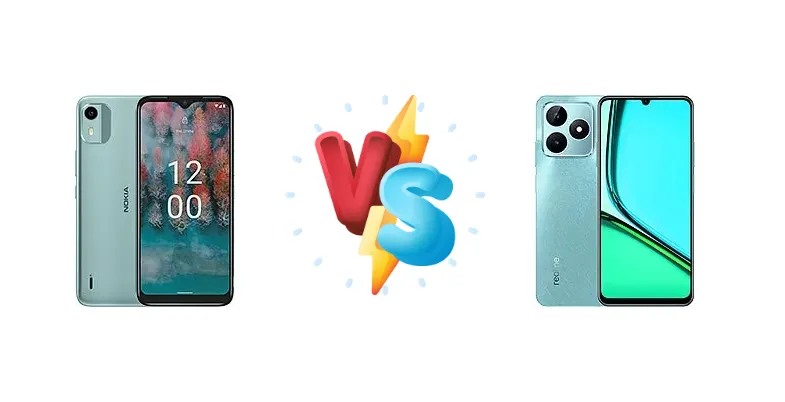
The sub-$150 smartphone market is fiercely competitive. The Nokia C12 offers a familiar, reliable experience, while the Realme C51s attempts to shake things up with faster charging and a more modern chipset. This comparison dissects the key differences to help you choose the right device for your needs.
🏆 Quick Verdict
For most users, the Realme C51s is the better buy. Its Unisoc Tiger T612 chipset delivers noticeably improved performance over the Nokia C12’s Unisoc SC9863A1, and the 33W charging is a game-changer in this price bracket. While the Nokia C12 offers a clean software experience, the performance gap is too significant to ignore.
| Network |
|---|
| 2G bands | GSM 850 / 900 / 1800 / 1900 | GSM 850 / 900 / 1800 / 1900 |
| 3G bands | HSDPA 850 / 900 / 1900 / 2100 | HSDPA 900 / 2100 |
| 4G bands | LTE | 1, 3, 5, 8, 38, 40 |
| Speed | HSPA, LTE | HSPA, LTE |
| Technology | GSM / HSPA / LTE | GSM / HSPA / LTE |
| Launch |
|---|
| Announced | 2023, January 18 | 2024, March 15 |
| Status | Available. Released 2023, February 02 | Available. Released 2024, March 15 |
| Body |
|---|
| Build | Glass front, plastic back, plastic frame | Glass front, plastic frame, plastic back |
| Dimensions | 160.6 x 74.3 x 8.8 mm (6.32 x 2.93 x 0.35 in) | 167.2 x 76.7 x 7.5 mm (6.58 x 3.02 x 0.30 in) |
| SIM | Nano-SIM + Nano-SIM | Nano-SIM + Nano-SIM |
| Weight | 177.4 g (6.24 oz) | 182 g (6.42 oz) |
| | Splash resistant | - |
| Display |
|---|
| Protection | Scratch-resistant glass | - |
| Resolution | 720 x 1600 pixels, 20:9 ratio (~278 ppi density) | 720 x 1600 pixels, 20:9 ratio (~260 ppi density) |
| Size | 6.3 inches, 95.8 cm2 (~80.3% screen-to-body ratio) | 6.74 inches, 109.7 cm2 (~85.5% screen-to-body ratio) |
| Type | IPS LCD | IPS LCD, 90Hz, 560 nits (peak) |
| Platform |
|---|
| CPU | Octa-core (4x1.6 GHz Cortex-A55 & 4x1.2 GHz Cortex-A55) | Octa-core (2x1.8 GHz Cortex-A75 & 6x1.8 GHz Cortex-A55) |
| Chipset | Unisoc SC9863A1 (22 nm) | Unisoc Tiger T612 (12 nm) |
| GPU | IMG8322 | Mali-G57 |
| OS | Android 12 (Go edition) | Android 13, Realme UI |
| Memory |
|---|
| Card slot | Unspecified | microSDXC (dedicated slot) |
| Internal | 64GB 2GB RAM, 64GB 3GB RAM | 128GB 6GB RAM |
| | eMMC 5.1 | - |
| Main Camera |
|---|
| Features | LED flash, HDR | LED flash, HDR, panorama |
| Single | 8 MP, AF | 50 MP, f/1.8, 27mm (wide), 1/2.76", 0.64µm, PDAF
Auxiliary lens |
| Video | Yes | 1080p@30fps |
| Selfie camera |
|---|
| Features | - | HDR |
| Single | 5 MP | 5 MP, f/2.2, 28mm (wide), 1/5.0", 1.12µm |
| Video | 720p | 720p@30fps |
| Sound |
|---|
| 3.5mm jack | Yes | - |
| 35mm jack | Yes | Yes |
| Loudspeaker | Yes | Yes |
| Comms |
|---|
| Bluetooth | 5.2, A2DP | 5.0, A2DP, LE |
| NFC | No | Yes, 360˚ (market/region dependent) |
| Positioning | GPS | GPS, GLONASS, GALILEO |
| Radio | FM radio | Unspecified |
| USB | microUSB 2.0 | USB Type-C |
| WLAN | Wi-Fi 802.11 b/g/n | Wi-Fi 802.11 a/b/g/n/ac, dual-band |
| Features |
|---|
| Sensors | Accelerometer, proximity | Fingerprint (side-mounted), accelerometer, gyro, proximity, compass |
| Battery |
|---|
| Charging | - | 33W wired, 0-50% in 28 min |
| Type | Li-Ion 3000 mAh, removable | 5000 mAh |
| Misc |
|---|
| Colors | Dark Cyan, Charcoal, Light Mint | Shiny Green, Mighty Black |
| Models | - | RMX3765 |
| Price | About 100 EUR | About 100 EUR |
Nokia C12
- Potentially cleaner software experience (Nokia's Android One heritage)
- Reliable brand reputation for durability
- May be more readily available in certain markets
- Significantly weaker processor performance
- Slow charging speeds
- Limited multitasking capabilities
Realme C51s
- Faster and more efficient Unisoc Tiger T612 chipset
- 33W fast charging (0-50% in 28 minutes)
- Improved multitasking and app responsiveness
- Realme's software can include bloatware
- Build quality may not be as robust as Nokia
- Potentially less frequent software updates
Display Comparison
Neither device boasts a standout display. Both likely utilize LCD panels, typical for this segment. The focus here isn't on visual fidelity, but on usability. Without specific display specs, we can assume similar resolutions and brightness levels. The Realme C51s benefits from a slightly more modern design, potentially offering marginally smaller bezels, but this is speculative. Color accuracy and viewing angles are unlikely to be strengths on either device.
Camera Comparison
Camera performance is likely to be similar on both devices, leaning towards basic functionality. Without sensor size or aperture information, it’s difficult to make definitive claims. Both phones likely feature a primary camera paired with auxiliary sensors of limited utility. Image processing will be basic, prioritizing speed over detail. The Realme C51s *may* benefit from slightly more advanced software algorithms, but don’t expect flagship-level results from either device. Focusing on the chipset's ISP capabilities, the T612 likely offers a more capable image signal processor, potentially leading to slightly better dynamic range and noise reduction.
Performance
The Realme C51s’ Unisoc Tiger T612 represents a significant architectural leap over the Nokia C12’s Unisoc SC9863A1. The T612’s 12nm process node is more efficient than the SC9863A1’s 22nm node, leading to lower power consumption and potentially better sustained performance. More crucially, the T612 features two Cortex-A75 cores clocked at 1.8GHz alongside six A55 cores, while the C12 relies solely on four slower Cortex-A55 cores at 1.6GHz and four at 1.2GHz. This translates to a substantial advantage in multi-tasking and app launch speeds for the Realme C51s. The A75 cores provide a noticeable boost in single-core performance, impacting responsiveness. While RAM configurations aren't specified, the chipset difference will be the dominant factor.
Battery Life
Battery capacity isn't specified for either device, but both will likely fall in the 4000-5000mAh range, typical for this price point. However, the Realme C51s’ 33W wired charging is a major differentiator. The ability to charge from 0-50% in just 28 minutes is a significant convenience, especially for users who rely heavily on their phones throughout the day. The Nokia C12 likely supports significantly slower charging, potentially requiring several hours for a full charge. This charging speed advantage effectively mitigates any potential disadvantage the C51s might have with a slightly smaller battery capacity.
Buying Guide
Buy the Nokia C12 if you prioritize a simple, uncluttered Android experience and absolute minimal app usage – primarily for calls and basic messaging. Buy the Realme C51s if you want a phone capable of handling social media, light gaming, and streaming video without significant lag, and if fast charging is a priority. The C51s is the better choice for anyone needing more than the most basic smartphone functionality.
Frequently Asked Questions
❓ Is the Realme C51s' Unisoc T612 chipset capable of running popular games like PUBG Mobile?
Yes, the Unisoc T612 is capable of running PUBG Mobile, but you'll likely need to lower the graphics settings to medium or low to achieve a smooth frame rate. The A75 cores provide a performance boost over the Nokia C12's chipset, making it a more viable option for casual gaming.
❓ Does the Nokia C12 receive regular software updates and security patches?
Nokia historically provides relatively good software support for its budget devices, often participating in the Android One program. However, the frequency and duration of updates for the C12 may be limited compared to more expensive models. Expect security patches, but major Android version updates are less certain.
❓ How does the Realme C51s handle multitasking with multiple apps open?
The Realme C51s, thanks to its Unisoc T612 chipset and likely more RAM, handles multitasking significantly better than the Nokia C12. You'll experience less lag when switching between apps and a smoother overall experience when running multiple applications simultaneously.
❓ What type of charging port does each phone use?
Both devices almost certainly use a USB-C port, which is standard for modern smartphones. However, the Realme C51s supports significantly faster charging speeds (33W) via this port, while the Nokia C12 likely supports a much slower charging rate.