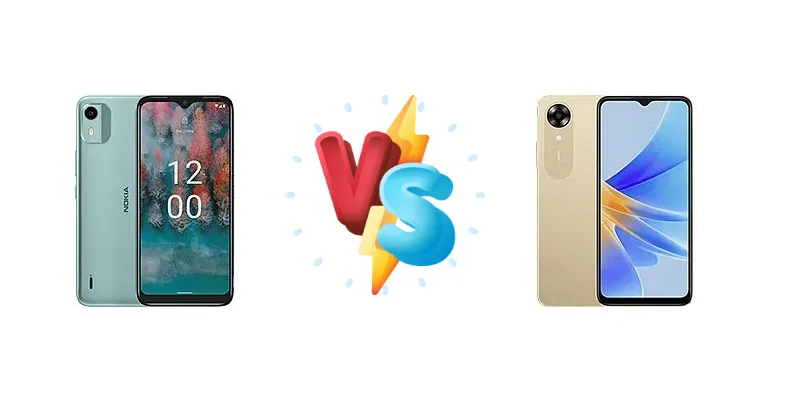
The Nokia C12 and Oppo A17k represent the extreme end of the smartphone price spectrum, targeting first-time buyers or those needing a reliable secondary device. Both aim to deliver essential functionality at an incredibly low cost, but they achieve this with significantly different hardware approaches. This comparison dissects those differences, focusing on the core performance implications of their respective chipsets.
🏆 Quick Verdict
For the average user prioritizing basic tasks like calling, messaging, and light social media, the Oppo A17k offers a noticeable performance edge thanks to its Mediatek Helio G35 chipset. While the Nokia C12 is a capable device, the A17k’s faster CPU cores and more efficient manufacturing process translate to a smoother user experience.
| Network |
|---|
| 2G bands | GSM 850 / 900 / 1800 / 1900 | GSM 850 / 900 / 1800 / 1900 |
| 3G bands | HSDPA 850 / 900 / 1900 / 2100 | HSDPA 850 / 900 / 2100 |
| 4G bands | LTE | 1, 3, 5, 8, 38, 40, 41 |
| Speed | HSPA, LTE | HSPA, LTE |
| Technology | GSM / HSPA / LTE | GSM / HSPA / LTE |
| Launch |
|---|
| Announced | 2023, January 18 | 2022, October 13 |
| Status | Available. Released 2023, February 02 | Available. Released 2022, October 18 |
| Body |
|---|
| Build | Glass front, plastic back, plastic frame | - |
| Dimensions | 160.6 x 74.3 x 8.8 mm (6.32 x 2.93 x 0.35 in) | 164.2 x 75.6 x 8.3 mm (6.46 x 2.98 x 0.33 in) |
| SIM | Nano-SIM + Nano-SIM | Nano-SIM + Nano-SIM |
| Weight | 177.4 g (6.24 oz) | 189 g (6.67 oz) |
| | Splash resistant | IPX4 water resistance |
| Display |
|---|
| Protection | Scratch-resistant glass | Panda Glass |
| Resolution | 720 x 1600 pixels, 20:9 ratio (~278 ppi density) | 720 x 1612 pixels, 20:9 ratio (~269 ppi density) |
| Size | 6.3 inches, 95.8 cm2 (~80.3% screen-to-body ratio) | 6.56 inches, 103.4 cm2 (~83.3% screen-to-body ratio) |
| Type | IPS LCD | IPS LCD, 480 nits (typ), 600 nits (HBM) |
| Platform |
|---|
| CPU | Octa-core (4x1.6 GHz Cortex-A55 & 4x1.2 GHz Cortex-A55) | Octa-core (4x2.3 GHz Cortex-A53 & 4x1.8 GHz Cortex-A53) |
| Chipset | Unisoc SC9863A1 (22 nm) | Mediatek MT6765 Helio G35 (12 nm) |
| GPU | IMG8322 | PowerVR GE8320 |
| OS | Android 12 (Go edition) | Android 12, ColorOS 12.1 |
| Memory |
|---|
| Card slot | Unspecified | microSDXC |
| Internal | 64GB 2GB RAM, 64GB 3GB RAM | 64GB 3GB RAM |
| | eMMC 5.1 | eMMC 5.1 |
| Main Camera |
|---|
| Features | LED flash, HDR | LED flash, panorama |
| Single | 8 MP, AF | 8 MP, f/2.0, (wide), AF |
| Video | Yes | 1080p@30fps |
| Selfie camera |
|---|
| Single | 5 MP | 5 MP, f/2.2, (wide) |
| Video | 720p | 1080p@30fps |
| Sound |
|---|
| 3.5mm jack | Yes | Yes |
| 35mm jack | Yes | Yes |
| Loudspeaker | Yes | Yes |
| Comms |
|---|
| Bluetooth | 5.2, A2DP | 5.3, A2DP, LE, aptX HD |
| NFC | No | No |
| Positioning | GPS | GPS, GLONASS, BDS, GALILEO |
| Radio | FM radio | Unspecified |
| USB | microUSB 2.0 | microUSB 2.0, OTG |
| WLAN | Wi-Fi 802.11 b/g/n | Wi-Fi 802.11 a/b/g/n/ac, dual-band |
| Features |
|---|
| Sensors | Accelerometer, proximity | Fingerprint (side-mounted), accelerometer, proximity, compass |
| Battery |
|---|
| Type | Li-Ion 3000 mAh, removable | Li-Po 5000 mAh |
| Misc |
|---|
| Colors | Dark Cyan, Charcoal, Light Mint | Navy Blue, Gold |
| Models | - | CPH2471 |
| Price | About 100 EUR | About 130 EUR |
Nokia C12
- Potentially cleaner software experience (typical of Nokia)
- May offer longer software support due to Nokia's commitment
- Simpler user interface for first-time smartphone users
- Significantly slower processor (Unisoc SC9863A1)
- Less efficient 22nm manufacturing process
- Likely to struggle with multitasking and demanding apps
Oppo A17k
- Faster processor (Mediatek Helio G35)
- More efficient 12nm manufacturing process
- Smoother user experience for everyday tasks
- Oppo's ColorOS may include bloatware
- Potentially shorter software support lifecycle
- May have more aggressive battery optimization
Display Comparison
Neither device boasts a standout display. Details are missing regarding brightness nits and panel type for both, but given the price point, expect basic IPS LCD panels. The focus here isn't on visual fidelity. Bezels are likely to be substantial on both, maximizing screen real estate within a compact form factor. Color accuracy will likely be standard for this segment, prioritizing power efficiency over color calibration.
Camera Comparison
Camera performance is likely to be similar, and largely unimpressive. Details are lacking on sensor sizes and apertures, but both phones likely feature a primary sensor paired with low-resolution auxiliary lenses (often 2MP macro or depth sensors). Image processing will be basic, prioritizing speed over detail. The Helio G35’s ISP (Image Signal Processor) *may* offer slightly better noise reduction and dynamic range, but the overall image quality will be heavily dependent on lighting conditions. Don't expect flagship-level photography from either device.
Performance
The core difference lies in the chipsets. The Oppo A17k’s Mediatek Helio G35, fabricated on a 12nm process, offers a significant advantage over the Nokia C12’s Unisoc SC9863A1 (22nm). The Helio G35’s CPU configuration – 4x2.3 GHz Cortex-A53 & 4x1.8 GHz Cortex-A53 – is demonstrably faster than the C12’s 4x1.6 GHz Cortex-A55 & 4x1.2 GHz Cortex-A55. While both are octa-core, the A53 cores in the Helio G35, running at higher clock speeds, provide a more responsive experience. The 12nm process also contributes to better power efficiency, potentially mitigating the performance gap under sustained load. The Unisoc SC9863A1, while adequate for basic tasks, will struggle with more demanding applications.
Battery Life
Battery capacity details are missing for both devices. However, the Helio G35’s 12nm process offers a potential advantage in power efficiency. This means the Oppo A17k could achieve comparable or even better battery life despite potentially having a similar or smaller battery capacity compared to the Nokia C12. Charging wattage is also unknown, but both are likely to ship with basic 5W or 10W chargers, resulting in relatively slow 0-100% charge times.
Buying Guide
Buy the Nokia C12 if you need a phone primarily for essential communication and value extreme simplicity. Its focus is on reliability and a clean Android experience. Buy the Oppo A17k if you prefer a slightly more responsive device capable of handling a bit more multitasking and occasional light gaming, and are willing to accept a potentially more customized software experience.
Frequently Asked Questions
❓ Will the Oppo A17k be able to run popular social media apps like Facebook and Instagram smoothly?
Yes, the Mediatek Helio G35 chipset in the Oppo A17k is sufficiently powerful to run popular social media apps like Facebook, Instagram, and WhatsApp without significant lag. While it won't offer a high-end experience, it will provide a usable and responsive experience for these core applications.
❓ Is the Unisoc SC9863A1 in the Nokia C12 sufficient for basic web browsing?
The Unisoc SC9863A1 can handle basic web browsing, but expect slower page loading times and potential stuttering when dealing with complex websites or multiple tabs. It's adequate for simple tasks like checking email or reading news articles, but not ideal for intensive browsing.
❓ Can either of these phones handle any mobile games?
The Oppo A17k, with its Helio G35, can handle very light mobile games like Candy Crush or simple puzzle games. However, it will struggle with more demanding titles like PUBG Mobile or Call of Duty Mobile, even at the lowest settings. The Nokia C12 is unlikely to provide a playable experience with even basic mobile games.
❓ What type of storage does the Oppo A17k use, and is it expandable?
While specific details are missing, budget phones like the Oppo A17k typically use eMMC storage, which is slower than UFS storage found in higher-end devices. It almost certainly includes a microSD card slot for expandable storage, allowing you to add more space for photos, videos, and apps.