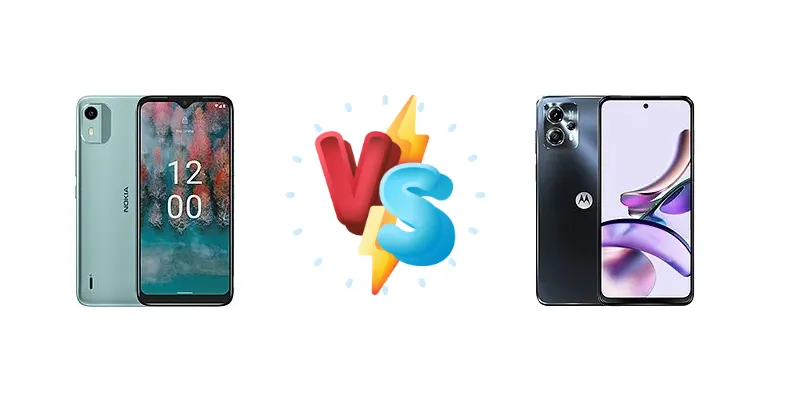
The sub-$150 smartphone market is fiercely competitive. Both the Nokia C12 and Motorola Moto G13 aim to deliver essential smartphone functionality at an accessible price point. However, they take different approaches to achieving this, with the Moto G13 leveraging a more powerful chipset while the Nokia C12 focuses on simplicity and affordability. This comparison will dissect their key differences to help you choose the right device.
🏆 Quick Verdict
For most users, the Motorola Moto G13 is the superior choice. Its Mediatek Helio G85 chipset, built on a more efficient 12nm process, provides a noticeable performance boost over the Nokia C12’s Unisoc SC9863A1, making it better suited for multitasking and light gaming. While the Nokia C12 offers a slightly cleaner software experience, the G13’s performance advantage outweighs this benefit.
| Network |
|---|
| 2G bands | GSM 850 / 900 / 1800 / 1900 | GSM 850 / 900 / 1800 / 1900 |
| 3G bands | HSDPA 850 / 900 / 1900 / 2100 | HSDPA 850 / 900 / 1900 / 2100 |
| 4G bands | LTE | 1, 2, 3, 5, 7, 8, 20, 38, 40, 41 |
| Speed | HSPA, LTE | HSPA, LTE |
| Technology | GSM / HSPA / LTE | GSM / HSPA / LTE |
| Launch |
|---|
| Announced | 2023, January 18 | 2023, January 24 |
| Status | Available. Released 2023, February 02 | Available. Released 2023, January 24 |
| Body |
|---|
| Build | Glass front, plastic back, plastic frame | Glass front, plastic frame, plastic back |
| Dimensions | 160.6 x 74.3 x 8.8 mm (6.32 x 2.93 x 0.35 in) | 162.7 x 74.7 x 8.2 mm (6.41 x 2.94 x 0.32 in) |
| SIM | Nano-SIM + Nano-SIM | · Nano-SIM· Nano-SIM + Nano-SIM |
| Weight | 177.4 g (6.24 oz) | 183.5 g (6.49 oz) |
| | Splash resistant | Water-resistant design |
| Display |
|---|
| Protection | Scratch-resistant glass | Panda glass |
| Resolution | 720 x 1600 pixels, 20:9 ratio (~278 ppi density) | 720 x 1600 pixels, 20:9 ratio (~270 ppi density) |
| Size | 6.3 inches, 95.8 cm2 (~80.3% screen-to-body ratio) | 6.5 inches, 102.0 cm2 (~83.9% screen-to-body ratio) |
| Type | IPS LCD | IPS LCD, 90Hz, 400 nits (peak) |
| Platform |
|---|
| CPU | Octa-core (4x1.6 GHz Cortex-A55 & 4x1.2 GHz Cortex-A55) | Octa-core (2x2.0 GHz Cortex-A75 & 6x1.8 GHz Cortex-A55) |
| Chipset | Unisoc SC9863A1 (22 nm) | Mediatek MT6769Z Helio G85 (12 nm) |
| GPU | IMG8322 | Mali-G52 MC2 |
| OS | Android 12 (Go edition) | Android 13 |
| Memory |
|---|
| Card slot | Unspecified | microSDXC (dedicated slot) |
| Internal | 64GB 2GB RAM, 64GB 3GB RAM | 64GB 4GB RAM, 128GB 4GB RAM |
| | eMMC 5.1 | - |
| Main Camera |
|---|
| Features | LED flash, HDR | LED flash, HDR, panorama |
| Single | 8 MP, AF | - |
| Triple | - | 50 MP, f/1.8, (wide), 0.64µm, PDAF
2 MP (macro)
Auxiliary lens |
| Video | Yes | 1080p@30fps |
| Selfie camera |
|---|
| Single | 5 MP | 8 MP, f/2.0, (wide), 1/4.0", 1.12µm |
| Video | 720p | 1080p@30fps |
| Sound |
|---|
| 3.5mm jack | Yes | Yes |
| 35mm jack | Yes | Yes |
| Loudspeaker | Yes | Yes, with stereo speakers |
| Comms |
|---|
| Bluetooth | 5.2, A2DP | 5.1, A2DP, LE |
| NFC | No | Yes (market/region dependent) |
| Positioning | GPS | GPS, GLONASS, GALILEO |
| Radio | FM radio | Unspecified |
| USB | microUSB 2.0 | USB Type-C 2.0 |
| WLAN | Wi-Fi 802.11 b/g/n | Wi-Fi 802.11 a/b/g/n/ac, dual-band |
| Features |
|---|
| Sensors | Accelerometer, proximity | Fingerprint (side-mounted), accelerometer, gyro, proximity |
| Battery |
|---|
| Charging | - | 20W or 10W wired |
| Type | Li-Ion 3000 mAh, removable | Li-Po 5000 mAh |
| Misc |
|---|
| Colors | Dark Cyan, Charcoal, Light Mint | Matte Charcoal, Blue Lavender, Rose Gold |
| Price | About 100 EUR | About 160 EUR |
Nokia C12
- Extremely affordable price point
- Simple and clean software experience (likely)
- Potentially longer battery life during light use
- Significantly weaker performance
- Outdated chipset architecture
- Limited multitasking capabilities
Motorola Moto G13
- More powerful Mediatek Helio G85 chipset
- Faster 20W (or 10W) charging
- Smoother multitasking and app performance
- Slightly higher price point
- Potentially more bloatware (Motorola's history)
- May not offer the absolute longest battery life under heavy load
Display Comparison
Neither device boasts a standout display. Both likely utilize LCD panels, common in this price bracket. However, the focus here is on processing power, not pixel density. The Nokia C12’s display specs are not provided, but given its price point, it’s likely a lower resolution panel. The Moto G13’s display details are also missing, but the more powerful chipset suggests it could handle a slightly more demanding display workload without significant performance impact. Bezels are expected to be substantial on both devices, reflecting their budget nature.
Camera Comparison
Camera performance is likely to be similar on both devices, with both likely featuring a primary sensor and potentially a secondary depth or macro lens. Given the price point, image quality will be heavily reliant on software processing. The Moto G13’s more powerful chipset *could* allow for slightly more sophisticated image processing algorithms, but the sensor quality will be the primary limiting factor. Without specific sensor details, it’s difficult to declare a clear winner. The inclusion of a 2MP macro camera on either device is largely a marketing gimmick and offers limited practical benefit.
Performance
The core difference lies in the chipsets. The Motorola Moto G13’s Mediatek Helio G85 (12nm) is a significant upgrade over the Nokia C12’s Unisoc SC9863A1 (22nm). The Helio G85 features a more modern CPU architecture – 2x2.0 GHz Cortex-A75 cores alongside 6x1.8 GHz Cortex-A55 cores – compared to the C12’s 4x1.6 GHz Cortex-A55 and 4x1.2 GHz Cortex-A55 configuration. This translates to faster app launch times, smoother multitasking, and a more responsive user interface on the Moto G13. The 12nm process node of the Helio G85 also contributes to better power efficiency, potentially leading to longer battery life under load. The Unisoc SC9863A1 is designed for basic tasks and will struggle with demanding applications.
Battery Life
Battery capacity details are missing for both devices. However, the Moto G13’s 20W (or 10W) charging capability is a significant advantage. Faster charging reduces downtime and provides more flexibility. While the Nokia C12 likely charges at a slower rate, the less powerful chipset may offset this with lower power consumption during typical use. The Helio G85’s 12nm process also contributes to better efficiency, potentially extending battery life despite the faster charging and more demanding performance.
Buying Guide
Buy the Nokia C12 if you prioritize extreme affordability and a very basic smartphone experience for essential tasks like calls, texts, and light social media. It’s ideal for first-time smartphone users or as a reliable backup device. Buy the Motorola Moto G13 if you want a more responsive and capable device for everyday use, including smoother app switching, occasional gaming, and a more future-proof experience. The G13 is the better option for users who demand more than the bare minimum.
Frequently Asked Questions
❓ Will the Motorola Moto G13 handle popular games like PUBG Mobile or Call of Duty Mobile?
The Helio G85 in the Moto G13 is capable of running PUBG Mobile and Call of Duty Mobile, but you’ll likely need to play at lower graphics settings (Medium or Low) to maintain a stable frame rate. Expect some occasional stuttering during intense firefights. The Nokia C12’s Unisoc SC9863A1 will struggle significantly with these titles.
❓ Does the Motorola Moto G13 support fast charging, and how long does it take to fully charge?
The Moto G13 supports 20W or 10W wired charging. With 20W charging, a full charge from 0% to 100% will likely take around 1.5 to 2 hours, depending on usage during charging. The Nokia C12 likely charges at a slower rate, potentially taking over 3 hours for a full charge.
❓ Is the software on the Nokia C12 closer to stock Android than the Motorola Moto G13?
The Nokia C12 generally offers a cleaner software experience with fewer pre-installed apps compared to Motorola. Motorola is known to include some bloatware and its own customizations, although it has become less intrusive in recent years. However, the performance difference between the chipsets is more impactful than the software differences.