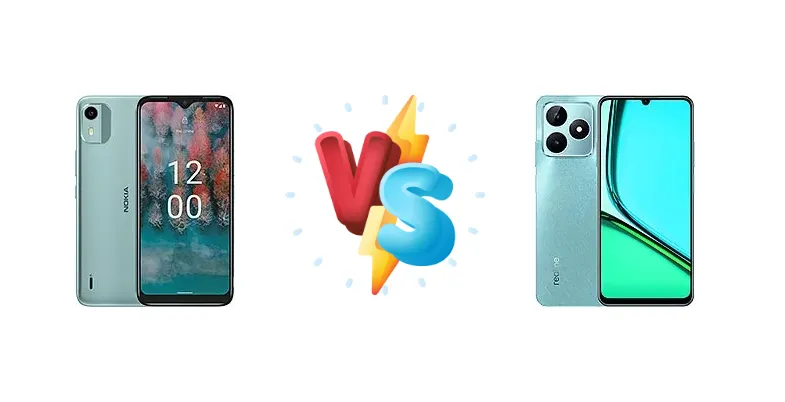
The sub-$150 smartphone market is fiercely competitive. The Nokia C12 Pro and Realme C51s both aim to deliver essential smartphone functionality at an accessible price point, but they take different approaches. The C12 Pro focuses on a clean software experience, while the C51s prioritizes faster charging and a more modern chipset. This comparison dissects their key differences to determine which device offers the best value.
🏆 Quick Verdict
For most users, the Realme C51s is the better choice. Its Unisoc Tiger T612 chipset provides a noticeable performance uplift over the Nokia C12 Pro’s SC9863A1, and the 33W fast charging is a game-changer in this price segment. While the Nokia offers a potentially cleaner software experience, the Realme’s hardware advantages are too significant to ignore.
| Network |
|---|
| 2G bands | GSM 850 / 900 / 1800 / 1900 | GSM 850 / 900 / 1800 / 1900 |
| 3G bands | HSDPA 850 / 900 / 1900 / 2100 | HSDPA 900 / 2100 |
| 4G bands | LTE | 1, 3, 5, 8, 38, 40 |
| Speed | HSPA, LTE | HSPA, LTE |
| Technology | GSM / HSPA / LTE | GSM / HSPA / LTE |
| Launch |
|---|
| Announced | 2023, March 21 | 2024, March 15 |
| Status | Available. Released 2023, March 21 | Available. Released 2024, March 15 |
| Body |
|---|
| Build | Glass front, plastic back, plastic frame | Glass front, plastic frame, plastic back |
| Dimensions | 160.6 x 74.3 x 8.8 mm (6.32 x 2.93 x 0.35 in) | 167.2 x 76.7 x 7.5 mm (6.58 x 3.02 x 0.30 in) |
| SIM | Nano-SIM + Nano-SIM | Nano-SIM + Nano-SIM |
| Weight | 177.4 g (6.24 oz) | 182 g (6.42 oz) |
| | Splash resistant | - |
| Display |
|---|
| Protection | Scratch-resistant glass | - |
| Resolution | 720 x 1600 pixels, 20:9 ratio (~278 ppi density) | 720 x 1600 pixels, 20:9 ratio (~260 ppi density) |
| Size | 6.3 inches, 95.8 cm2 (~80.3% screen-to-body ratio) | 6.74 inches, 109.7 cm2 (~85.5% screen-to-body ratio) |
| Type | IPS LCD | IPS LCD, 90Hz, 560 nits (peak) |
| Platform |
|---|
| CPU | Octa-core (4x1.6 GHz Cortex-A55 & 4x1.2 GHz Cortex-A55) | Octa-core (2x1.8 GHz Cortex-A75 & 6x1.8 GHz Cortex-A55) |
| Chipset | Unisoc SC9863A1 (22 nm) | Unisoc Tiger T612 (12 nm) |
| GPU | IMG8322 | Mali-G57 |
| OS | Android 12 (Go edition) | Android 13, Realme UI |
| Memory |
|---|
| Card slot | Unspecified | microSDXC (dedicated slot) |
| Internal | 64GB 2GB RAM, 64GB 3GB RAM, 64GB 4GB RAM | 128GB 6GB RAM |
| | eMMC 5.1 | - |
| Main Camera |
|---|
| Features | LED flash, HDR | LED flash, HDR, panorama |
| Single | 8 MP, AF | 50 MP, f/1.8, 27mm (wide), 1/2.76", 0.64µm, PDAF
Auxiliary lens |
| Video | Yes | 1080p@30fps |
| Selfie camera |
|---|
| Features | - | HDR |
| Single | 5 MP | 5 MP, f/2.2, 28mm (wide), 1/5.0", 1.12µm |
| Video | 720p | 720p@30fps |
| Sound |
|---|
| 3.5mm jack | Yes | - |
| 35mm jack | Yes | Yes |
| Loudspeaker | Yes | Yes |
| Comms |
|---|
| Bluetooth | 5.2, A2DP | 5.0, A2DP, LE |
| NFC | No | Yes, 360˚ (market/region dependent) |
| Positioning | GPS | GPS, GLONASS, GALILEO |
| Radio | Wireless FM radio | Unspecified |
| USB | microUSB 2.0 | USB Type-C |
| WLAN | Wi-Fi 802.11 b/g/n | Wi-Fi 802.11 a/b/g/n/ac, dual-band |
| Features |
|---|
| Sensors | Accelerometer, proximity | Fingerprint (side-mounted), accelerometer, gyro, proximity, compass |
| Battery |
|---|
| Charging | 10W wired | 33W wired, 0-50% in 28 min |
| Type | Li-Ion 4000 mAh, removable | 5000 mAh |
| Misc |
|---|
| Colors | Dark Cyan, Charcoal, Light Mint | Shiny Green, Mighty Black |
| Models | - | RMX3765 |
| Price | About 80 EUR | About 100 EUR |
Nokia C12 Pro
- Potentially cleaner software experience (Nokia's strength)
- May offer longer software support (Nokia's brand promise)
- Simple and straightforward user interface
- Significantly slower processor
- Slow 10W charging
- Less responsive user experience
Realme C51s
- Faster and more efficient Unisoc Tiger T612 chipset
- 33W fast charging (0-50% in 28 minutes)
- Smoother multitasking and app performance
- Realme UI may include bloatware
- Potentially shorter software support compared to Nokia
- Build quality may be less premium
Display Comparison
Neither device boasts a standout display. Both likely utilize LCD panels, common in this price bracket. However, the focus here is on the underlying performance impact. Display specs are not provided, so we can only infer. The Realme C51s’s more powerful chipset will likely handle UI animations and video playback more smoothly, indirectly improving the perceived display experience. Bezels are likely similar on both, given their target market.
Camera Comparison
Without detailed camera specifications, a direct comparison is difficult. However, it’s safe to assume both phones feature basic camera setups geared towards casual photography. The Realme C51s, benefiting from its more powerful chipset, will likely have superior image processing capabilities, resulting in better dynamic range and noise reduction. The Nokia C12 Pro’s image processing will likely be more basic, potentially leading to softer images and less detail. The presence of a 2MP macro camera on either device is largely a marketing gimmick and shouldn’t heavily influence purchasing decisions.
Performance
The Realme C51s’s Unisoc Tiger T612 is the clear winner here. Built on a 12nm process, it features a more modern CPU configuration with 2x 1.8 GHz Cortex-A75 cores alongside 6x 1.8 GHz Cortex-A55 cores. This contrasts with the Nokia C12 Pro’s Unisoc SC9863A1, fabricated on a less efficient 22nm process, and utilizing 4x 1.6 GHz Cortex-A55 and 4x 1.2 GHz Cortex-A55 cores. The A75 cores in the Realme chip offer significantly higher single-core performance, translating to snappier app launches and smoother multitasking. The 12nm process also contributes to better power efficiency, potentially extending battery life despite the performance gains.
Battery Life
The Realme C51s’s 33W wired charging is a massive advantage. The ability to charge from 0-50% in just 28 minutes is a significant convenience, especially for users who rely heavily on their phones throughout the day. The Nokia C12 Pro’s 10W charging is comparatively slow, requiring considerably more time to reach a full charge. While battery capacity isn’t specified for either device, the Realme’s more efficient chipset and faster charging capabilities effectively mitigate any potential capacity differences.
Buying Guide
Buy the Nokia C12 Pro if you prioritize a potentially cleaner, more stock Android experience and are willing to sacrifice performance and charging speed. This phone suits users who primarily need a device for basic communication and light tasks. Buy the Realme C51s if you value performance for social media, streaming, and casual gaming, and if fast charging is a must-have feature. This is the better option for users who want a more responsive and versatile device.
Frequently Asked Questions
❓ Will the Realme C51s struggle with demanding games like PUBG Mobile?
While the Unisoc Tiger T612 isn't a gaming powerhouse, it's capable of running PUBG Mobile at medium settings with reasonable frame rates. Expect some occasional stuttering, but it's a playable experience, significantly better than what the Nokia C12 Pro can offer.
❓ Is the software on the Nokia C12 Pro truly bloatware-free?
Nokia traditionally offers a cleaner Android experience, but it's not entirely bloatware-free. You may find some pre-installed Google apps and potentially some Nokia-branded utilities. However, it's generally less intrusive than the software experience on many other budget Android phones.
❓ How does the 22nm process of the Unisoc SC9863A1 affect battery life on the Nokia C12 Pro?
The 22nm process is less efficient than the 12nm process used in the Realme C51s’s chipset. This means the Nokia C12 Pro’s processor consumes more power for the same level of performance, potentially leading to shorter battery life, even if the battery capacity is similar.
❓ Does the Realme C51s support reverse charging?
Based on available information, the Realme C51s does not appear to support reverse charging. This feature is uncommon in this price segment.