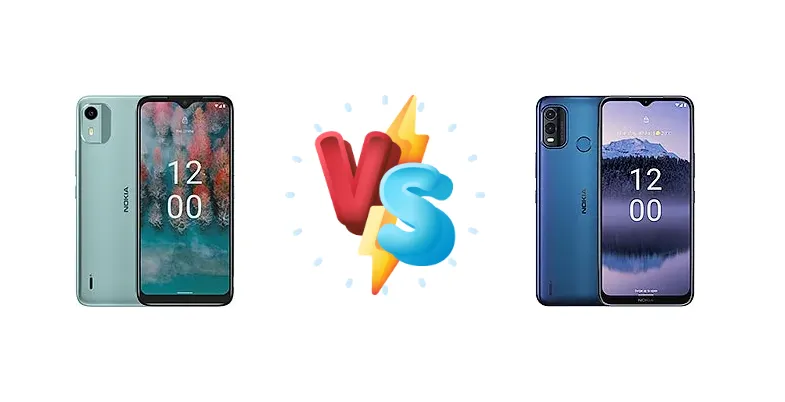
Nokia's C-series and G-series represent their entry-level and mainstream budget offerings, respectively. The C12 Pro and G11 Plus both aim to deliver affordability, but diverge in their internal hardware. This comparison dissects the key differences between the Unisoc-powered devices, focusing on performance, efficiency, and the user experience they deliver.
🏆 Quick Verdict
For the average user prioritizing sustained performance and slightly better efficiency, the Nokia G11 Plus is the better choice. Its Unisoc T606 chipset, built on a 12nm process, offers a more capable CPU configuration than the C12 Pro’s SC9863A1, despite both phones sharing a 10W charging rate.
| Network |
|---|
| 2G bands | GSM 850 / 900 / 1800 / 1900 | GSM 850 / 900 / 1800 / 1900 |
| 3G bands | HSDPA 850 / 900 / 1900 / 2100 | HSDPA 850 / 900 / 2100 - International |
| 4G bands | LTE | 1, 3, 5, 7, 8, 20, 28, 38, 40, 41 - International |
| Speed | HSPA, LTE | HSPA 42.2/5.76 Mbps, LTE Cat4 150/50 Mbps |
| Technology | GSM / HSPA / LTE | GSM / HSPA / LTE |
| | - | 1, 3, 5, 8, 40, 41 - India |
| Launch |
|---|
| Announced | 2023, March 21 | 2022, June 29 |
| Status | Available. Released 2023, March 21 | Available. Released 2022, July 20 |
| Body |
|---|
| Build | Glass front, plastic back, plastic frame | Glass front, plastic frame, plastic back |
| Dimensions | 160.6 x 74.3 x 8.8 mm (6.32 x 2.93 x 0.35 in) | 164.8 x 75.9 x 8.6 mm (6.49 x 2.99 x 0.34 in) |
| SIM | Nano-SIM + Nano-SIM | · Nano-SIM· Nano-SIM + Nano-SIM |
| Weight | 177.4 g (6.24 oz) | 192 g (6.77 oz) |
| | Splash resistant | Splash protection |
| Display |
|---|
| Protection | Scratch-resistant glass | - |
| Resolution | 720 x 1600 pixels, 20:9 ratio (~278 ppi density) | 720 x 1600 pixels, 20:9 ratio (~269 ppi density) |
| Size | 6.3 inches, 95.8 cm2 (~80.3% screen-to-body ratio) | 6.52 inches, 102.6 cm2 (~82.1% screen-to-body ratio) |
| Type | IPS LCD | IPS LCD, 90Hz, 400 nits (typ) |
| Platform |
|---|
| CPU | Octa-core (4x1.6 GHz Cortex-A55 & 4x1.2 GHz Cortex-A55) | Octa-core (2x1.6 GHz Cortex-A75 & 6x1.6 GHz Cortex-A55) |
| Chipset | Unisoc SC9863A1 (22 nm) | Unisoc T606 (12 nm) |
| GPU | IMG8322 | Mali-G57 MP1 |
| OS | Android 12 (Go edition) | Android 12, upgradable to Android 13 |
| Memory |
|---|
| Card slot | Unspecified | microSDXC (dedicated slot) |
| Internal | 64GB 2GB RAM, 64GB 3GB RAM, 64GB 4GB RAM | 32GB 3GB RAM, 64GB 3GB RAM, 64GB 4GB RAM, 128GB 3GB RAM |
| | eMMC 5.1 | eMMC 5.1 |
| Main Camera |
|---|
| Dual | - | 50 MP, f/1.8, (wide), 1/2.67", PDAF
Auxiliary lens |
| Features | LED flash, HDR | LED flash |
| Single | 8 MP, AF | 8 MP, f/2.0, (wide), 1/4.0" |
| Video | Yes | 1080p@30fps |
| Selfie camera |
|---|
| Single | 5 MP | 8 MP, f/2.0, (wide), 1/4.0" |
| Video | 720p | 1080p@30fps |
| Sound |
|---|
| 3.5mm jack | Yes | Yes |
| 35mm jack | Yes | Yes |
| Loudspeaker | Yes | Yes |
| Comms |
|---|
| Bluetooth | 5.2, A2DP | 5.0, A2DP, LE |
| NFC | No | No |
| Positioning | GPS | GPS |
| Radio | Wireless FM radio | FM radio |
| USB | microUSB 2.0 | USB Type-C 2.0, OTG |
| WLAN | Wi-Fi 802.11 b/g/n | Wi-Fi 802.11 a/b/g/n/ac, dual-band, Wi-Fi Direct |
| Features |
|---|
| Sensors | Accelerometer, proximity | Fingerprint (rear-mounted), accelerometer, proximity |
| Battery |
|---|
| Charging | 10W wired | 10W wired |
| Type | Li-Ion 4000 mAh, removable | Li-Ion 5000 mAh |
| Misc |
|---|
| Colors | Dark Cyan, Charcoal, Light Mint | Lake Blue, Charcoal Grey |
| Price | About 80 EUR | About 130 EUR |
Nokia C12 Pro
- Potentially lower price point
- Simple and straightforward user experience
- Adequate for basic tasks
- Less powerful processor
- Lower power efficiency
- Slower app loading times
Nokia G11 Plus
- More powerful and efficient processor
- Better multitasking capabilities
- Improved responsiveness
- Slightly higher price
- 10W charging remains slow
- Still a budget device with limitations
Display Comparison
Neither Nokia provides detailed display specifications beyond resolution. However, both likely utilize LCD panels common in this price bracket. The absence of high refresh rates or advanced features like LTPO is expected. Bezels are likely comparable, focusing on cost reduction rather than premium aesthetics. Color accuracy will likely be standard for budget devices, prioritizing power saving over color fidelity.
Camera Comparison
Detailed camera specs are unavailable, but both phones likely feature basic camera setups geared towards casual photography. Without sensor size or aperture information, it’s difficult to make a definitive judgment. However, the image signal processor (ISP) within the Unisoc T606 of the G11 Plus is likely more advanced than that of the SC9863A1, potentially leading to better image processing and low-light performance. The inclusion of a 2MP macro camera on either device is largely a marketing feature with limited practical benefit.
Performance
The core difference lies in the chipsets. The Nokia G11 Plus’s Unisoc T606 (12nm) features a more modern CPU configuration: 2x 1.6 GHz Cortex-A75 cores alongside 6x 1.6 GHz Cortex-A55 cores. This contrasts with the C12 Pro’s Unisoc SC9863A1 (22nm) which uses 4x 1.6 GHz Cortex-A55 and 4x 1.2 GHz Cortex-A55 cores. The A75 cores in the G11 Plus provide a significant performance boost in single-core tasks and offer better responsiveness. The 12nm fabrication process of the T606 also contributes to improved power efficiency compared to the older 22nm process of the SC9863A1, meaning less heat and potentially longer sustained performance. While both phones likely feature similar RAM configurations, the chipset difference will be the primary determinant of overall speed.
Battery Life
Both devices share a 10W wired charging rate, indicating similar charging speeds. While battery capacity isn't specified, the more efficient Unisoc T606 in the G11 Plus will likely translate to longer battery life in real-world usage. The 12nm process node consumes less power than the 22nm node of the C12 Pro’s chipset, even with similar usage patterns. Expect both phones to require several hours for a full charge from 0-100%.
Buying Guide
Buy the Nokia C12 Pro if you need a basic smartphone for essential tasks like calls, messaging, and light social media use, and are prioritizing the absolute lowest price point. Buy the Nokia G11 Plus if you prefer a device capable of handling more demanding apps, multitasking, and occasional gaming, and value a more responsive user experience, even if it means a slightly higher initial investment.
Frequently Asked Questions
❓ Will the Nokia G11 Plus handle popular games like PUBG Mobile?
While the Unisoc T606 isn't a gaming powerhouse, the Nokia G11 Plus can run PUBG Mobile at lower settings. Expect frame rate drops during intense action, but it's playable. The C12 Pro will struggle significantly with this title.
❓ How much of a difference will the 12nm vs 22nm process node make in real-world battery life?
The 12nm process node used in the Unisoc T606 is significantly more efficient than the 22nm process in the SC9863A1. This translates to roughly 10-20% longer battery life under similar usage conditions, meaning you'll likely get through a full day with the G11 Plus more reliably.
❓ Are software updates guaranteed for either of these devices?
Nokia typically provides a limited number of software updates for their budget devices. Expect at least one major Android version update, but long-term support is not guaranteed. Check Nokia's official website for the latest update information for each model.
❓ Is the difference in CPU cores (A75 vs A55) noticeable in everyday tasks?
Yes, the inclusion of Cortex-A75 cores in the G11 Plus's chipset makes a noticeable difference in responsiveness. Apps will launch faster, multitasking will be smoother, and the overall user experience will feel more fluid compared to the C12 Pro.