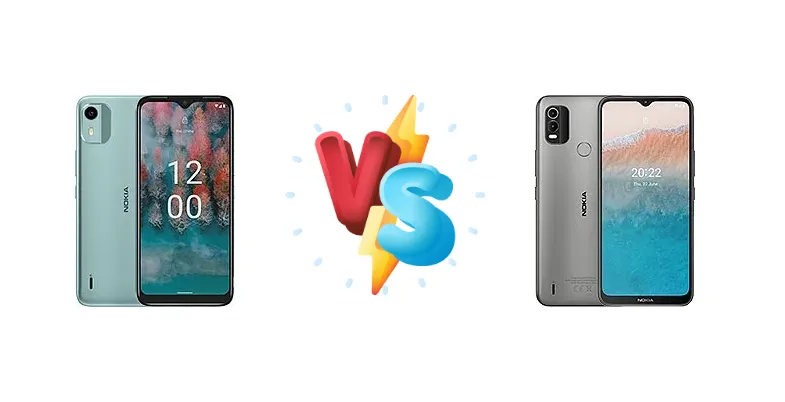
Nokia's C-series aims to deliver affordability without completely sacrificing usability. The C12 Pro and C21 Plus represent two points within that spectrum, both powered by Unisoc chipsets but differing in fabrication process. This comparison dissects those differences, focusing on how the seemingly minor change from a 28nm to a 22nm process impacts real-world performance and user experience.
🏆 Quick Verdict
For most users, the Nokia C12 Pro offers a slight edge due to its more efficient Unisoc SC9863A1 chipset. The 22nm process allows for potentially better thermal management and sustained performance, even though both phones share the same CPU core configuration. The C21 Plus remains a viable option if price is the absolute primary concern.
| Network |
|---|
| 2G bands | GSM 850 / 900 / 1800 / 1900 | GSM 850 / 900 / 1800 / 1900 |
| 3G bands | HSDPA 850 / 900 / 1900 / 2100 | HSDPA 850 / 900 / 2100 |
| 4G bands | LTE | LTE |
| Speed | HSPA, LTE | HSPA 42.2/5.76 Mbps, LTE Cat4 150/50 Mbps |
| Technology | GSM / HSPA / LTE | GSM / HSPA / LTE |
| | - | HSDPA 850 / 900 / 1700(AWS) / 1900 / 2100 |
| Launch |
|---|
| Announced | 2023, March 21 | 2022, February 28 |
| Status | Available. Released 2023, March 21 | Available. Released 2022, April 29 |
| Body |
|---|
| Build | Glass front, plastic back, plastic frame | Glass front, aluminum frame, plastic back |
| Dimensions | 160.6 x 74.3 x 8.8 mm (6.32 x 2.93 x 0.35 in) | 164.8 x 75.9 x 8.6 mm (6.49 x 2.99 x 0.34 in) |
| SIM | Nano-SIM + Nano-SIM | · Nano-SIM· Nano-SIM + Nano-SIM |
| Weight | 177.4 g (6.24 oz) | 178 g or 191 g (6.28 oz) |
| | Splash resistant | Splash protection |
| Display |
|---|
| Protection | Scratch-resistant glass | Scratch-resistant glass |
| Resolution | 720 x 1600 pixels, 20:9 ratio (~278 ppi density) | 720 x 1600 pixels, 20:9 ratio (~269 ppi density) |
| Size | 6.3 inches, 95.8 cm2 (~80.3% screen-to-body ratio) | 6.52 inches, 102.6 cm2 (~82.1% screen-to-body ratio) |
| Type | IPS LCD | IPS LCD |
| Platform |
|---|
| CPU | Octa-core (4x1.6 GHz Cortex-A55 & 4x1.2 GHz Cortex-A55) | Octa-core (4x1.6 GHz Cortex-A55 & 4x1.2 GHz Cortex-A55) |
| Chipset | Unisoc SC9863A1 (22 nm) | Unisoc SC9863A (28 nm) |
| GPU | IMG8322 | IMG8322 |
| OS | Android 12 (Go edition) | Android 11 (Go edition) |
| Memory |
|---|
| Card slot | Unspecified | microSDXC (dedicated slot) |
| Internal | 64GB 2GB RAM, 64GB 3GB RAM, 64GB 4GB RAM | 32GB 2GB RAM, 32GB 3GB RAM, 64GB 2GB RAM, 64GB 3GB RAM, 64GB 4GB RAM |
| | eMMC 5.1 | eMMC 5.1 |
| Main Camera |
|---|
| Dual | - | 13 MP, (wide), AF
Auxiliary lens |
| Features | LED flash, HDR | LED flash, HDR, panorama |
| Single | 8 MP, AF | 5 MP |
| Video | Yes | 1080p@30fps |
| Selfie camera |
|---|
| Features | - | LED flash |
| Single | 5 MP | 5 MP |
| Video | 720p | 720p |
| Sound |
|---|
| 3.5mm jack | Yes | Yes |
| 35mm jack | Yes | Yes |
| Loudspeaker | Yes | Yes |
| Comms |
|---|
| Bluetooth | 5.2, A2DP | 4.2, A2DP |
| NFC | No | No |
| Positioning | GPS | GPS |
| Radio | Wireless FM radio | FM radio |
| USB | microUSB 2.0 | microUSB 2.0 |
| WLAN | Wi-Fi 802.11 b/g/n | Wi-Fi 802.11 b/g/n |
| Features |
|---|
| Sensors | Accelerometer, proximity | Fingerprint (rear-mounted), accelerometer, proximity |
| Battery |
|---|
| Charging | 10W wired | 10W wired |
| Type | Li-Ion 4000 mAh, removable | Li-Ion 4000/5050 mAh |
| Misc |
|---|
| Colors | Dark Cyan, Charcoal, Light Mint | Dark Cyan, Warm Gray |
| Models | - | TA-1433, TA-1431, TA-1426, TA-1424 |
| Price | About 80 EUR | About 120 EUR |
| SAR | - | 0.57 W/kg (head) 0.65 W/kg (body) |
| SAR EU | - | 0.40 W/kg (head) 0.99 W/kg (body) |
Nokia C12 Pro
- More efficient chipset (22nm)
- Potentially better sustained performance
- Slightly improved battery life
- May be slightly more expensive
- Limited detailed specifications available
Nokia C21 Plus
- Likely more affordable
- Functional for basic smartphone tasks
- Acceptable for first-time users
- Less efficient chipset (28nm)
- Potential for thermal throttling
- Shorter battery life
Display Comparison
Both the Nokia C12 Pro and C21 Plus likely feature similar LCD panels, given their price points. Detailed display specs (resolution, brightness, color gamut) are unavailable, but the focus here is on the chipset's ability to drive the display smoothly. The more efficient SC9863A1 in the C12 Pro *could* translate to slightly less strain on the system when rendering UI elements and videos, potentially resulting in a marginally more responsive experience. However, without concrete display specs, this remains speculative.
Camera Comparison
Camera details are sparse for both devices. It's safe to assume both feature basic camera setups geared towards casual photography. Without sensor size or aperture information, a direct comparison is difficult. However, image processing performance is tied to the chipset, and the C12 Pro's more efficient processor *could* allow for slightly faster image processing times and potentially better low-light performance, though the difference will likely be minimal. The presence of a 2MP macro camera on both is largely a marketing feature and unlikely to deliver significant image quality improvements.
Performance
The core difference lies in the chipset fabrication process. The Nokia C12 Pro utilizes the Unisoc SC9863A1 built on a 22nm process, while the C21 Plus uses the SC9863A on 28nm. A smaller process node generally equates to improved power efficiency and potentially higher clock speeds. While both phones share the same octa-core CPU configuration (4x1.6 GHz Cortex-A55 & 4x1.2 GHz Cortex-A55), the C12 Pro's chipset is likely to generate less heat under load, reducing the likelihood of thermal throttling. This means sustained performance during longer tasks will likely be better on the C12 Pro. The GPU performance is also expected to be slightly better on the C12 Pro due to the more efficient chipset.
Battery Life
Both phones feature 10W wired charging, indicating a similar charging experience – expect around 2-3 hours for a full charge. Battery capacity is not specified, but the C12 Pro’s more efficient chipset should translate to slightly better battery life in real-world usage. The 22nm process consumes less power, meaning the phone can operate for longer on a single charge, especially during moderate usage scenarios like browsing and social media. The C21 Plus will likely require more frequent charging with similar usage.
Buying Guide
Buy the Nokia C12 Pro if you prioritize slightly improved performance and potentially longer sustained usage during demanding tasks like video playback or light gaming. This phone is ideal for users who want a reliable daily driver that won't choke under moderate load. Buy the Nokia C21 Plus if you are on an extremely tight budget and need a functional smartphone for basic communication, social media, and light web browsing. It's a good choice for first-time smartphone users or as a backup device.
Frequently Asked Questions
❓ Will I notice a significant performance difference between the Unisoc SC9863A and SC9863A1 in everyday tasks?
For basic tasks like calling, texting, and browsing, the difference will be minimal. However, when multitasking, playing graphically demanding games, or editing photos, the C12 Pro’s SC9863A1 chipset should offer a smoother and more responsive experience due to its improved efficiency and reduced thermal throttling.
❓ Does the Nokia C12 Pro support fast charging, and how long does it take to fully charge?
Unfortunately, both the C12 Pro and C21 Plus only support 10W wired charging. This means a full charge will take approximately 2-3 hours. While not fast charging, it's adequate for overnight charging or topping up the battery during downtime.
❓ Is the Nokia C21 Plus a good option for someone upgrading from a feature phone?
Yes, the Nokia C21 Plus is a perfectly suitable option for someone upgrading from a feature phone. It provides all the essential smartphone functionalities – calling, texting, internet access, and social media – at a very affordable price point. It's a great entry point into the world of smartphones.