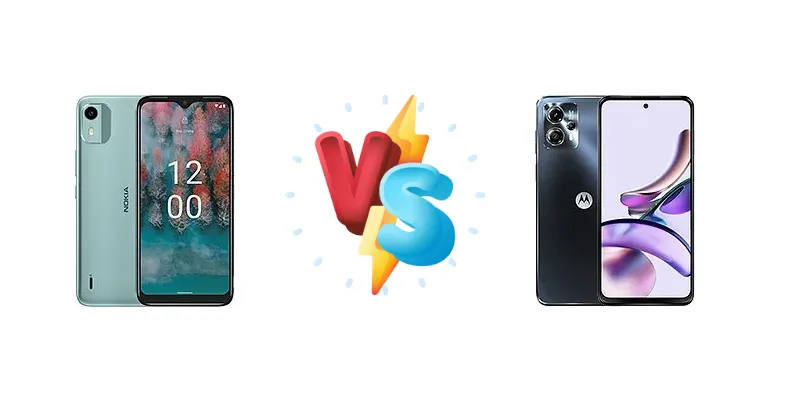
The sub-$150 smartphone market is fiercely competitive. Both the Nokia C12 Pro and Motorola Moto G13 aim to deliver essential smartphone functionality at an accessible price. However, they take different approaches to achieving this, with the Nokia prioritizing a clean Android experience and the Motorola focusing on a more powerful chipset. This comparison will break down the key differences to help you choose the right device.
🏆 Quick Verdict
For most users, the Motorola Moto G13 is the better buy. Its Mediatek Helio G85 chipset, built on a more efficient 12nm process, provides a noticeable performance advantage over the Nokia C12 Pro’s Unisoc SC9863A1. While the Nokia offers a slightly cleaner software experience, the G13’s faster charging and superior processing power make it the more practical choice.
| Network |
|---|
| 2G bands | GSM 850 / 900 / 1800 / 1900 | GSM 850 / 900 / 1800 / 1900 |
| 3G bands | HSDPA 850 / 900 / 1900 / 2100 | HSDPA 850 / 900 / 1900 / 2100 |
| 4G bands | LTE | 1, 2, 3, 5, 7, 8, 20, 38, 40, 41 |
| Speed | HSPA, LTE | HSPA, LTE |
| Technology | GSM / HSPA / LTE | GSM / HSPA / LTE |
| Launch |
|---|
| Announced | 2023, March 21 | 2023, January 24 |
| Status | Available. Released 2023, March 21 | Available. Released 2023, January 24 |
| Body |
|---|
| Build | Glass front, plastic back, plastic frame | Glass front, plastic frame, plastic back |
| Dimensions | 160.6 x 74.3 x 8.8 mm (6.32 x 2.93 x 0.35 in) | 162.7 x 74.7 x 8.2 mm (6.41 x 2.94 x 0.32 in) |
| SIM | Nano-SIM + Nano-SIM | · Nano-SIM· Nano-SIM + Nano-SIM |
| Weight | 177.4 g (6.24 oz) | 183.5 g (6.49 oz) |
| | Splash resistant | Water-resistant design |
| Display |
|---|
| Protection | Scratch-resistant glass | Panda glass |
| Resolution | 720 x 1600 pixels, 20:9 ratio (~278 ppi density) | 720 x 1600 pixels, 20:9 ratio (~270 ppi density) |
| Size | 6.3 inches, 95.8 cm2 (~80.3% screen-to-body ratio) | 6.5 inches, 102.0 cm2 (~83.9% screen-to-body ratio) |
| Type | IPS LCD | IPS LCD, 90Hz, 400 nits (peak) |
| Platform |
|---|
| CPU | Octa-core (4x1.6 GHz Cortex-A55 & 4x1.2 GHz Cortex-A55) | Octa-core (2x2.0 GHz Cortex-A75 & 6x1.8 GHz Cortex-A55) |
| Chipset | Unisoc SC9863A1 (22 nm) | Mediatek MT6769Z Helio G85 (12 nm) |
| GPU | IMG8322 | Mali-G52 MC2 |
| OS | Android 12 (Go edition) | Android 13 |
| Memory |
|---|
| Card slot | Unspecified | microSDXC (dedicated slot) |
| Internal | 64GB 2GB RAM, 64GB 3GB RAM, 64GB 4GB RAM | 64GB 4GB RAM, 128GB 4GB RAM |
| | eMMC 5.1 | - |
| Main Camera |
|---|
| Features | LED flash, HDR | LED flash, HDR, panorama |
| Single | 8 MP, AF | - |
| Triple | - | 50 MP, f/1.8, (wide), 0.64µm, PDAF
2 MP (macro)
Auxiliary lens |
| Video | Yes | 1080p@30fps |
| Selfie camera |
|---|
| Single | 5 MP | 8 MP, f/2.0, (wide), 1/4.0", 1.12µm |
| Video | 720p | 1080p@30fps |
| Sound |
|---|
| 3.5mm jack | Yes | Yes |
| 35mm jack | Yes | Yes |
| Loudspeaker | Yes | Yes, with stereo speakers |
| Comms |
|---|
| Bluetooth | 5.2, A2DP | 5.1, A2DP, LE |
| NFC | No | Yes (market/region dependent) |
| Positioning | GPS | GPS, GLONASS, GALILEO |
| Radio | Wireless FM radio | Unspecified |
| USB | microUSB 2.0 | USB Type-C 2.0 |
| WLAN | Wi-Fi 802.11 b/g/n | Wi-Fi 802.11 a/b/g/n/ac, dual-band |
| Features |
|---|
| Sensors | Accelerometer, proximity | Fingerprint (side-mounted), accelerometer, gyro, proximity |
| Battery |
|---|
| Charging | 10W wired | 20W or 10W wired |
| Type | Li-Ion 4000 mAh, removable | Li-Po 5000 mAh |
| Misc |
|---|
| Colors | Dark Cyan, Charcoal, Light Mint | Matte Charcoal, Blue Lavender, Rose Gold |
| Price | About 80 EUR | About 160 EUR |
Nokia C12 Pro
- Clean, near-stock Android experience
- Potentially longer standby time due to less demanding chipset
- Simple and user-friendly interface
- Significantly slower performance compared to the Moto G13
- Slower 10W charging
- Less capable processor for gaming and multitasking
Motorola Moto G13
- Faster and more responsive performance with the Helio G85
- 20W fast charging for quicker top-ups
- More efficient processor for potentially longer battery life under load
- Software may include more bloatware than the Nokia
- Potentially less streamlined user experience
- May run slightly warmer under heavy load
Display Comparison
Neither device boasts a standout display. Both likely utilize LCD panels, a common cost-saving measure in this segment. However, details regarding brightness and color accuracy are missing. The focus here is on processing power, not visual fidelity. Bezels are expected to be substantial on both, contributing to a larger overall footprint for the screen size. The absence of high refresh rates or advanced panel technologies like LTPO is standard for this price bracket.
Camera Comparison
Camera performance is likely to be similar on both devices, relying heavily on software processing to compensate for the limitations of their sensors. Details on sensor size and aperture are unavailable, but given the price point, expectations should be tempered. The presence of a 2MP macro camera on both is largely a marketing tactic, offering limited practical benefit due to its low resolution and fixed focus. Image quality will likely be acceptable in good lighting conditions, but struggle in low-light scenarios. The Motorola may have a slight edge due to the more powerful ISP within the Helio G85 chipset, potentially enabling better noise reduction and dynamic range.
Performance
The Motorola Moto G13’s Mediatek Helio G85 (12nm) is the clear winner in the performance category. Its octa-core configuration, featuring 2x2.0 GHz Cortex-A75 cores, provides a significant boost over the Nokia C12 Pro’s Unisoc SC9863A1 (22nm). The A75 cores in the G13 are architecturally superior to the A55 cores found in both clusters of the C12 Pro’s processor, resulting in faster app loading times and smoother multitasking. The 12nm fabrication process of the Helio G85 also contributes to better power efficiency compared to the 22nm process of the Unisoc chip, potentially leading to longer battery life under load. This difference will be most noticeable when running demanding applications or playing games.
Battery Life
While both phones offer adequate battery capacity (specific mAh figures are missing), the Motorola Moto G13’s 20W charging capability is a significant advantage over the Nokia C12 Pro’s 10W charging. This translates to a much faster 0-100% charge time, reducing downtime and increasing convenience. Even with a similar battery capacity, the more efficient Helio G85 chipset in the G13 could contribute to slightly longer battery life during typical usage. The faster charging is a key differentiator for users who prioritize minimizing charging time.
Buying Guide
Buy the Nokia C12 Pro if you prioritize a streamlined, near-stock Android experience and are willing to sacrifice performance for simplicity. It’s ideal for users who primarily need a phone for basic communication and light tasks. Buy the Motorola Moto G13 if you value performance for the price, enjoy occasional gaming, or need faster charging. It’s a better fit for users who want a more responsive and versatile device.
Frequently Asked Questions
❓ Will the Motorola Moto G13 struggle with demanding games like PUBG Mobile?
While the Helio G85 isn't a high-end gaming chip, it's capable of running PUBG Mobile at medium settings with reasonable frame rates. Expect some occasional stuttering or frame drops during intense action. The Nokia C12 Pro would likely struggle significantly more with the same game.
❓ Does the Nokia C12 Pro receive regular software updates and security patches?
Nokia is generally known for providing timely software updates and security patches, even for its budget devices. However, the frequency and duration of support for the C12 Pro remain to be seen. Motorola's update track record is less consistent, so the Nokia may have an advantage in long-term software support.
❓ Is the difference in performance between the Unisoc and Mediatek chipsets noticeable in everyday tasks?
Yes, the difference is noticeable. The Helio G85 in the Moto G13 will result in faster app launch times, smoother scrolling, and a more responsive overall experience when navigating the user interface and switching between apps. The Unisoc chip in the C12 Pro will feel sluggish in comparison.
❓ How long does it realistically take to fully charge each phone?
With 10W charging, the Nokia C12 Pro will likely take around 3-4 hours to fully charge. The Motorola Moto G13, with its 20W charging, should charge from 0-100% in approximately 1.5-2 hours, offering a significant time saving.