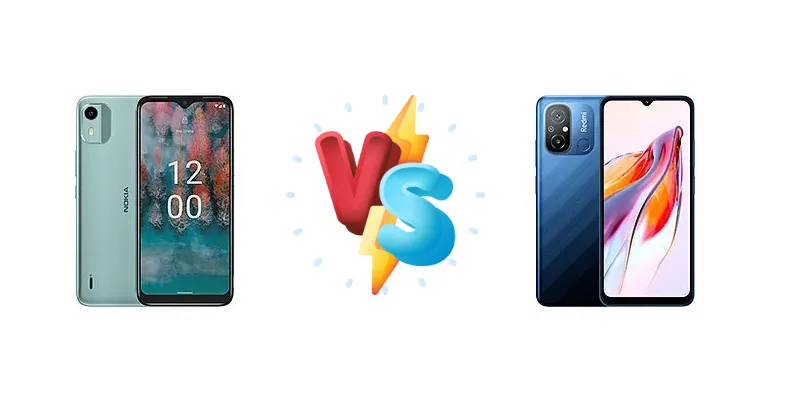
The sub-$150 smartphone market is fiercely competitive, demanding a careful balance of features and performance. Both the Nokia C12 Plus and Xiaomi Redmi 12C aim to deliver an affordable Android experience, but they take different approaches. The Nokia prioritizes a clean software experience, while the Redmi 12C focuses on a more powerful chipset. This comparison will dissect their key differences to help you choose the right device.
🏆 Quick Verdict
For most users, the Xiaomi Redmi 12C is the better choice. Its MediaTek Helio G85 chipset, built on a more efficient 12nm process, provides a noticeable performance advantage over the Nokia C12 Plus’ Unisoc SC9863A1. While both offer similar battery life, the Redmi 12C’s faster processor makes it more capable for multitasking and light gaming.
| Network |
|---|
| 2G bands | GSM 850 / 900 / 1800 / 1900 | GSM 850 / 900 / 1800 / 1900 |
| 3G bands | HSDPA 850 / 900 / 1900 / 2100 | HSDPA 850 / 900 / 2100 |
| 4G bands | LTE | 1, 3, 5, 7, 8, 20, 28, 38, 40, 41 - International |
| Speed | HSPA, LTE | HSPA, LTE |
| Technology | GSM / HSPA / LTE | GSM / CDMA / HSPA / EVDO / LTE |
| | - | CDMA2000 1xEV-DO |
| Launch |
|---|
| Announced | 2023, April 01 | 2022, December 31 |
| Status | Cancelled | Available. Released 2023, January 01 |
| Body |
|---|
| Build | Glass front, plastic back, plastic frame | - |
| Dimensions | - | 168.8 x 76.4 x 8.8 mm (6.65 x 3.01 x 0.35 in) |
| SIM | Nano-SIM + Nano-SIM | Nano-SIM + Nano-SIM |
| Weight | - | 192 g (6.77 oz) |
| Display |
|---|
| Resolution | 720 x 1520 pixels, 19:9 ratio (~267 ppi density) | 720 x 1650 pixels (~268 ppi density) |
| Size | 6.3 inches, 99.1 cm2 (~83.0% screen-to-body ratio) | 6.71 inches, 106.5 cm2 (~82.6% screen-to-body ratio) |
| Type | IPS LCD | IPS LCD, 500 nits (typ) |
| Platform |
|---|
| CPU | Octa-core (4x1.6 GHz Cortex-A55 & 4x1.2 GHz Cortex-A55) | Octa-core (2x2.0 GHz Cortex-A75 & 6x1.8 GHz Cortex-A55) |
| Chipset | Unisoc SC9863A1 (22 nm) | Mediatek MT6769Z Helio G85 (12 nm) |
| GPU | IMG8322 | Mali-G52 MC2 |
| OS | Android 12 (Go edition) | Android 12, MIUI 13 |
| Memory |
|---|
| Card slot | microSDXC | microSDXC (dedicated slot) |
| Internal | 32GB 2GB RAM | 32GB 2GB RAM, 32GB 3GB RAM, 32GB 4GB RAM, 64GB 3GB RAM, 64GB 4GB RAM, 128GB 3GB RAM, 128GB 4GB RAM, 128GB 6GB RAM |
| | eMMC 5.1 | eMMC 5.1 |
| Main Camera |
|---|
| Dual | - | 50 MP, (wide), PDAF
0.08 MP (depth) |
| Features | LED flash, HDR | LED flash, HDR |
| Single | 8 MP, AF | 50 MP, f/1.8, (wide), 1/2.76", PDAF
Auxiliary lens |
| Video | Yes | 1080p@30fps |
| Selfie camera |
|---|
| Single | 5 MP | 5 MP, f/2.2, (wide) |
| Video | 720p | 1080p@30fps |
| Sound |
|---|
| 3.5mm jack | Yes | Yes |
| 35mm jack | Yes | Yes |
| Loudspeaker | Yes | Yes |
| Comms |
|---|
| Bluetooth | 5.2, A2DP | 5.1, A2DP, LE |
| NFC | No | Yes (market/region dependent) |
| Positioning | GPS | GPS, GLONASS, BDS, GALILEO |
| Radio | FM radio | FM radio |
| USB | microUSB 2.0 | microUSB 2.0 |
| WLAN | Wi-Fi 802.11 b/g/n | Wi-Fi 802.11 a/b/g/n/ac, dual-band, Wi-Fi Direct |
| Features |
|---|
| Sensors | Accelerometer, proximity | Fingerprint (rear-mounted), accelerometer |
| | - | Virtual proximity sensing |
| Battery |
|---|
| Charging | - | 10W wired |
| Type | Li-Ion 4000 mAh, removable | Li-Po 5000 mAh |
| Misc |
|---|
| Colors | Dark Cyan, Charcoal, Light Mint | Graphite Gray, Ocean Blue, Mint Green, Lavender Purple |
| Models | - | 22120RN86G, 22120RN86I, 22126RN91Y, 2212ARNC4L |
| Price | About 90 EUR | £ 132.99 / € 107.41 |
| SAR | - | 1.08 W/kg (head) 0.64 W/kg (body) |
| SAR EU | - | 0.98 W/kg (head) 0.99 W/kg (body) |
Nokia C12 Plus
- Clean Android experience with potential for timely updates
- Slightly more compact and pocketable design
- Potentially lower price point (depending on region)
- Significantly weaker processor performance
- Less responsive user experience
- Limited gaming capabilities
Xiaomi Redmi 12C
- More powerful MediaTek Helio G85 chipset
- Larger display for a more immersive experience
- Faster charging (10W)
- Potentially more bloatware and ads
- Larger form factor may be less comfortable for some
- Software update support may be less consistent
Display Comparison
Neither device boasts a standout display. Both likely utilize LCD panels, a common trait in this price bracket. However, the Redmi 12C benefits from a larger 6.71-inch screen compared to the Nokia C12 Plus’ 6.3-inch display, offering a more immersive viewing experience. While specific brightness data is unavailable, the Redmi 12C’s larger surface area may translate to slightly better perceived brightness. Color accuracy and viewing angles are expected to be similar, leaning towards basic performance rather than color-critical work.
Camera Comparison
Camera performance is likely to be similar, with both devices featuring basic camera setups. Details on sensor sizes are unavailable, but both are expected to rely on budget sensors. The Redmi 12C’s camera system is likely to benefit from MediaTek’s image signal processor (ISP), potentially offering slightly better image processing and noise reduction. However, don't expect flagship-level image quality from either device. Both will struggle in low-light conditions, and the 2MP macro cameras on both are largely marketing features with limited practical utility.
Performance
The core difference lies in the chipsets. The Xiaomi Redmi 12C’s MediaTek Helio G85 (12nm) is significantly more powerful than the Nokia C12 Plus’ Unisoc SC9863A1 (22nm). The Helio G85 features two Cortex-A75 cores clocked at 2.0 GHz, providing a substantial boost in single-core performance compared to the C12 Plus’ four Cortex-A55 cores at 1.6 GHz. This translates to snappier app launches, smoother multitasking, and a more enjoyable gaming experience on the Redmi 12C. The 12nm process also contributes to better power efficiency, potentially mitigating the performance gap under sustained loads. The Unisoc chip in the Nokia C12 Plus is geared towards basic functionality, suitable for calls, texts, and light app usage.
Battery Life
Both phones feature similar battery capacities, likely around 5000mAh, offering all-day battery life for moderate usage. However, the Redmi 12C’s 10W charging is a slight advantage, allowing for a faster (though still slow by modern standards) recharge compared to the Nokia C12 Plus, which likely has a similar charging rate. The Helio G85’s more efficient 12nm process may also contribute to slightly better battery endurance under heavy load, but the difference is unlikely to be substantial.
Buying Guide
Buy the Nokia C12 Plus if you prioritize a guaranteed clean Android experience with timely security updates and a slightly more compact form factor. It’s ideal for users who primarily need a phone for basic communication and light tasks. Buy the Xiaomi Redmi 12C if you value performance and responsiveness for the price. It’s better suited for users who enjoy occasional gaming, social media browsing, and multitasking, even if it means accepting a potentially more cluttered software experience.
Frequently Asked Questions
❓ Will the Redmi 12C struggle with popular apps like WhatsApp and Facebook?
No, the Helio G85 in the Redmi 12C is more than capable of handling everyday apps like WhatsApp, Facebook, and YouTube. While it won't offer a flagship-level experience, it will provide a smooth and responsive experience for these common tasks. The Nokia C12 Plus may exhibit noticeable lag when switching between these apps.
❓ Is the Redmi 12C suitable for playing mobile games like PUBG Mobile or Call of Duty Mobile?
The Redmi 12C can run PUBG Mobile and Call of Duty Mobile, but you'll need to lower the graphics settings to medium or low to achieve playable frame rates. The Helio G85 is a gaming-focused chipset, but it's not powerful enough for high-end graphics settings. The Nokia C12 Plus will struggle significantly with these games, even on the lowest settings.
❓ How often can I expect software updates on the Nokia C12 Plus?
Nokia is known for providing relatively timely security updates, even on its budget devices. While major Android version updates are less frequent, you can expect regular security patches for the Nokia C12 Plus, offering a degree of protection against vulnerabilities. Xiaomi's update schedule for the Redmi 12C is less predictable.
❓ Does the Redmi 12C have a headphone jack?
Yes, the Xiaomi Redmi 12C retains a 3.5mm headphone jack, allowing you to connect wired headphones or speakers. This is a convenient feature for users who prefer not to rely on Bluetooth connectivity.