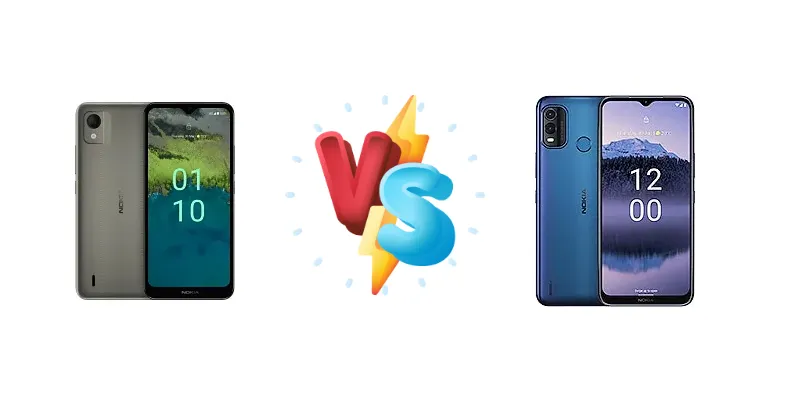
Nokia's C-series and G-series represent their entry-level and mainstream offerings, respectively. The C110 and G11 Plus both aim for the ultra-budget segment, but diverge in their internal hardware. This comparison dissects the key differences – specifically the chipset and charging capabilities – to determine which phone delivers the best value for users prioritizing performance or longevity.
🏆 Quick Verdict
For most users, the Nokia G11 Plus is the better choice. While both phones operate within the same price bracket, the Unisoc T606 chipset offers a more modern CPU architecture and a noticeable performance uplift over the Helio P22 in the C110. The faster 10W charging also provides a practical advantage, mitigating the impact of a potentially similar battery capacity.
| Network |
|---|
| 2G bands | GSM 850 / 1900 | GSM 850 / 900 / 1800 / 1900 |
| 3G bands | HSDPA 850 / 1700 / 1900 | HSDPA 850 / 900 / 2100 - International |
| 4G bands | 2, 4, 5, 12, 13, 41, 66, 71 | 1, 3, 5, 7, 8, 20, 28, 38, 40, 41 - International |
| Speed | HSPA, LTE | HSPA 42.2/5.76 Mbps, LTE Cat4 150/50 Mbps |
| Technology | GSM / HSPA / LTE | GSM / HSPA / LTE |
| | - | 1, 3, 5, 8, 40, 41 - India |
| Launch |
|---|
| Announced | 2023, June 02 | 2022, June 29 |
| Status | Available. Released 2023, June 14 | Available. Released 2022, July 20 |
| Body |
|---|
| Build | Glass front, plastic back, plastic frame | Glass front, plastic frame, plastic back |
| Dimensions | 160.8 x 74 x 8.5 mm (6.33 x 2.91 x 0.33 in) | 164.8 x 75.9 x 8.6 mm (6.49 x 2.99 x 0.34 in) |
| SIM | Nano-SIM | · Nano-SIM· Nano-SIM + Nano-SIM |
| Weight | 172 g (6.07 oz) | 192 g (6.77 oz) |
| | - | Splash protection |
| Display |
|---|
| Protection | Scratch-resistant glass | - |
| Resolution | 720 x 1560 pixels, 19.5:9 ratio (~273 ppi density) | 720 x 1600 pixels, 20:9 ratio (~269 ppi density) |
| Size | 6.3 inches, 97.4 cm2 (~81.9% screen-to-body ratio) | 6.52 inches, 102.6 cm2 (~82.1% screen-to-body ratio) |
| Type | IPS LCD, 400 nits (typ) | IPS LCD, 90Hz, 400 nits (typ) |
| Platform |
|---|
| CPU | Octa-core (4x2.0 GHz Cortex-A53 & 4x1.5 GHz Cortex-A53) | Octa-core (2x1.6 GHz Cortex-A75 & 6x1.6 GHz Cortex-A55) |
| Chipset | Mediatek MT6762 Helio P22 (12 nm) | Unisoc T606 (12 nm) |
| GPU | PowerVR GE8320 | Mali-G57 MP1 |
| OS | Android 12 | Android 12, upgradable to Android 13 |
| Memory |
|---|
| Card slot | microSDXC (dedicated slot) | microSDXC (dedicated slot) |
| Internal | 32GB 3GB RAM | 32GB 3GB RAM, 64GB 3GB RAM, 64GB 4GB RAM, 128GB 3GB RAM |
| | - | eMMC 5.1 |
| Main Camera |
|---|
| Dual | - | 50 MP, f/1.8, (wide), 1/2.67", PDAF
Auxiliary lens |
| Features | LED flash, HDR | LED flash |
| Single | 13 MP, (wide), AF | 8 MP, f/2.0, (wide), 1/4.0" |
| Video | 1080p@30fps | 1080p@30fps |
| Selfie camera |
|---|
| Single | 5 MP | 8 MP, f/2.0, (wide), 1/4.0" |
| Video | Yes | 1080p@30fps |
| Sound |
|---|
| 3.5mm jack | - | Yes |
| 35mm jack | Yes | Yes |
| Loudspeaker | Yes | Yes |
| Comms |
|---|
| Bluetooth | 5.0, A2DP | 5.0, A2DP, LE |
| NFC | No | No |
| Positioning | GPS | GPS |
| Radio | FM radio | FM radio |
| USB | USB Type-C 2.0 | USB Type-C 2.0, OTG |
| WLAN | Wi-Fi 802.11 b/g/n/ac, dual-band, hotspot | Wi-Fi 802.11 a/b/g/n/ac, dual-band, Wi-Fi Direct |
| Features |
|---|
| Sensors | Accelerometer, proximity, barometer | Fingerprint (rear-mounted), accelerometer, proximity |
| Battery |
|---|
| Charging | 5W wired | 10W wired |
| Type | Li-Po 3000 mAh | Li-Ion 5000 mAh |
| Misc |
|---|
| Colors | Gray | Lake Blue, Charcoal Grey |
| Models | N156DL | - |
| Price | About 100 EUR | About 130 EUR |
Nokia C110
- Potentially lower price point
- Simple and straightforward user experience
- Reliable Nokia brand reputation
- Outdated Helio P22 chipset
- Slow 5W charging
- Limited performance for demanding apps
Nokia G11 Plus
- More modern Unisoc T606 chipset
- Faster 10W charging
- Improved CPU architecture for smoother performance
- May be slightly more expensive
- Unisoc chipset may have less software support
- Basic camera capabilities
Display Comparison
Neither Nokia provides detailed display specifications beyond resolution. Given their price points, both likely utilize LCD panels. The absence of information regarding peak brightness or color gamut suggests neither device will excel in outdoor visibility or color accuracy. Bezels are expected to be substantial on both models, consistent with their budget positioning. The focus here is clearly not on display quality.
Camera Comparison
Detailed camera specifications are unavailable. However, given the market segment, it’s safe to assume both phones feature basic camera setups. Focusing on the chipset’s image signal processor (ISP) capabilities, the Unisoc T606 likely offers slightly better image processing potential than the Helio P22, potentially resulting in marginally improved image quality in favorable lighting conditions. The presence of a 2MP macro camera on either device is largely a marketing tactic and unlikely to deliver significant photographic value.
Performance
The core difference lies in the chipsets. The Nokia C110’s MediaTek Helio P22 (MT6762) uses an older architecture – four Cortex-A53 cores clocked at 2.0 GHz paired with another four at 1.5 GHz. The Nokia G11 Plus, however, features the Unisoc T606. This chipset employs a more efficient design with two Cortex-A75 cores at 1.6 GHz and six Cortex-A55 cores, also at 1.6 GHz. The A75 cores represent a significant architectural improvement, offering better single-core performance crucial for app responsiveness. While both are 12nm chips, the Unisoc T606’s CPU configuration translates to a smoother user experience, particularly when multitasking or launching applications. The G11 Plus will handle more demanding tasks with less lag.
Battery Life
Battery capacity details are missing for both devices. However, the Nokia G11 Plus’s 10W wired charging is a clear advantage over the C110’s 5W charging. This means the G11 Plus will reach a full charge significantly faster, reducing downtime. Even with a similar battery capacity, the faster charging speed provides a tangible benefit for users who rely on their phones throughout the day. The efficiency gains from the Unisoc T606 may also contribute to slightly better battery life in real-world usage.
Buying Guide
Buy the Nokia C110 if your primary need is a basic smartphone for essential tasks like calls, messaging, and light social media use, and you prioritize absolute affordability. Buy the Nokia G11 Plus if you want a more responsive experience for everyday apps, occasional gaming, and appreciate the convenience of faster charging, even if it means a slightly higher upfront cost.
Frequently Asked Questions
❓ Will the Nokia G11 Plus handle popular games like PUBG Mobile or Call of Duty?
While the Unisoc T606 is an improvement over the Helio P22, don't expect a high-end gaming experience. PUBG Mobile and Call of Duty will likely be playable at low to medium settings with reduced frame rates. The chipset's thermal management will be a limiting factor during extended gaming sessions.
❓ Is the software experience significantly different between the two phones?
Both phones run Android (likely a Go Edition on the C110). Nokia is known for providing relatively clean Android experiences with timely security updates. However, the G11 Plus, being a slightly newer device, may receive software support for a longer period. The Helio P22's age could mean fewer future Android updates for the C110.
❓ How much faster is the charging on the Nokia G11 Plus in real-world terms?
A full charge on the Nokia G11 Plus with its 10W charger will likely take around 3-4 hours. The Nokia C110's 5W charging could easily take 6-8 hours or more. This difference is significant for users who need to quickly top up their battery during the day.