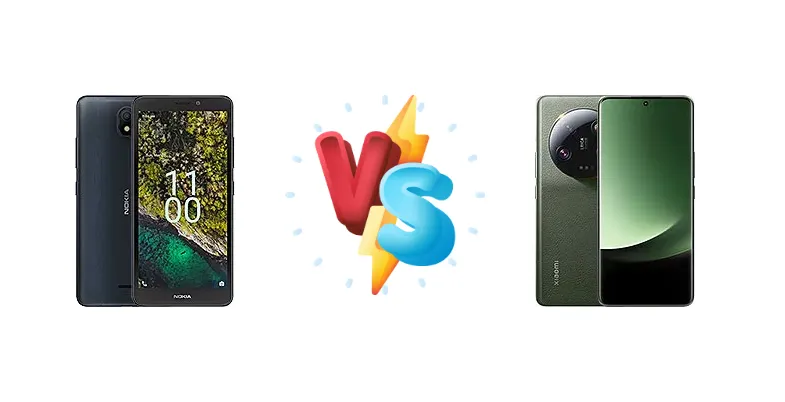
The smartphone landscape is vast, ranging from ultra-affordable options to premium flagships. Today, we pit two vastly different devices against each other: the budget-conscious Nokia C100 and the powerhouse Xiaomi 13 Ultra. Can the C100 hold its own against a true titan?
🏆 Quick Verdict
The Xiaomi 13 Ultra utterly dominates in almost every category – performance, camera, display, and charging. However, its premium price tag makes the Nokia C100 a compelling choice for those prioritizing affordability and basic functionality. It's a clear win for Xiaomi, but with a significant price difference.
| Network |
|---|
| 2G bands | GSM 850 / 900 / 1800 / 1900 | GSM 850 / 900 / 1800 / 1900 |
| 3G bands | HSDPA 850 / 1700(AWS) / 1900 | HSDPA 800 / 850 / 900 / 1700(AWS) / 1900 / 2100 |
| 4G bands | 2, 4, 5, 12, 13, 41, 66, 71 | 1, 2, 3, 4, 5, 7, 8, 18, 19, 20, 26, 28, 38, 40, 41, 66 - International |
| 5G bands | - | 1, 3, 5, 7, 8, 20, 28, 38, 40, 41, 77, 78, 79 SA/NSA - International |
| Speed | HSPA, LTE | HSPA, LTE, 5G |
| Technology | GSM / HSPA / LTE | GSM / CDMA / HSPA / EVDO / LTE / 5G |
| | - | CDMA2000 1xEV-DO |
| Launch |
|---|
| Announced | 2022, January 05 | 2023, April 18 |
| Status | Available. Released 2022, Q2 | Available. Released 2023, April 21 |
| Body |
|---|
| Build | - | Glass front (Gorilla Glass Victus), eco leather back, aluminum frame |
| Dimensions | 149.6 x 71.9 x 9.7 mm (5.89 x 2.83 x 0.38 in) | 163.2 x 74.6 x 9.1 mm (6.43 x 2.94 x 0.36 in) |
| SIM | Nano-SIM | Nano-SIM + Nano-SIM |
| Weight | - | 227 g (8.01 oz) |
| | Splash protection | IP68 dust/water resistant (up to 1.5m for 30 min) |
| Display |
|---|
| Protection | - | Corning Gorilla Glass Victus |
| Resolution | 720 x 1440 pixels, 18:9 ratio (~295 ppi density) | 1440 x 3200 pixels, 20:9 ratio (~522 ppi density) |
| Size | 5.45 inches, 76.7 cm2 (~71.3% screen-to-body ratio) | 6.73 inches, 108.9 cm2 (~89.5% screen-to-body ratio) |
| Type | IPS LCD | LTPO AMOLED, 68B colors, 120Hz, Dolby Vision, HDR10+, 1300 nits (HBM), 2600 nits (peak) |
| Platform |
|---|
| CPU | Quad-core 2.0 GHz Cortex-A53 | Octa-core (1x3.2 GHz Cortex-X3 & 2x2.8 GHz Cortex-A715 & 2x2.8 GHz Cortex-A710 & 3x2.0 GHz Cortex-A510) |
| Chipset | Mediatek MT6761 Helio A22 (12 nm) | Qualcomm SM8550-AB Snapdragon 8 Gen 2 (4 nm) |
| GPU | PowerVR GE8320 | Adreno 740 |
| OS | Android 12 | Android 13, upgradable to Android 14, HyperOS |
| Memory |
|---|
| Card slot | microSDXC (dedicated slot) | No |
| Internal | 32GB 3GB RAM | 256GB 12GB RAM, 512GB 12GB RAM, 512GB 16GB RAM, 1TB 16GB RAM |
| | eMMC 5.1 | UFS 4.0 |
| Main Camera |
|---|
| Features | LED flash | Laser AF, color spectrum sensor, Leica lenses, Dual-LED flash, HDR, panorama, 67mm filter ring holder (optional) |
| Quad | - | 50 MP, f/1.9 or f/4.0, 23mm (wide), 1.0"-type, 1.6µm, dual pixel PDAF, OIS
50 MP, f/1.8, 75mm (telephoto), 1/2.51", 0.7µm, dual pixel PDAF, OIS, 3.2x optical zoom
50 MP, f/3.0, 120mm (periscope telephoto), 1/2.51", 0.7µm, dual pixel PDAF, OIS, 5x optical zoom
50 MP, f/1.8, 12mm, 122˚ (ultrawide), 1/2.51", 0.7µm, dual pixel PDAF
TOF 3D, (depth) |
| Single | 8 MP, AF | - |
| Video | 1080p@30fps | 8K@24fps, 4K@24/30/60fps, 1080p@30/60/120/240/480/960/1920fps, gyro-EIS, Dolby Vision HDR 10-bit rec. (4K@60fps, 1080p) |
| Selfie camera |
|---|
| Features | - | HDR, panorama |
| Single | 5 MP | 32 MP, f/2.0, 22mm (wide), 1/3.14", 0.7µm |
| Video | 720p | 1080p@30/60fps, gyro-EIS |
| Sound |
|---|
| 3.5mm jack | Yes | No |
| 35mm jack | Yes | No |
| Loudspeaker | Yes | Yes, with stereo speakers |
| | - | 24-bit/192kHz audio |
| Comms |
|---|
| Bluetooth | 5.0, A2DP, LE | 5.3, A2DP, LE, aptX HD, aptX Adaptive |
| Infrared port | - | Yes |
| NFC | No | Yes |
| Positioning | GPS | GPS (L1+L5), GLONASS (L1), BDS (B1I+B1c+B2a), GALILEO (E1+E5a), QZSS (L1+L5), NavIC (L5) |
| Radio | No | No |
| USB | USB Type-C 2.0 | USB Type-C 3.2, DisplayPort, OTG |
| WLAN | Wi-Fi 802.11 b/g/n/ac | Wi-Fi 802.11 a/b/g/n/ac/6e/7, tri-band, Wi-Fi Direct |
| Features |
|---|
| Sensors | Accelerometer, proximity, barometer | Fingerprint (under display, optical), accelerometer, proximity, gyro, compass, barometer |
| | - | Virtual proximity sensing |
| Battery |
|---|
| Charging | - | 90W wired, PD3.0, QC4, 100% in 35 min
50W wireless, 100% in 49 min
10W reverse wireless |
| Type | Li-Ion 3000 mAh, removable | Li-Po 5000 mAh |
| Misc |
|---|
| Colors | Blue | Black, Olive Green, White, Orange, Yellow, Blue |
| Models | TA-1484, TA-1520, N152DL | 2304FPN6DC, 2304FPN6DG |
| Price | About 50 EUR | € 797.98 / $ 389.69 |
| SAR | 1.03 W/kg (head) 1.35 W/kg (body) | - |
| SAR EU | - | 0.99 W/kg (head) 1.00 W/kg (body) |
Nokia C100
- Extremely affordable
- Simple and easy to use
- Durable build quality (typical Nokia)
- Decent battery life for light use
- Weak performance
- Low-resolution display
- Basic camera
- Slow charging
Xiaomi 13 Ultra
- Exceptional performance
- Stunning display
- Top-tier camera system
- Fast charging (wired & wireless)
- Premium design and build quality
- Very expensive
- Large size may not suit everyone
- Software can be bloated (MIUI)
Display Comparison
The Xiaomi 13 Ultra boasts a stunning 6.73-inch AMOLED display with a 120Hz refresh rate and a peak brightness of 1207 nits, offering vibrant colors and exceptional clarity. The Nokia C100’s 6.5-inch IPS LCD display is adequate for basic use but lacks the vibrancy and smoothness of the Xiaomi’s screen. The difference is night and day.
Camera Comparison
The Xiaomi 13 Ultra’s camera system is a standout feature, offering incredible detail, dynamic range, and low-light performance. It features a versatile array of lenses. The Nokia C100’s camera is adequate for casual snapshots but lacks the advanced features and image quality of the Xiaomi.
Performance
The Snapdragon 8 Gen 2 in the Xiaomi 13 Ultra delivers blistering performance, handling demanding games and multitasking with ease. The Nokia C100’s Helio A22 chipset is sufficient for basic tasks but struggles with anything beyond light usage. Expect significant lag and slowdowns on the C100.
Battery Life
The Xiaomi 13 Ultra offers exceptional battery life, easily lasting a full day with active use and boasting an impressive endurance rating. Its 90W wired and 50W wireless charging capabilities are incredibly fast. The Nokia C100’s battery life is decent, but charging is significantly slower.
Buying Guide
The Nokia C100 is ideal for first-time smartphone users, seniors, or anyone needing a basic device for calls, texts, and light browsing. The Xiaomi 13 Ultra is for photography enthusiasts, power users, and those who demand the absolute best in performance and features, regardless of cost.
Frequently Asked Questions
❓ Is the Nokia C100 good for gaming?
No, the Nokia C100's chipset is not powerful enough for demanding games. It can handle very basic games, but expect poor performance.
❓ How much does the Xiaomi 13 Ultra cost?
The Xiaomi 13 Ultra is a flagship device and typically costs between $800 and $1200, depending on the configuration and retailer.
❓ What operating system do these phones use?
The Nokia C100 runs Android Go Edition, a lightweight version of Android optimized for lower-powered devices. The Xiaomi 13 Ultra runs MIUI, Xiaomi's custom Android skin.