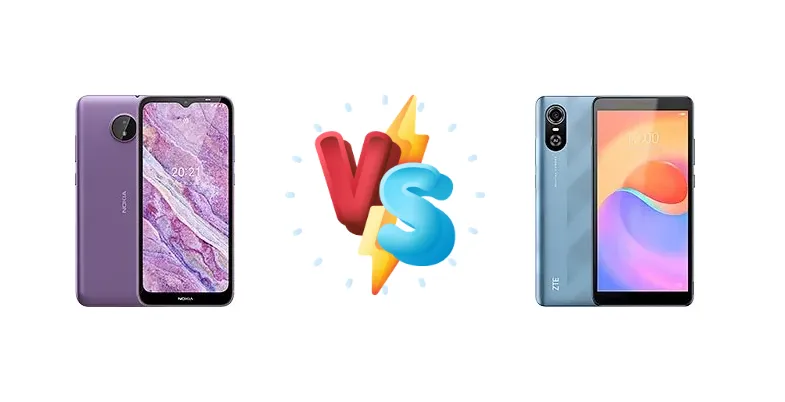
The Nokia C10 and ZTE Blade A31 Plus represent the extreme end of the smartphone price spectrum. Both aim to deliver essential smartphone functionality at a minimal cost, but they achieve this with significantly different hardware approaches. This comparison dissects those differences, focusing on how the chipset choices impact real-world performance and usability.
🏆 Quick Verdict
For the average user prioritizing responsiveness and multitasking, the ZTE Blade A31 Plus is the clear winner. Its octa-core processor, utilizing Cortex-A55 cores, provides a substantial performance advantage over the Nokia C10’s quad-core Cortex-A7. While both phones are entry-level, the A31 Plus offers a smoother experience for everyday tasks.
| Network |
|---|
| 2G bands | GSM 850 / 900 / 1800 / 1900 | GSM 850 / 900 / 1800 / 1900 |
| 3G bands | HSDPA 850 / 900 / 1700(AWS) / 1900 / 2100 | HSDPA 850 / 900 / 2100 |
| 4G bands | - | 1, 2, 3, 5, 7, 8, 20, 28, 38, 40, 41 |
| Speed | HSPA 42.2/5.76 Mbps | HSPA, LTE |
| Technology | GSM / HSPA | GSM / HSPA / LTE |
| Launch |
|---|
| Announced | 2021, April 08 | 2021, October 31 |
| Status | Available. Released 2021, June 29 | Available. Released 2021, October 31 |
| Body |
|---|
| Dimensions | 169.9 x 77.9 x 8.8 mm (6.69 x 3.07 x 0.35 in) | 159.2 x 77.5 x 9.6 mm (6.27 x 3.05 x 0.38 in) |
| SIM | Nano-SIM + Nano-SIM | Nano-SIM + Nano-SIM |
| Weight | 191 g (6.74 oz) | - |
| Display |
|---|
| Protection | Panda Glass | - |
| Resolution | 720 x 1600 pixels, 20:9 ratio (~269 ppi density) | 480 x 960 pixels, 18:9 ratio (~179 ppi density) |
| Size | 6.52 inches, 102.6 cm2 (~77.5% screen-to-body ratio) | 6.0 inches, 92.9 cm2 (~75.3% screen-to-body ratio) |
| Type | IPS LCD, 400 nits (typ) | IPS LCD |
| Platform |
|---|
| CPU | Quad-core 1.3 GHz Cortex-A7 | Octa-core (4x1.6 GHz Cortex-A55 & 4x1.2 GHz Cortex-A55) |
| Chipset | Unisoc SC7331E (28 nm) | Unisoc SC9863A (28 nm) |
| GPU | Mali-400 MP2 | IMG8322 |
| OS | Android 11 (Go edition) | Android 11 (Go edition) |
| Memory |
|---|
| Card slot | microSDXC (dedicated slot) | microSDXC |
| Internal | 16GB 1GB RAM, 16GB 2GB RAM, 32GB 1GB RAM, 32GB 2GB RAM | 32GB 1GB RAM |
| | eMMC 5.1 | eMMC 5.1 |
| Main Camera |
|---|
| Features | LED flash, HDR | LED flash, HDR |
| Single | 5 MP, f/2.2 | 5 MP (up-scaled to 8 MP) |
| Video | 720p@30fps | 720p@30fps |
| Selfie camera |
|---|
| Features | LED flash | - |
| Single | 5 MP, f/2.2 | 2 MP (up-scaled to 5 MP) |
| Video | 720p | - |
| Sound |
|---|
| 3.5mm jack | Yes | Yes |
| 35mm jack | Yes | Yes |
| Loudspeaker | Yes | Yes |
| Comms |
|---|
| Bluetooth | 4.2, A2DP | 4.2, A2DP, LE |
| NFC | No | Yes |
| Positioning | GPS | GPS, GLONASS |
| Radio | FM radio | FM radio |
| USB | microUSB 2.0 | microUSB 2.0 |
| WLAN | Wi-Fi 802.11 b/g/n | Wi-Fi 802.11 b/g/n |
| Features |
|---|
| Sensors | Accelerometer, proximity | Accelerometer |
| Battery |
|---|
| Type | Li-Ion 3000 mAh, removable | Li-Ion 3000 mAh |
| Misc |
|---|
| Colors | Gray, Light Purple | Blue, Gray |
| Models | TA-1342 | - |
| Price | About 80 EUR | - |
| SAR EU | 0.36 W/kg (head) 1.44 W/kg (body) | - |
Nokia C10
- Potentially better brand reputation for software updates (Nokia)
- Simpler user experience for basic tasks
- Lower price point (potentially)
- Significantly slower performance due to older CPU architecture
- Limited multitasking capabilities
- May struggle with modern app demands
ZTE Blade A31 Plus
- Faster and more responsive performance with octa-core CPU
- More efficient Cortex-A55 cores for better battery life
- Smoother multitasking experience
- Less established brand reputation
- Potential for bloatware
- Software update support may be limited
Display Comparison
Neither Nokia nor ZTE provide detailed display specifications beyond resolution. Given the price point, both likely utilize LCD panels. However, the focus here is on processing power, which will impact how smoothly content renders on the screen. The lack of higher refresh rates on either device means display responsiveness is heavily reliant on the chipset's ability to deliver consistent frame rates.
Camera Comparison
Both devices likely feature basic camera setups, and detailed specifications are scarce. Given the market segment, image quality will be heavily reliant on software processing. Without knowing sensor sizes or lens apertures, it’s difficult to make a definitive statement. However, the improved processing power of the ZTE Blade A31 Plus *could* allow for slightly faster image processing and potentially better low-light performance, even with similar sensors. Expect both to struggle in challenging lighting conditions.
Performance
The core difference lies in the chipsets. The Nokia C10’s Unisoc SC7331E features a quad-core Cortex-A7 CPU clocked at 1.3 GHz. This architecture is aging and designed for basic tasks. Conversely, the ZTE Blade A31 Plus boasts the Unisoc SC9863A, an octa-core processor with four Cortex-A55 cores at 1.6 GHz and another four at 1.2 GHz. The Cortex-A55 is a significantly more efficient and capable architecture than the A7. This translates to faster app loading times, smoother multitasking, and a more responsive user interface on the ZTE device. The A31 Plus’s octa-core configuration also allows for better handling of background processes.
Battery Life
Battery capacity details are missing for both devices. However, the more efficient Cortex-A55 cores in the ZTE Blade A31 Plus, coupled with the chipset’s overall power management capabilities, likely result in better battery life despite potentially having a similar capacity to the Nokia C10. The A31 Plus’s ability to handle tasks more efficiently means less time spent at peak power draw, extending usage between charges.
Buying Guide
Buy the Nokia C10 if you need a supremely basic smartphone for calls, texts, and extremely light app usage, and prioritize brand reliability. It’s a good choice for first-time smartphone users or as a simple backup device. Buy the ZTE Blade A31 Plus if you prefer a more responsive experience for social media, web browsing, and occasional gaming, and are willing to consider a less established brand for better performance within the same budget.
Frequently Asked Questions
❓ Will the ZTE Blade A31 Plus struggle with popular apps like Facebook or WhatsApp?
While the ZTE Blade A31 Plus is an entry-level device, its octa-core processor and Cortex-A55 cores are generally sufficient to run apps like Facebook and WhatsApp smoothly. However, expect some slowdown with multiple apps open simultaneously or when using resource-intensive features within those apps.
❓ Is the Nokia C10 a good choice for someone who primarily uses their phone for calls and texts?
Yes, the Nokia C10 is a perfectly adequate choice for basic communication. Its quad-core processor is sufficient for making calls, sending texts, and using simple contact management features. However, if you anticipate using any other apps, even basic ones, the ZTE Blade A31 Plus will provide a significantly better experience.
❓ Can either of these phones handle basic mobile games?
Simple 2D games will run on both devices, but don't expect a great gaming experience. The ZTE Blade A31 Plus will handle them slightly better due to its more powerful processor. Demanding 3D games are likely to be unplayable or suffer from severe lag on both phones.
❓ What about software updates? Which phone is more likely to receive them?
Nokia generally has a better track record for providing software updates, even on their budget devices. ZTE's update support is less predictable. If timely security patches and potential Android version upgrades are important to you, the Nokia C10 is the safer bet, though even then, expectations should be tempered.