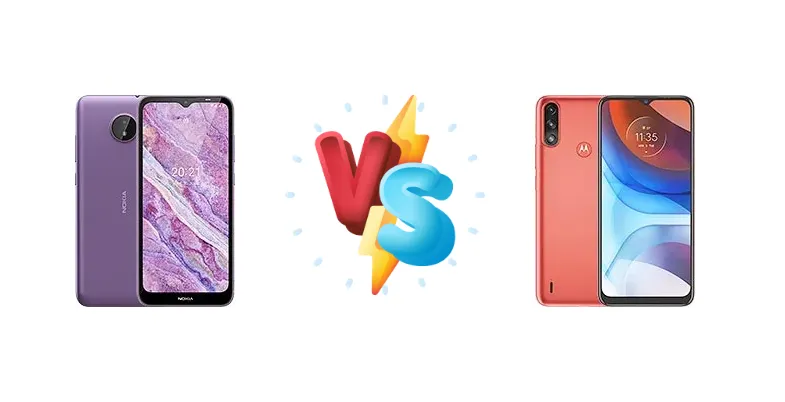
The Nokia C10 and Motorola Moto E7i Power represent the absolute bottom end of the smartphone market, targeting first-time buyers or those needing a reliable secondary device. Both phones prioritize affordability, but they take different approaches to achieving it, particularly in their chipset choices. This comparison dissects those differences to determine which offers the best value.
🏆 Quick Verdict
For most users, the Motorola Moto E7i Power is the better choice. Its octa-core Unisoc SC9863A processor provides a significantly smoother experience than the Nokia C10’s quad-core SC7331E, making everyday tasks noticeably faster. While charging is slow at 10W, the performance uplift justifies the slight price premium.
| Network |
|---|
| 2G bands | GSM 850 / 900 / 1800 / 1900 | GSM 850 / 900 / 1800 / 1900 |
| 3G bands | HSDPA 850 / 900 / 1700(AWS) / 1900 / 2100 | HSDPA 850 / 900 / 1700(AWS) / 1900 / 2100 |
| 4G bands | - | LTE |
| Speed | HSPA 42.2/5.76 Mbps | HSPA, LTE |
| Technology | GSM / HSPA | GSM / HSPA / LTE |
| Launch |
|---|
| Announced | 2021, April 08 | 2021, February 23 |
| Status | Available. Released 2021, June 29 | Available. Released 2021, March 15 |
| Body |
|---|
| Build | - | Glass front, plastic back, plastic frame |
| Dimensions | 169.9 x 77.9 x 8.8 mm (6.69 x 3.07 x 0.35 in) | 165.1 x 75.9 x 9.2 mm (6.5 x 2.99 x 0.36 in) |
| SIM | Nano-SIM + Nano-SIM | Nano-SIM + Nano-SIM |
| Weight | 191 g (6.74 oz) | 200 g (7.05 oz) |
| | - | Water-repellent design |
| Display |
|---|
| Protection | Panda Glass | - |
| Resolution | 720 x 1600 pixels, 20:9 ratio (~269 ppi density) | 720 x 1600 pixels, 20:9 ratio (~270 ppi density) |
| Size | 6.52 inches, 102.6 cm2 (~77.5% screen-to-body ratio) | 6.51 inches, 102.3 cm2 (~81.7% screen-to-body ratio) |
| Type | IPS LCD, 400 nits (typ) | IPS LCD, 380 nits (typ) |
| Platform |
|---|
| CPU | Quad-core 1.3 GHz Cortex-A7 | Octa-core (4x1.6 GHz Cortex-A55 & 4x1.2 GHz Cortex-A55) |
| Chipset | Unisoc SC7331E (28 nm) | Unisoc SC9863A (28 nm) |
| GPU | Mali-400 MP2 | IMG8322 |
| OS | Android 11 (Go edition) | Android 10 (Go edition) |
| Memory |
|---|
| Card slot | microSDXC (dedicated slot) | microSDXC (uses shared SIM slot) |
| Internal | 16GB 1GB RAM, 16GB 2GB RAM, 32GB 1GB RAM, 32GB 2GB RAM | 32GB 2GB RAM |
| | eMMC 5.1 | eMMC 5.1 |
| Main Camera |
|---|
| Dual | - | 13 MP, f/2.0, 26mm (wide), 1/3.1", 1.12µm, PDAF
2 MP (macro) |
| Features | LED flash, HDR | LED flash, HDR, panorama |
| Single | 5 MP, f/2.2 | - |
| Video | 720p@30fps | 1080p@30fps |
| Selfie camera |
|---|
| Features | LED flash | HDR |
| Single | 5 MP, f/2.2 | 5 MP, f/2.2, 27mm (wide), 1.12µm |
| Video | 720p | 1080p@30fps |
| Sound |
|---|
| 3.5mm jack | Yes | Yes |
| 35mm jack | Yes | Yes |
| Loudspeaker | Yes | Yes |
| Comms |
|---|
| Bluetooth | 4.2, A2DP | 4.2, A2DP |
| NFC | No | No |
| Positioning | GPS | GPS, GLONASS, GALILEO |
| Radio | FM radio | Unspecified |
| USB | microUSB 2.0 | USB Type-C 2.0 |
| WLAN | Wi-Fi 802.11 b/g/n | Wi-Fi 802.11 b/g/n |
| Features |
|---|
| Sensors | Accelerometer, proximity | Fingerprint (rear-mounted), accelerometer, proximity |
| Battery |
|---|
| Charging | - | 10W wired |
| Type | Li-Ion 3000 mAh, removable | Li-Ion 5000 mAh |
| Misc |
|---|
| Colors | Gray, Light Purple | Tahiti Blue, Coral Red |
| Models | TA-1342 | XT2097-13 |
| Price | About 80 EUR | About 120 EUR |
| SAR EU | 0.36 W/kg (head) 1.44 W/kg (body) | - |
Nokia C10
- Clean Android Go Edition software
- Potentially lower price point
- Simple and easy to use
- Significantly slower processor
- Less responsive user experience
- Limited multitasking capabilities
Motorola Moto E7i Power
- Faster octa-core processor
- Smoother performance for everyday tasks
- More responsive user interface
- Slower 10W charging
- Potentially higher price
- Software may include bloatware
Display Comparison
Neither phone boasts a standout display. Both are likely to feature LCD panels, typical for this price bracket. Specifics like resolution and brightness are not provided, but we can assume both are 720p or lower, and brightness will be adequate for indoor use but struggle in direct sunlight. The lack of higher refresh rates or advanced panel technologies like IPS is expected. The display experience will likely be similar on both, prioritizing functionality over visual fidelity.
Camera Comparison
Camera performance on both devices will be limited. Details are scarce, but it’s safe to assume both feature basic sensors. Focusing on megapixel counts alone is misleading at this price point. Image quality will heavily rely on software processing, and both phones likely employ basic algorithms. The absence of Optical Image Stabilization (OIS) is guaranteed. The Motorola Moto E7i Power may have a slight edge if it incorporates better software optimization, but expectations should remain low. Any 'macro' camera included will likely be a 2MP sensor offering minimal practical benefit.
Performance
The core difference lies in the chipsets. The Motorola Moto E7i Power’s Unisoc SC9863A is an octa-core processor, featuring four Cortex-A55 cores clocked at 1.6 GHz and another four at 1.2 GHz. This configuration offers a substantial advantage over the Nokia C10’s Unisoc SC7331E, which uses a quad-core Cortex-A7 setup clocked at 1.3 GHz. The A55 architecture is more efficient and delivers better performance per clock cycle than the older A7. This translates to faster app loading times, smoother multitasking, and a more responsive overall experience on the Moto E7i Power. While both are 28nm chips, the increased core count and architectural improvements of the SC9863A are significant.
Battery Life
Battery capacity isn't specified for either device, but both likely house batteries in the 4000-5000 mAh range, common for entry-level smartphones. The Motorola Moto E7i Power includes 10W wired charging, which is slow by modern standards. The Nokia C10’s charging speed is unknown, but likely similar. Real-world battery life will depend heavily on usage patterns, but the more efficient processor in the Moto E7i Power may offset the potentially smaller battery capacity, offering comparable or even slightly better endurance.
Buying Guide
Buy the Nokia C10 if your primary need is a phone for extremely basic tasks – calls, texts, and light app usage – and you prioritize a clean, uncluttered software experience with Android Go Edition. Buy the Motorola Moto E7i Power if you prefer a more responsive user interface, even for simple tasks, and anticipate using the phone for slightly more demanding activities like social media browsing or occasional video playback.
Frequently Asked Questions
❓ Will the Motorola Moto E7i Power struggle with popular apps like Facebook or WhatsApp?
While the Moto E7i Power won't deliver a flagship-level experience, its octa-core processor should handle Facebook and WhatsApp reasonably well. Expect some occasional slowdowns with multiple apps open or during heavy usage, but it's significantly better equipped than the Nokia C10 for these common tasks.
❓ Is the Android Go Edition on the Nokia C10 a benefit for older users?
Android Go Edition is designed for devices with limited resources, offering a simplified interface and pre-installed 'Go' versions of popular apps that use less data and storage. This can be beneficial for older users or those unfamiliar with smartphones, as it reduces clutter and makes the phone easier to navigate. However, it also means some apps may have limited functionality.
❓ Can I play games on either of these phones?
Basic, less demanding games are playable on both devices, but don't expect a smooth experience with graphically intensive titles. The Motorola Moto E7i Power will offer slightly better performance, but even then, frame rates will likely be low and settings will need to be turned down to the minimum.
❓ What type of SIM card do these phones use?
Both the Nokia C10 and Motorola Moto E7i Power are likely to use Nano-SIM cards, which is the standard for most modern smartphones. They also likely support dual SIM functionality, allowing you to use two SIM cards simultaneously.