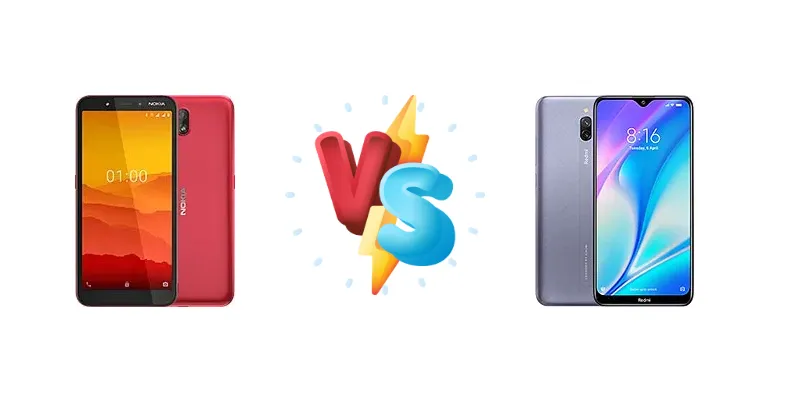
The Nokia C1 and Xiaomi Redmi 8A Pro represent the extreme end of the smartphone price spectrum. Both aim to deliver essential smartphone functionality at an incredibly low cost, but they take different approaches. The Nokia C1 relies on a basic quad-core processor and a clean Android Go experience, while the Redmi 8A Pro boasts a more powerful octa-core Snapdragon chipset and faster charging capabilities. This comparison will dissect their strengths and weaknesses to determine which offers the best value.
🏆 Quick Verdict
For the average user, the Xiaomi Redmi 8A Pro is the clear winner. Its Snapdragon 439 chipset provides a significantly smoother and more responsive experience than the Nokia C1’s quad-core processor. While the Nokia C1 offers a clean software experience, the performance deficit is too large to ignore for most users.
| Network |
|---|
| 2G bands | GSM 850 / 900 / 1800 / 1900 | GSM 850 / 900 / 1800 / 1900 |
| 3G bands | HSDPA 850 / 900 / 1900 / 2100 | HSDPA 850 / 900 / 1900 / 2100 |
| 4G bands | - | 1, 3, 5, 8, 40, 41 |
| Speed | HSPA 21.1/5.76 Mbps | HSPA, LTE |
| Technology | GSM / HSPA | GSM / HSPA / LTE |
| Launch |
|---|
| Announced | 2019, December 11. Released 2020, December 11 | 2020, April 02. Released 2020, April 02 |
| Status | Discontinued | Discontinued |
| Body |
|---|
| Build | Glass front, plastic back, plastic frame | Glass front (Gorilla Glass 5), plastic back, plastic frame |
| Dimensions | 147.6 x 71.4 x 8.7 mm (5.81 x 2.81 x 0.34 in) | 156.5 x 75.4 x 9.4 mm (6.16 x 2.97 x 0.37 in) |
| SIM | Nano-SIM + Nano-SIM | Nano-SIM + Nano-SIM |
| Weight | 155 g (5.47 oz) | 188 g (6.63 oz) |
| | - | Water-repellent coating |
| Display |
|---|
| Protection | Yes | Corning Gorilla Glass 5 |
| Resolution | 480 x 960 pixels, 18:9 ratio (~197 ppi density) | 720 x 1520 pixels, 19:9 ratio (~270 ppi density) |
| Size | 5.45 inches, 76.7 cm2 (~72.7% screen-to-body ratio) | 6.22 inches, 96.6 cm2 (~81.8% screen-to-body ratio) |
| Type | IPS LCD | IPS LCD, 400 nits (typ) |
| Platform |
|---|
| CPU | Quad-core 1.3 GHz | Octa-core (4x1.95 GHz Cortex-A53 & 4x1.45 GHz Cortex A53) |
| Chipset | - | Qualcomm SDM439 Snapdragon 439 (12 nm) |
| GPU | - | Adreno 505 |
| OS | Android 9.0 Pie (Go edition) | Android 9.0 (Pie), planned upgrade to Android 10, MIUI 12 |
| Memory |
|---|
| Card slot | microSDXC (dedicated slot) | microSDXC (dedicated slot) |
| Internal | 16GB 1GB RAM | 32GB 2GB RAM, 32GB 3GB RAM |
| | eMMC 5.1 | eMMC 5.1 |
| Main Camera |
|---|
| Dual | - | 13 MP, f/2.2, (wide), 1/3.1", 1.12µm, PDAF
Auxiliary lens |
| Features | LED flash | LED flash, HDR, panorama |
| Single | 5 MP, f/2.4, AF | - |
| Video | 720p@30fps | 1080p@30fps |
| Selfie camera |
|---|
| Features | LED flash | HDR |
| Single | 5 MP | 8 MP, f/2.0, 1/4.0", 1.12µm |
| Video | 720p@30fps | 1080p@30fps |
| Sound |
|---|
| 3.5mm jack | Yes | Yes |
| 35mm jack | Yes | Yes |
| Loudspeaker | Yes | Yes |
| Comms |
|---|
| Bluetooth | 4.2, A2DP, LE | 4.2, A2DP, LE |
| NFC | No | No |
| Positioning | GPS | GPS, GLONASS, BDS |
| Radio | FM radio | FM Radio, built-in antenna |
| USB | microUSB 2.0 | USB Type-C 2.0, OTG |
| WLAN | Wi-Fi 802.11 a/b/g/n | Wi-Fi 802.11 b/g/n, Wi-Fi Direct |
| Features |
|---|
| Sensors | Accelerometer, proximity | Accelerometer, proximity, compass |
| Battery |
|---|
| Charging | - | 18W wired
2.5W reverse wired |
| Type | Li-Ion 2500 mAh, removable | Li-Po 5000 mAh |
| Misc |
|---|
| Colors | Black, Red | Sky White, Sea Blue, Midnight Grey |
| Models | TA-1165 | - |
| Price | About 50 EUR | About 90 EUR |
| SAR EU | 0.40 W/kg (head) 1.30 W/kg (body) | - |
Nokia C1
- Potentially cleaner software experience with Android Go Edition
- Likely lower price point
- Simplicity for basic users
- Significantly slower processor
- Limited multitasking capabilities
- Likely poor camera performance
Xiaomi Redmi 8A Pro
- Faster Snapdragon 439 processor
- 18W fast charging
- Reverse wired charging capability
- May have more pre-installed bloatware
- Potentially higher price than Nokia C1
- LCD display quality likely similar to Nokia C1
Display Comparison
Neither device is expected to deliver a premium display experience. The Nokia C1’s display specifications are not provided, but given its price point, it likely features a basic LCD panel with a modest resolution. The Redmi 8A Pro also utilizes an LCD, but details regarding its brightness and color accuracy are unavailable. The focus here isn't on visual fidelity, but rather basic readability. Bezels are likely to be substantial on both devices, reflecting their budget nature.
Camera Comparison
Camera performance on both devices is expected to be basic. The Nokia C1’s camera specifications are not available, but it’s safe to assume it features a low-resolution sensor. The Redmi 8A Pro’s camera details are also limited, but the presence of a chipset capable of some image processing suggests slightly better results. Neither phone is likely to excel in low-light conditions or offer advanced features like optical image stabilization. Focusing on capturing usable images in good lighting conditions is the realistic expectation here.
Performance
This is where the Redmi 8A Pro truly shines. Its Qualcomm Snapdragon 439, built on a 12nm process, is a substantial upgrade over the Nokia C1’s quad-core 1.3 GHz processor. The Snapdragon 439’s octa-core configuration (4x1.95 GHz Cortex-A53 & 4x1.45 GHz Cortex A53) allows for significantly faster app loading times, smoother multitasking, and a more responsive user interface. The 12nm process also contributes to better power efficiency compared to a likely larger node process used in the Nokia C1. Users who intend to run more than a handful of apps or engage in any form of gaming will find the Redmi 8A Pro far more capable.
Battery Life
Battery capacity details for the Nokia C1 are unavailable. The Redmi 8A Pro offers 18W wired charging, a significant advantage over the Nokia C1, which likely supports only standard 5W charging. While the Redmi 8A Pro’s battery capacity isn’t specified, 18W charging will dramatically reduce charging times, allowing users to quickly top up their battery when needed. The Redmi 8A Pro also features 2.5W reverse wired charging, allowing it to act as a power bank for other devices, a feature absent on the Nokia C1.
Buying Guide
Buy the Nokia C1 if you prioritize a truly minimalist software experience and absolute simplicity, and your smartphone usage is limited to basic tasks like calls, texts, and light web browsing. Buy the Xiaomi Redmi 8A Pro if you need a phone that can handle multitasking, streaming video, and occasional gaming without significant lag, and you value faster charging speeds.
Frequently Asked Questions
❓ Is the Snapdragon 439 in the Redmi 8A Pro powerful enough for casual gaming?
The Snapdragon 439 can handle casual gaming titles with reasonable performance. However, demanding games may require lower graphics settings and may still experience occasional lag. It's a significant step up from the Nokia C1's processor for gaming.
❓ What is Android Go Edition on the Nokia C1, and how does it affect performance?
Android Go Edition is a lightweight version of Android designed for devices with limited processing power and RAM. While it helps improve performance on the Nokia C1, it also means some features found in the standard Android experience are missing or simplified. It prioritizes speed and efficiency over advanced functionality.
❓ Does the Redmi 8A Pro support USB-C charging?
No, the Redmi 8A Pro uses a Micro-USB port for charging and data transfer. This is a common feature on phones in this price range, but it's slower and less convenient than USB-C.
❓ How much storage does each phone offer, and is it expandable?
Storage details are not provided in the context data. However, both phones likely offer limited internal storage (e.g., 32GB) and support microSD card expansion, which is crucial for storing photos, videos, and apps.