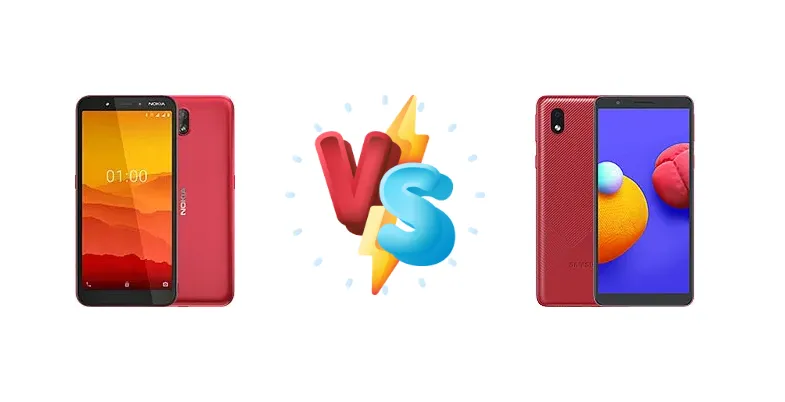
The Nokia C1 and Samsung Galaxy A01 Core represent the absolute bottom end of the smartphone market, targeting first-time buyers or those needing a very basic, affordable device. Both phones prioritize cost over cutting-edge features, but significant differences in their underlying hardware impact real-world performance and usability. This comparison dissects those differences to help you choose the best option for your needs.
🏆 Quick Verdict
For most users, the Samsung Galaxy A01 Core offers a slightly better experience due to its more powerful Mediatek MT6739 chipset. The 1.5 GHz Cortex-A53 cores provide a noticeable performance boost over the Nokia C1’s 1.3 GHz processor, making everyday tasks feel smoother. However, both phones are limited by their low RAM and storage.
| Network |
|---|
| 2G bands | GSM 850 / 900 / 1800 / 1900 | GSM 850 / 900 / 1800 / 1900 |
| 3G bands | HSDPA 850 / 900 / 1900 / 2100 | HSDPA 850 / 900 / 2100 |
| 4G bands | - | 1, 3, 5, 7, 8, 20, 28, 38, 40, 41 |
| Speed | HSPA 21.1/5.76 Mbps | HSPA 21.1/5.76 Mbps, LTE |
| Technology | GSM / HSPA | GSM / HSPA / LTE |
| Launch |
|---|
| Announced | 2019, December 11. Released 2020, December 11 | 2020, July 21. Released 2020, August 06 |
| Status | Discontinued | Discontinued |
| Body |
|---|
| Build | Glass front, plastic back, plastic frame | Plastic back, plastic frame |
| Dimensions | 147.6 x 71.4 x 8.7 mm (5.81 x 2.81 x 0.34 in) | 141.7 x 67.5 x 8.6 mm (5.58 x 2.66 x 0.34 in) |
| SIM | Nano-SIM + Nano-SIM | · Nano-SIM· Nano-SIM + Nano-SIM |
| Weight | 155 g (5.47 oz) | 150 g (5.29 oz) |
| Display |
|---|
| Protection | Yes | - |
| Resolution | 480 x 960 pixels, 18:9 ratio (~197 ppi density) | 720 x 1480 pixels, 18.5:9 ratio (~311 ppi density) |
| Size | 5.45 inches, 76.7 cm2 (~72.7% screen-to-body ratio) | 5.3 inches, 71.3 cm2 (~74.5% screen-to-body ratio) |
| Type | IPS LCD | PLS LCD |
| Platform |
|---|
| CPU | Quad-core 1.3 GHz | Quad-core 1.5 GHz Cortex-A53 |
| Chipset | - | Mediatek MT6739 (28 nm) |
| GPU | - | PowerVR GE8100 |
| OS | Android 9.0 Pie (Go edition) | Android 10 (Go edition) |
| Memory |
|---|
| Card slot | microSDXC (dedicated slot) | microSDXC (dedicated slot) |
| Internal | 16GB 1GB RAM | 16GB 1GB RAM, 16GB 2GB RAM, 32GB 2GB RAM |
| | eMMC 5.1 | eMMC 5.1 |
| Main Camera |
|---|
| Features | LED flash | LED flash |
| Single | 5 MP, f/2.4, AF | 8 MP, f/2.2, AF |
| Video | 720p@30fps | 1080p@30fps |
| Selfie camera |
|---|
| Features | LED flash | - |
| Single | 5 MP | 5 MP, f/2.4 |
| Video | 720p@30fps | - |
| Sound |
|---|
| 3.5mm jack | Yes | Yes |
| 35mm jack | Yes | Yes |
| Loudspeaker | Yes | Yes |
| Comms |
|---|
| Bluetooth | 4.2, A2DP, LE | 5.0, A2DP, LE |
| NFC | No | No |
| Positioning | GPS | GPS |
| Radio | FM radio | FM radio |
| USB | microUSB 2.0 | microUSB 2.0 |
| WLAN | Wi-Fi 802.11 a/b/g/n | Wi-Fi 802.11 b/g/n, Wi-Fi Direct |
| Features |
|---|
| Sensors | Accelerometer, proximity | Accelerometer |
| Battery |
|---|
| Type | Li-Ion 2500 mAh, removable | Li-Ion 3000 mAh |
| Misc |
|---|
| Colors | Black, Red | Black, Blue, Red |
| Models | TA-1165 | SM-A013F, SM-A013F/DS, SM-A013G, SM-A013G/DS, SM-A013M |
| Price | About 50 EUR | About 150 EUR |
| SAR EU | 0.40 W/kg (head) 1.30 W/kg (body) | 0.64 W/kg (head) 1.18 W/kg (body) |
Nokia C1
- Potentially the lowest price point available
- Clean, stock Android experience (likely Android Go)
- Simple and easy to use
- Significantly slower processor
- Likely lower build quality
- Limited software support
Samsung Galaxy A01 Core
- More powerful Mediatek MT6739 chipset
- Established brand reputation
- Slightly better multitasking capabilities
- Still very limited performance
- Basic camera quality
- May include pre-installed bloatware
Display Comparison
Neither device boasts a standout display. Specifications are unavailable for the Nokia C1’s panel, but given its price point, it’s likely a low-resolution LCD. The Samsung Galaxy A01 Core also features a basic LCD, and while resolution details are scarce, it’s expected to be similar. Both will likely suffer from narrow viewing angles and limited brightness, making outdoor visibility challenging. Color accuracy is not a priority at this price point, and both displays will likely exhibit noticeable color shifting.
Camera Comparison
Camera performance on both devices will be extremely limited. Details are scarce, but both are expected to feature basic sensors. Focusing on the main sensor, the A01 Core likely has a slight edge due to the more capable chipset’s image signal processor (ISP). However, expect low detail, poor dynamic range, and significant noise in low-light conditions. Any secondary cameras (often 2MP macro lenses) are largely marketing gimmicks and offer minimal practical benefit. Image processing will be basic on both, prioritizing file size over image quality.
Performance
The core difference lies in the chipsets. The Nokia C1 utilizes a generic Quad-core 1.3 GHz processor, while the Samsung Galaxy A01 Core is powered by the Mediatek MT6739, a Quad-core 1.5 GHz Cortex-A53. The MT6739, built on a 28nm process, offers a clear advantage in CPU clock speed and utilizes the more efficient Cortex-A53 architecture. This translates to faster app loading times and smoother multitasking on the A01 Core. While neither phone is suitable for demanding games, the A01 Core will handle basic apps and web browsing with less lag. RAM specifications are crucial here, and both are likely to be limited, further impacting multitasking capabilities.
Battery Life
Battery capacity details are unavailable for the Nokia C1. The Samsung Galaxy A01 Core packs a 3000 mAh battery. While not exceptional, this is reasonable for the phone’s low-power components and small display. Expect all-day battery life with light usage – primarily calls, texts, and occasional browsing. Charging speeds are likely slow on both devices, utilizing Micro-USB, and a full charge will take several hours. The A01 Core’s more efficient chipset may contribute to slightly longer battery life under similar usage patterns.
Buying Guide
Buy the Nokia C1 if you absolutely need the lowest possible price and prioritize a clean, stock Android experience. It’s a suitable option for very basic communication – calls, texts, and light app usage. Buy the Samsung Galaxy A01 Core if you prefer a slightly more responsive user experience and a more established brand reputation. The A01 Core’s chipset offers a modest performance advantage for slightly more demanding tasks, like browsing social media or using basic navigation apps.
Frequently Asked Questions
❓ Will the Samsung Galaxy A01 Core struggle with popular apps like Facebook or WhatsApp?
While the A01 Core can run Facebook and WhatsApp, expect a sluggish experience. The limited RAM and processing power will result in slow loading times and occasional lag, especially when multitasking. It's best to avoid running many apps simultaneously.
❓ Is the Nokia C1 a good option for a first smartphone for a senior citizen?
The Nokia C1's simplicity could be beneficial for a first-time smartphone user, particularly a senior citizen. However, its slow performance might be frustrating. Consider the A01 Core if a slightly smoother experience is desired, but be prepared to assist with setup and basic usage.
❓ Can either of these phones handle basic mobile games?
Neither phone is designed for gaming. Very simple, 2D games might be playable at low settings, but expect significant lag and frame rate drops. More demanding games are simply not an option.
❓ What version of Android do these phones run?
The Nokia C1 likely runs Android Go Edition, a lightweight version of Android designed for low-end hardware. The Samsung Galaxy A01 Core likely runs a full version of Android, but with Samsung's One UI skin, which can add to the performance burden.