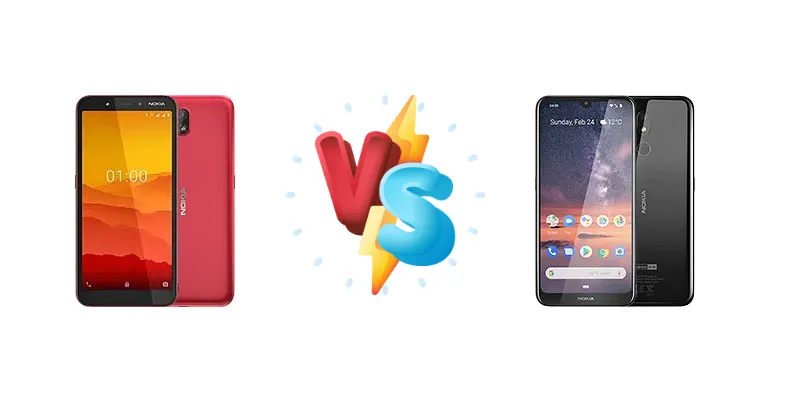
The Nokia C1 and Nokia 3.2 represent distinct approaches to the ultra-budget smartphone market. The C1 aims for absolute affordability, while the 3.2 attempts to balance cost with a more modern chipset and feature set. This comparison dissects the key differences to determine which device delivers the best experience for your money.
🏆 Quick Verdict
For most users, the Nokia 3.2 is the superior choice. Its Qualcomm Snapdragon 429 chipset, clocked at 1.8 GHz, provides a significantly more responsive experience than the Nokia C1’s 1.3 GHz quad-core processor. While both are entry-level devices, the 3.2 offers a noticeable performance boost for everyday tasks and light multitasking.
| Network |
|---|
| 2G bands | GSM 850 / 900 / 1800 / 1900 | GSM 850 / 900 / 1800 / 1900 |
| 3G bands | HSDPA 850 / 900 / 1900 / 2100 | HSDPA 850 / 900 / 2100 |
| 4G bands | - | 1, 3, 5, 7, 8, 20, 28, 38, 40 - EMEA, APAC, MENA |
| Speed | HSPA 21.1/5.76 Mbps | HSPA 42.2/5.76 Mbps, LTE Cat4 150/50 Mbps |
| Technology | GSM / HSPA | GSM / HSPA / LTE |
| | - | 1, 3, 5, 8, 40, 41 - India |
| Launch |
|---|
| Announced | 2019, December 11. Released 2020, December 11 | 2019, February 24. Released 2019, May 22 |
| Status | Discontinued | Discontinued |
| Body |
|---|
| Build | Glass front, plastic back, plastic frame | Glass front, plastic back, plastic frame |
| Dimensions | 147.6 x 71.4 x 8.7 mm (5.81 x 2.81 x 0.34 in) | 159.4 x 76.2 x 8.6 mm (6.28 x 3.00 x 0.34 in) |
| SIM | Nano-SIM + Nano-SIM | Nano-SIM + Nano-SIM |
| Weight | 155 g (5.47 oz) | 181 g (6.38 oz) |
| Display |
|---|
| Protection | Yes | - |
| Resolution | 480 x 960 pixels, 18:9 ratio (~197 ppi density) | 720 x 1520 pixels, 19:9 ratio (~269 ppi density) |
| Size | 5.45 inches, 76.7 cm2 (~72.7% screen-to-body ratio) | 6.26 inches, 97.8 cm2 (~80.5% screen-to-body ratio) |
| Type | IPS LCD | IPS LCD |
| Platform |
|---|
| CPU | Quad-core 1.3 GHz | Quad-core 1.8 GHz Cortex-A53 |
| Chipset | - | Qualcomm SDM429 Snapdragon 429 (12 nm) |
| GPU | - | Adreno 504 |
| OS | Android 9.0 Pie (Go edition) | Android 9.0 (Pie), upgradable to Android 11, Android One |
| Memory |
|---|
| Card slot | microSDXC (dedicated slot) | microSDXC (dedicated slot) |
| Internal | 16GB 1GB RAM | 16GB 2GB RAM, 32GB 3GB RAM, 64GB 3GB RAM |
| | eMMC 5.1 | eMMC 5.1 |
| Main Camera |
|---|
| Features | LED flash | LED flash |
| Single | 5 MP, f/2.4, AF | 13 MP, f/2.2, 1/3.1", 1.12µm, AF |
| Video | 720p@30fps | 1080p@30fps |
| Selfie camera |
|---|
| Features | LED flash | - |
| Single | 5 MP | 5 MP, f/2.2, 27mm (wide), 1/5.0", 1.12µm |
| Video | 720p@30fps | - |
| Sound |
|---|
| 3.5mm jack | Yes | Yes |
| 35mm jack | Yes | Yes |
| Loudspeaker | Yes | Yes |
| Comms |
|---|
| Bluetooth | 4.2, A2DP, LE | 4.2, A2DP, LE, aptX |
| NFC | No | No |
| Positioning | GPS | GPS, GLONASS, BDS |
| Radio | FM radio | FM radio |
| USB | microUSB 2.0 | microUSB 2.0, OTG |
| WLAN | Wi-Fi 802.11 a/b/g/n | Wi-Fi 802.11 b/g/n |
| Features |
|---|
| Sensors | Accelerometer, proximity | Fingerprint (rear-mounted, 32/3GB only), accelerometer, proximity |
| Battery |
|---|
| Charging | - | 10W wired |
| Type | Li-Ion 2500 mAh, removable | Li-Ion 4000 mAh, non-removable |
| Misc |
|---|
| Colors | Black, Red | Black, Steel |
| Models | TA-1165 | TA-1156, TA-1159, TA-1164 |
| Price | About 50 EUR | About 140 EUR |
| SAR EU | 0.40 W/kg (head) 1.30 W/kg (body) | 0.24 W/kg (head) 1.63 W/kg (body) |
Nokia C1
- Lowest possible price point
- Simple and easy to use
- Compact form factor (likely)
- Very slow performance
- Outdated processor
- Limited features
Nokia 3.2
- Significantly better performance
- More efficient chipset
- 10W wired charging
- Still an entry-level device
- Limited camera capabilities
- May be slightly more expensive
Display Comparison
Neither Nokia provides detailed display specifications. However, given their price points, both likely utilize LCD panels with modest resolutions. The Nokia 3.2’s slightly higher price suggests a potentially better panel, but without specific data on brightness (nits) or color accuracy, it’s difficult to quantify. Bezels are expected to be substantial on both devices, reflecting their budget nature. The C1's lack of any stated display features suggests a very basic implementation.
Camera Comparison
Camera details are sparse for both devices. It’s safe to assume both feature basic camera setups geared towards casual snapshots. Without sensor size or aperture information, a direct comparison is challenging. However, the Nokia 3.2’s more powerful chipset allows for potentially better image processing, leading to slightly improved image quality. The presence of a chipset designed for image signal processing (ISP) in the 3.2 is a key advantage, even if the sensor itself is similar to the C1.
Performance
The core difference lies in the chipset. The Nokia C1’s quad-core 1.3 GHz processor is a generation behind the Nokia 3.2’s Qualcomm Snapdragon 429. The SDM429, built on a 12nm process, offers a 1.8 GHz clock speed and Cortex-A53 cores, resulting in a substantial performance advantage. This translates to faster app loading times, smoother multitasking, and a more responsive user interface on the 3.2. The 12nm fabrication process also contributes to better power efficiency compared to an unspecified process for the C1’s CPU. While RAM details are missing for both, the 3.2’s chipset is designed to handle more memory efficiently.
Battery Life
Battery capacity is not specified for either device. However, the Nokia 3.2’s 10W wired charging is a notable feature absent from the C1. While 10W isn’t fast charging by modern standards, it’s still a significant convenience. The Snapdragon 429’s improved power efficiency also contributes to potentially longer battery life on the 3.2, even if the battery capacity is similar to the C1. The C1 will likely require longer charging times and may exhibit shorter runtimes under moderate use.
Buying Guide
Buy the Nokia C1 if you absolutely need the lowest possible price point and your usage is limited to basic communication – calls, texts, and very light app use. Buy the Nokia 3.2 if you prioritize a smoother user experience, occasional social media browsing, and the ability to run more demanding apps without significant lag. The 3.2 is the better option for anyone who doesn't want to constantly fight their phone's performance.
Frequently Asked Questions
❓ Will the Nokia 3.2 handle popular social media apps like Facebook and Instagram smoothly?
Yes, the Qualcomm Snapdragon 429 in the Nokia 3.2 provides enough processing power to run Facebook, Instagram, and other popular social media apps without significant lag. While it won't offer a flagship-level experience, it will be noticeably smoother than the Nokia C1.
❓ Is the Nokia C1 suitable for older adults who primarily use a phone for calls and texts?
The Nokia C1 is a viable option for users with very basic needs – primarily making calls and sending texts. However, its slow processor may make even simple tasks like opening the contacts app feel sluggish. If the user values a responsive experience, even for basic functions, the Nokia 3.2 is a better choice.
❓ Can the Nokia 3.2 run any games?
The Nokia 3.2 can run some light games, but don't expect to play demanding titles like PUBG Mobile at high settings. Simple 2D games and less graphically intensive 3D games should be playable, but you may need to lower the graphics settings for a smoother experience.