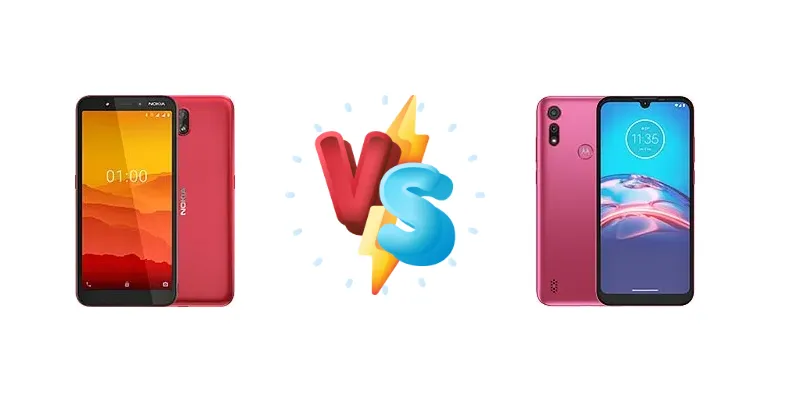
The Nokia C1 and Motorola Moto E6i represent the extreme end of the smartphone price spectrum. Both aim to deliver basic smartphone functionality at an incredibly affordable price point, but they take different approaches to achieving this. The C1 relies on a simple quad-core processor, while the Moto E6i leverages a more complex octa-core Unisoc chipset. This comparison will dissect the key differences to determine which device offers the best value for users on a tight budget.
🏆 Quick Verdict
For the average user prioritizing responsiveness and multitasking, the Motorola Moto E6i is the clear winner. Its octa-core Unisoc SC9863A chipset provides a significant performance advantage over the Nokia C1’s quad-core processor, making everyday tasks smoother and more enjoyable. While the C1 may offer a slightly cleaner software experience, the E6i’s processing power justifies the small price difference.
| Network |
|---|
| 2G bands | GSM 850 / 900 / 1800 / 1900 | GSM 850 / 900 / 1800 / 1900 |
| 3G bands | HSDPA 850 / 900 / 1900 / 2100 | HSDPA 850 / 900 / 1700(AWS) / 1900 / 2100 |
| 4G bands | - | 1, 2, 3, 4, 5, 7, 8, 19, 28, 66 |
| Speed | HSPA 21.1/5.76 Mbps | HSPA, LTE |
| Technology | GSM / HSPA | GSM / HSPA / LTE |
| Launch |
|---|
| Announced | 2019, December 11. Released 2020, December 11 | 2021, February 11 |
| Status | Discontinued | Available. Released 2021, February 11 |
| Body |
|---|
| Build | Glass front, plastic back, plastic frame | Glass front, plastic back, plastic frame |
| Dimensions | 147.6 x 71.4 x 8.7 mm (5.81 x 2.81 x 0.34 in) | 155.6 x 73 x 8.5 mm (6.13 x 2.87 x 0.33 in) |
| SIM | Nano-SIM + Nano-SIM | Nano-SIM + Nano-SIM |
| Weight | 155 g (5.47 oz) | 160 g (5.64 oz) |
| Display |
|---|
| Protection | Yes | - |
| Resolution | 480 x 960 pixels, 18:9 ratio (~197 ppi density) | 720 x 1560 pixels, 19.5:9 ratio (~282 ppi density) |
| Size | 5.45 inches, 76.7 cm2 (~72.7% screen-to-body ratio) | 6.1 inches, 91.3 cm2 (~80.4% screen-to-body ratio) |
| Type | IPS LCD | IPS LCD |
| Platform |
|---|
| CPU | Quad-core 1.3 GHz | Octa-core (4x1.6 GHz Cortex-A55 & 4x1.2 GHz Cortex-A55) |
| Chipset | - | Unisoc SC9863A (28 nm) |
| GPU | - | IMG8322 |
| OS | Android 9.0 Pie (Go edition) | Android 10 (Go edition) |
| Memory |
|---|
| Card slot | microSDXC (dedicated slot) | microSDXC (uses shared SIM slot) |
| Internal | 16GB 1GB RAM | 32GB 2GB RAM |
| | eMMC 5.1 | eMMC 5.1 |
| Main Camera |
|---|
| Dual | - | 13 MP, f/2.2, 26mm (wide), 1/3.1", 1.12µm, PDAF
Auxiliary lens |
| Features | LED flash | LED flash, HDR, panorama |
| Single | 5 MP, f/2.4, AF | - |
| Video | 720p@30fps | 1080p@30fps |
| Selfie camera |
|---|
| Features | LED flash | - |
| Single | 5 MP | 5 MP, f/2.2, 27mm (wide), 1.12µm |
| Video | 720p@30fps | 1080p@30fps |
| Sound |
|---|
| 3.5mm jack | Yes | Yes |
| 35mm jack | Yes | Yes |
| Loudspeaker | Yes | Yes |
| Comms |
|---|
| Bluetooth | 4.2, A2DP, LE | 4.2, A2DP, LE |
| NFC | No | No |
| Positioning | GPS | GPS, GLONASS |
| Radio | FM radio | Unspecified |
| USB | microUSB 2.0 | microUSB 2.0, OTG |
| WLAN | Wi-Fi 802.11 a/b/g/n | Wi-Fi 802.11 b/g/n |
| Features |
|---|
| Sensors | Accelerometer, proximity | Fingerprint (rear-mounted), accelerometer, proximity |
| Battery |
|---|
| Charging | - | 10W wired |
| Type | Li-Ion 2500 mAh, removable | Li-Ion 3000 mAh |
| Misc |
|---|
| Colors | Black, Red | Titanium Gray, Pink |
| Models | TA-1165 | XT2053-5 |
| Price | About 50 EUR | About 170 EUR |
| SAR EU | 0.40 W/kg (head) 1.30 W/kg (body) | - |
Nokia C1
- Potentially the lowest price point available.
- Clean Android Go edition software (likely).
- Simple and easy to use.
- Significantly slower performance.
- Limited multitasking capabilities.
- Camera quality likely to be poor.
Motorola Moto E6i
- Octa-core processor for smoother performance.
- More responsive user experience.
- 10W charging for convenient top-ups.
- May have more pre-installed bloatware.
- Display quality is likely basic.
- Camera performance is still limited.
Display Comparison
Neither device boasts a standout display. The Nokia C1’s display specifications are not provided, but given its market segment, it likely features a basic LCD panel with a modest resolution. The Moto E6i also utilizes an LCD, but details regarding its brightness or color accuracy are unavailable. Both displays are likely optimized for power efficiency rather than visual fidelity, prioritizing battery life over a premium viewing experience. Bezels are expected to be substantial on both devices, reflecting their budget nature.
Camera Comparison
Camera performance on both devices is expected to be limited. Neither manufacturer provides details on sensor size or image processing capabilities. Given the price point, both likely feature basic sensors with limited low-light performance. The Nokia C1’s camera specifications are not available, but the Moto E6i likely includes a primary sensor paired with a depth sensor or a low-resolution macro lens. Image quality will be acceptable for casual snapshots in good lighting conditions, but users should not expect professional-grade results.
Performance
The performance gap is the most significant differentiator. The Nokia C1’s quad-core 1.3 GHz processor is a basic configuration, suitable for only the most essential tasks. In contrast, the Motorola Moto E6i’s Unisoc SC9863A chipset features an octa-core configuration (4x1.6 GHz Cortex-A55 & 4x1.2 GHz Cortex-A55) built on a 28nm process. This means the E6i can handle more demanding applications and multitasking with greater ease. The Cortex-A55 cores, while not high-performance, offer a substantial improvement over the C1’s unspecified processor architecture. The 28nm fabrication process, while older, is optimized for cost-effectiveness in this segment.
Battery Life
Battery capacity details for the Nokia C1 are unavailable. The Motorola Moto E6i offers 10W wired charging. While 10W is slow by modern standards, it’s adequate for a device with limited power demands. The E6i’s Unisoc chipset, built on a 28nm process, is likely more power-efficient than any processor the C1 might use, potentially offsetting any capacity differences. Expect both devices to offer all-day battery life with moderate usage, but heavy users may need to top up during the day.
Buying Guide
Buy the Nokia C1 if you absolutely need the lowest possible price and prioritize a very basic, uncluttered Android experience. It’s suitable for users who primarily need a device for calls, texts, and light app usage. Buy the Motorola Moto E6i if you prefer a more responsive device capable of handling multiple apps and occasional light gaming. The E6i is a better choice for users who want a more versatile smartphone experience without breaking the bank.
Frequently Asked Questions
❓ Will the Motorola Moto E6i struggle with popular social media apps like Facebook and Instagram?
While the Moto E6i won't offer a flagship-level experience, its octa-core processor and sufficient RAM should handle Facebook and Instagram reasonably well. Expect some loading times and occasional slowdowns, but it's significantly more capable than the Nokia C1 for these types of apps.
❓ Is the Nokia C1 a good choice for a first smartphone for a senior citizen?
The Nokia C1's simplicity could be appealing for a first-time smartphone user, particularly a senior citizen. However, its limited performance might lead to frustration if they attempt to use more demanding apps. The larger screen and smoother operation of the Moto E6i might be a better long-term investment.
❓ Can the Motorola Moto E6i handle basic mobile games?
The Moto E6i can handle basic 2D games and some less demanding 3D titles. However, don't expect to play graphically intensive games like PUBG or Call of Duty at high settings. The Unisoc SC9863A chipset is not designed for serious gaming.