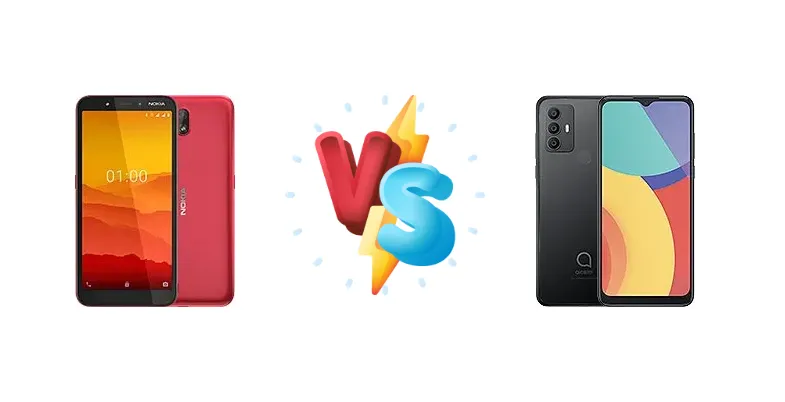
The Nokia C1 and Alcatel 1V (2021) represent the absolute bottom end of the smartphone market, targeting first-time buyers or those needing a very basic, affordable device. While neither phone will challenge flagship performance, understanding their differences is crucial for making the right choice within this price bracket. This comparison focuses on how the Alcatel 1V’s more modern chipset impacts real-world usability compared to the Nokia C1’s simpler processor.
🏆 Quick Verdict
For most users, the Alcatel 1V (2021) is the better choice. Its Mediatek Helio A22 chipset, clocked at 2.0 GHz, provides a noticeable performance boost over the Nokia C1’s 1.3 GHz quad-core CPU, making everyday tasks smoother. While both phones are extremely basic, the Alcatel 1V offers a more responsive experience for the price.
| Network |
|---|
| 2G bands | GSM 850 / 900 / 1800 / 1900 | GSM 850 / 900 / 1800 / 1900 |
| 3G bands | HSDPA 850 / 900 / 1900 / 2100 | HSDPA 850 / 900 / 1700(AWS) / 1900 / 2100 - 6002A |
| 4G bands | - | 2, 3, 4, 5, 7, 8, 12, 13, 17, 26, 28, 66 - 6002A |
| Speed | HSPA 21.1/5.76 Mbps | HSPA 42.2/11.5 Mbps, LTE Cat4 150/50 Mbps |
| Technology | GSM / HSPA | GSM / HSPA / LTE |
| | - | 1, 3, 5, 7, 8, 20, 28, 38, 40, 41 - 6002D |
| Launch |
|---|
| Announced | 2019, December 11. Released 2020, December 11 | 2021, February |
| Status | Discontinued | Available. Released 2021, April |
| Body |
|---|
| Build | Glass front, plastic back, plastic frame | Glass front, plastic back, plastic frame |
| Dimensions | 147.6 x 71.4 x 8.7 mm (5.81 x 2.81 x 0.34 in) | 165.2 x 75.5 x 8.9 mm (6.50 x 2.97 x 0.35 in) |
| SIM | Nano-SIM + Nano-SIM | · Nano-SIM· Nano-SIM + Nano-SIM |
| Weight | 155 g (5.47 oz) | 190 g (6.70 oz) |
| Display |
|---|
| Protection | Yes | - |
| Resolution | 480 x 960 pixels, 18:9 ratio (~197 ppi density) | 720 x 1600 pixels, 20:9 ratio (~269 ppi density) |
| Size | 5.45 inches, 76.7 cm2 (~72.7% screen-to-body ratio) | 6.52 inches, 102.6 cm2 (~82.3% screen-to-body ratio) |
| Type | IPS LCD | IPS LCD |
| Platform |
|---|
| CPU | Quad-core 1.3 GHz | Quad-core 2.0 GHz Cortex-A53 |
| Chipset | - | Mediatek MT6761 Helio A22 (12 nm) |
| GPU | - | PowerVR GE8320 |
| OS | Android 9.0 Pie (Go edition) | Android 11 (Go edition) |
| Memory |
|---|
| Card slot | microSDXC (dedicated slot) | microSDXC (dedicated slot) |
| Internal | 16GB 1GB RAM | 32GB 2GB RAM, 64GB 2GB RAM |
| | eMMC 5.1 | eMMC 5.1 |
| Main Camera |
|---|
| Dual | - | 13 MP, f/2.2, (wide), 1/3.0", 1.12µm, AF
2 MP (macro)
Auxiliary lens |
| Features | LED flash | LED flash, HDR, panorama |
| Single | 5 MP, f/2.4, AF | 5 MP, f/2.2, (wide), 1/5", 1.12µm |
| Video | 720p@30fps | 1080p@30fps |
| Selfie camera |
|---|
| Features | LED flash | HDR |
| Single | 5 MP | 5 MP, f/2.2, (wide), 1/5.0", 1.12µm |
| Video | 720p@30fps | 1080p@30fps |
| Sound |
|---|
| 3.5mm jack | Yes | Yes |
| 35mm jack | Yes | Yes |
| Loudspeaker | Yes | Yes |
| Comms |
|---|
| Bluetooth | 4.2, A2DP, LE | 5.0, A2DP, LE |
| NFC | No | No |
| Positioning | GPS | GPS, GLONASS, GALILEO, BDS |
| Radio | FM radio | FM radio (market/operator dependent) |
| USB | microUSB 2.0 | USB Type-C 2.0 |
| WLAN | Wi-Fi 802.11 a/b/g/n | Wi-Fi 802.11 b/g/n, Wi-Fi Direct |
| Features |
|---|
| Sensors | Accelerometer, proximity | Fingerprint (rear-mounted), accelerometer, proximity, compass |
| Battery |
|---|
| Charging | - | 10W wired |
| Type | Li-Ion 2500 mAh, removable | Li-Ion 5000 mAh |
| Misc |
|---|
| Colors | Black, Red | Space Gray, Atlantic Blue |
| Models | TA-1165 | 6002A, 6002D |
| Price | About 50 EUR | About 100 EUR |
| SAR EU | 0.40 W/kg (head) 1.30 W/kg (body) | - |
Nokia C1
- Potentially simpler user interface
- Brand recognition for software support (limited)
- Compact form factor
- Significantly slower processor
- Less efficient chipset
- Limited performance for multitasking
alcatel 1V (2021)
- Faster and more efficient Mediatek Helio A22 chipset
- More responsive user experience
- 10W wired charging
- Software update support may be limited
- Basic camera performance
- Still limited for demanding tasks
Display Comparison
Neither Nokia nor Alcatel provide detailed display specifications for these models. Given their price point, both likely utilize low-resolution LCD panels. However, the lack of information prevents a direct comparison of brightness, color accuracy, or viewing angles. Expect both displays to be adequate for basic tasks but underwhelming for media consumption. Bezels are likely substantial on both devices, maximizing screen real estate within a compact form factor.
Camera Comparison
Both phones are expected to feature basic camera setups. Details are scarce, but it’s safe to assume both will include a primary rear camera and potentially a front-facing camera for video calls. Given the price point, image quality will be limited, particularly in low-light conditions. The absence of optical image stabilization (OIS) on either device further exacerbates this issue. Focusing on megapixel counts would be misleading; image processing and sensor size are far more critical, and neither manufacturer provides this information.
Performance
The core difference lies in the chipsets. The Alcatel 1V (2021) features the Mediatek MT6761 Helio A22, a 12nm process chipset with a quad-core Cortex-A53 CPU clocked at 2.0 GHz. This represents a significant upgrade over the Nokia C1’s unspecified chipset, but confirmed 1.3 GHz quad-core CPU. The 12nm process node of the Helio A22 also contributes to better power efficiency. This translates to smoother app launches, faster web browsing, and a more responsive user interface on the Alcatel 1V. While neither phone is suited for demanding games, the Alcatel 1V will handle simpler titles with less lag.
Battery Life
Battery capacity details are unavailable for the Nokia C1. The Alcatel 1V (2021) supports 10W wired charging. While 10W is slow by modern standards, it’s adequate for these devices, given their limited processing demands and likely smaller battery capacities. The more efficient Mediatek Helio A22 in the Alcatel 1V will likely contribute to longer battery life compared to the Nokia C1, even if the latter has a slightly larger battery capacity.
Buying Guide
Buy the Nokia C1 if you prioritize brand reputation for software updates (though limited) and a potentially simpler user experience. It’s a reasonable option for those needing a very basic phone for calls and texts. Buy the Alcatel 1V (2021) if you prefer a more responsive device for light multitasking, social media browsing, and basic app usage. The Helio A22 chipset provides a tangible performance advantage, making it a better all-rounder within this ultra-budget segment.
Frequently Asked Questions
❓ Will the Alcatel 1V (2021) be able to run popular social media apps like Facebook and WhatsApp smoothly?
Yes, the Mediatek Helio A22 chipset in the Alcatel 1V (2021) is capable of running Facebook, WhatsApp, and similar social media apps without significant lag. While it won't offer a fluid experience like higher-end phones, it provides a usable experience for basic social networking.
❓ Is the Nokia C1 a good choice for a first-time smartphone user or someone unfamiliar with Android?
The Nokia C1's simplicity could be beneficial for a first-time smartphone user. However, its slower processor might lead to frustration when learning the operating system. The Alcatel 1V (2021) offers a slightly more responsive experience, which could be more forgiving for new users.
❓ Can either of these phones handle video streaming services like YouTube?
Both phones can technically stream YouTube videos, but expect buffering and lower resolution playback, especially on larger videos. The Alcatel 1V (2021) will likely handle lower-resolution streams (360p or 480p) more reliably due to its faster processor.