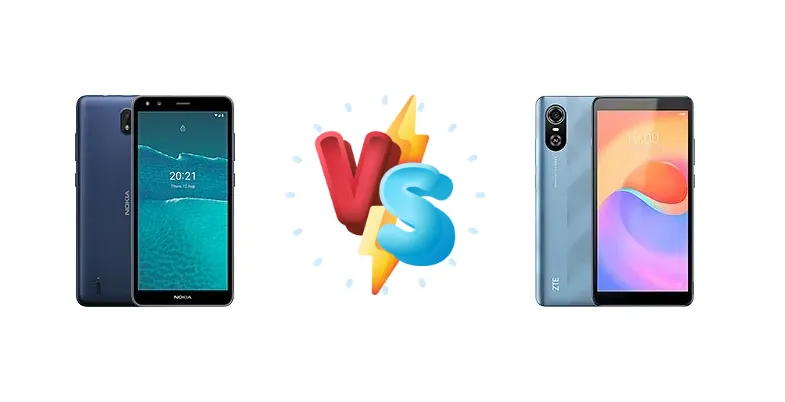
The Nokia C1 2nd Edition and ZTE Blade A31 Plus represent the extreme end of the smartphone price spectrum. Both devices rely on Unisoc chipsets to deliver basic functionality, but significant architectural differences exist. This comparison dissects those differences to determine which phone offers the best experience for users prioritizing affordability.
🏆 Quick Verdict
For the average user seeking a functional, if basic, smartphone experience, the ZTE Blade A31 Plus emerges as the better choice. Its octa-core processor, built on a more modern architecture, provides a noticeable performance advantage over the Nokia C1 2nd Edition’s quad-core design, making everyday tasks smoother.
| Network |
|---|
| 2G bands | GSM 850 / 900 / 1800 / 1900 | GSM 850 / 900 / 1800 / 1900 |
| 3G bands | HSDPA 850 / 900 / 1900 / 2100 | HSDPA 850 / 900 / 2100 |
| 4G bands | - | 1, 2, 3, 5, 7, 8, 20, 28, 38, 40, 41 |
| Speed | HSPA 21.1/5.76 Mbps | HSPA, LTE |
| Technology | GSM / HSPA | GSM / HSPA / LTE |
| | eMMC 5.1 | - |
| Launch |
|---|
| Announced | 2021, July 05 | 2021, October 31 |
| Status | Available. Released 2021, August 27 | Available. Released 2021, October 31 |
| Body |
|---|
| Build | Glass front, plastic back, plastic frame | - |
| Dimensions | 148 x 71.8 x 9.3 mm (5.83 x 2.83 x 0.37 in) | 159.2 x 77.5 x 9.6 mm (6.27 x 3.05 x 0.38 in) |
| SIM | Nano-SIM + Nano-SIM | Nano-SIM + Nano-SIM |
| Weight | 154 g (5.43 oz) | - |
| Display |
|---|
| Resolution | 720 x 1440 pixels, 18:9 ratio (~295 ppi density) | 480 x 960 pixels, 18:9 ratio (~179 ppi density) |
| Size | 5.45 inches, 76.7 cm2 (~72.1% screen-to-body ratio) | 6.0 inches, 92.9 cm2 (~75.3% screen-to-body ratio) |
| Type | TFT LCD | IPS LCD |
| Platform |
|---|
| CPU | Quad-core 1.3 GHz Cortex-A7 | Octa-core (4x1.6 GHz Cortex-A55 & 4x1.2 GHz Cortex-A55) |
| Chipset | Unisoc SC7731e | Unisoc SC9863A (28 nm) |
| GPU | Mali-400 MP2 | IMG8322 |
| OS | Android 11 (Go edition) | Android 11 (Go edition) |
| Memory |
|---|
| Card slot | microSDXC | microSDXC |
| Internal | 16GB 1GB RAM | 32GB 1GB RAM |
| | - | eMMC 5.1 |
| Main Camera |
|---|
| Features | LED flash | LED flash, HDR |
| Single | 5 MP | 5 MP (up-scaled to 8 MP) |
| Video | 720p@30fps | 720p@30fps |
| Selfie camera |
|---|
| Features | LED flash | - |
| Single | 5 MP | 2 MP (up-scaled to 5 MP) |
| Video | 720p@30fps | - |
| Sound |
|---|
| 3.5mm jack | Yes | Yes |
| 35mm jack | Yes | Yes |
| Loudspeaker | Yes | Yes |
| Comms |
|---|
| Bluetooth | 4.2, A2DP, LE | 4.2, A2DP, LE |
| NFC | No | Yes |
| Positioning | GPS | GPS, GLONASS |
| Radio | FM radio | FM radio |
| USB | microUSB 2.0 | microUSB 2.0 |
| WLAN | Wi-Fi 802.11 b/g/n | Wi-Fi 802.11 b/g/n |
| Features |
|---|
| Sensors | Accelerometer, proximity | Accelerometer |
| Battery |
|---|
| Type | Li-Ion 2500 mAh, removable | Li-Ion 3000 mAh |
| Misc |
|---|
| Colors | Blue, Purple | Blue, Gray |
| Models | TA-1380 | - |
| Price | About 50 EUR | - |
| SAR EU | 0.60 W/kg (head) 1.44 W/kg (body) | - |
Nokia C1 2nd Edition
- Potentially lower price point
- Simple and straightforward user experience
- Reliable Nokia brand reputation
- Significantly slower performance
- Outdated processor architecture
- Limited multitasking capabilities
ZTE Blade A31 Plus
- Faster and more responsive performance
- More efficient processor architecture
- Better multitasking capabilities
- May be slightly more expensive
- ZTE brand perception may be less favorable to some
- Camera performance likely still limited
Display Comparison
Neither device boasts a standout display. Given the context of these phones, display specs are likely similar – 720p resolution and IPS LCD panels are expected. However, the focus should be on the processing power needed to drive the display. The ZTE Blade A31 Plus’s more capable chipset will likely handle UI animations and scrolling more smoothly, even with a similar panel.
Camera Comparison
Both phones likely feature basic camera setups. Without specific sensor details, it’s safe to assume both will struggle in low-light conditions. The ZTE Blade A31 Plus’s more powerful ISP (Image Signal Processor), integrated within the SC9863A, may offer slightly better image processing and noise reduction, but the difference will be marginal. Expect both to rely heavily on software processing to compensate for limited hardware.
Performance
The core difference lies in the chipsets. The Nokia C1 2nd Edition’s Unisoc SC7731e features a quad-core Cortex-A7 CPU clocked at 1.3 GHz. This is an older architecture, designed for power efficiency rather than speed. Conversely, the ZTE Blade A31 Plus utilizes the Unisoc SC9863A, an octa-core processor with a combination of Cortex-A55 cores clocked at 1.6 GHz and 1.2 GHz. The Cortex-A55 is a significantly more efficient and powerful architecture than the A7. The octa-core configuration further enhances multitasking capabilities. This translates to faster app loading times and a more fluid user experience on the ZTE Blade A31 Plus.
Battery Life
Battery life will heavily depend on usage patterns. While specific mAh capacities are unknown, the more efficient Cortex-A55 cores in the ZTE Blade A31 Plus will likely contribute to longer battery life under similar workloads. The SC9863A’s 28nm process node, while not cutting-edge, is still more efficient than whatever process node the SC7731e uses. Charging speeds are also likely to be similar – slow, given the price point of both devices.
Buying Guide
Buy the Nokia C1 2nd Edition if you absolutely need the most minimal smartphone possible for basic communication – calls, texts, and very light app usage. It’s a good option for first-time smartphone users or as a temporary device. Buy the ZTE Blade A31 Plus if you prefer a more responsive experience, even for simple tasks, and anticipate using more than just the most essential apps. The A31 Plus offers a better balance of performance and usability for a slightly higher price.
Frequently Asked Questions
❓ Will the ZTE Blade A31 Plus handle popular social media apps like Facebook and WhatsApp smoothly?
Yes, the ZTE Blade A31 Plus’s octa-core processor and Cortex-A55 architecture are significantly better equipped to handle the demands of social media apps compared to the Nokia C1 2nd Edition. You should experience smoother scrolling and faster loading times within these applications.
❓ Is the Nokia C1 2nd Edition suitable for playing mobile games?
The Nokia C1 2nd Edition is not ideal for gaming. The Unisoc SC7731e’s quad-core Cortex-A7 processor lacks the power to run most modern mobile games at playable frame rates. Expect significant lag and stuttering, even with less demanding titles. The ZTE Blade A31 Plus will offer a slightly better experience, but still won't be suitable for graphically intensive games.
❓ How much storage do these phones typically offer, and can it be expanded?
Both phones likely come with limited internal storage (around 16GB or 32GB). Fortunately, both are expected to support microSD card expansion, allowing you to add more storage for photos, videos, and apps. Check the specific model's specifications to confirm the maximum supported microSD card capacity.