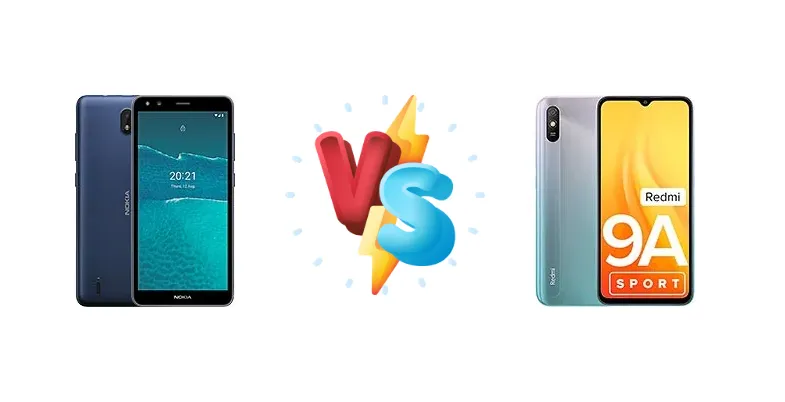
The ultra-budget smartphone segment is fiercely competitive. Both the Nokia C1 2nd Edition and the Xiaomi Redmi 9A Sport aim to deliver essential smartphone functionality at the lowest possible price. However, they take different approaches to achieving this, with the Redmi 9A Sport prioritizing processing power while the Nokia C1 focuses on a streamlined software experience.
🏆 Quick Verdict
For the average user, the Xiaomi Redmi 9A Sport is the better choice. Its MediaTek Helio G25 chipset, featuring an octa-core CPU, provides a significantly smoother and more responsive experience than the Nokia C1’s quad-core Unisoc SC7731e. While both phones are limited, the Redmi 9A Sport offers a more usable daily driver.
| Network |
|---|
| 2G bands | GSM 850 / 900 / 1800 / 1900 | GSM 850 / 900 / 1800 / 1900 |
| 3G bands | HSDPA 850 / 900 / 1900 / 2100 | HSDPA 850 / 900 / 2100 |
| 4G bands | - | 1, 3, 5, 8, 40, 41 |
| Speed | HSPA 21.1/5.76 Mbps | HSPA, LTE |
| Technology | GSM / HSPA | GSM / HSPA / LTE |
| | eMMC 5.1 | - |
| Launch |
|---|
| Announced | 2021, July 05 | 2021, September 28 |
| Status | Available. Released 2021, August 27 | Available. Released 2021, September 28 |
| Body |
|---|
| Build | Glass front, plastic back, plastic frame | - |
| Dimensions | 148 x 71.8 x 9.3 mm (5.83 x 2.83 x 0.37 in) | 164.9 x 77.1 x 9 mm (6.49 x 3.04 x 0.35 in) |
| SIM | Nano-SIM + Nano-SIM | Nano-SIM + Nano-SIM |
| Weight | 154 g (5.43 oz) | 194 g (6.84 oz) |
| | - | Water-repellent coating |
| Display |
|---|
| Resolution | 720 x 1440 pixels, 18:9 ratio (~295 ppi density) | 720 x 1600 pixels, 20:9 ratio (~269 ppi density) |
| Size | 5.45 inches, 76.7 cm2 (~72.1% screen-to-body ratio) | 6.53 inches, 102.9 cm2 (~81.0% screen-to-body ratio) |
| Type | TFT LCD | IPS LCD, 400 nits (typ) |
| Platform |
|---|
| CPU | Quad-core 1.3 GHz Cortex-A7 | Octa-core (4x2.0 GHz Cortex-A53 & 4x1.5 GHz Cortex-A53) |
| Chipset | Unisoc SC7731e | Mediatek MT6762G Helio G25 (12 nm) |
| GPU | Mali-400 MP2 | PowerVR GE8320 |
| OS | Android 11 (Go edition) | Android 10, MIUI 12 |
| Memory |
|---|
| Card slot | microSDXC | microSDXC (dedicated slot) |
| Internal | 16GB 1GB RAM | 32GB 2GB RAM, 32GB 3GB RAM |
| | - | eMMC 5.1 |
| Main Camera |
|---|
| Features | LED flash | LED flash, HDR |
| Single | 5 MP | 13 MP, f/2.2, 28mm (wide), 1.0µm, PDAF |
| Video | 720p@30fps | 1080p@30/60fps |
| Selfie camera |
|---|
| Features | LED flash | HDR |
| Single | 5 MP | 5 MP, f/2.2, (wide), 1.12µm |
| Video | 720p@30fps | 1080p@30fps |
| Sound |
|---|
| 3.5mm jack | Yes | Yes |
| 35mm jack | Yes | Yes |
| Loudspeaker | Yes | Yes |
| Comms |
|---|
| Bluetooth | 4.2, A2DP, LE | 5.0, A2DP, LE |
| NFC | No | No |
| Positioning | GPS | GPS, GLONASS, BDS |
| Radio | FM radio | FM radio |
| USB | microUSB 2.0 | microUSB 2.0, OTG |
| WLAN | Wi-Fi 802.11 b/g/n | Wi-Fi 802.11 a/b/g/n, Wi-Fi Direct |
| Features |
|---|
| Sensors | Accelerometer, proximity | Accelerometer, proximity |
| Battery |
|---|
| Charging | - | 10W wired |
| Type | Li-Ion 2500 mAh, removable | Li-Po 5000 mAh |
| Misc |
|---|
| Colors | Blue, Purple | Carbon Black, Coral Green, Metallic Blue |
| Models | TA-1380 | - |
| Price | About 50 EUR | About 100 EUR |
| SAR EU | 0.60 W/kg (head) 1.44 W/kg (body) | - |
Nokia C1 2nd Edition
- Clean Android Go Edition software
- Potentially lower price point
- Simple and easy to use
- Significantly weaker processor
- Limited multitasking capabilities
- Poor performance with demanding apps
Xiaomi Redmi 9A Sport
- More powerful MediaTek Helio G25 chipset
- Larger 5000mAh battery
- Better multitasking performance
- Software experience may include bloatware
- Slower 10W charging
- Basic camera quality
Display Comparison
Neither device boasts a standout display. Specifications for the Nokia C1 2nd Edition's display are sparse, but it's likely a basic LCD panel. The Redmi 9A Sport also features an LCD, but details regarding its brightness and color accuracy are unavailable. Given the price point, expect limited viewing angles and color reproduction on both. The focus here is purely on functionality, not visual fidelity.
Camera Comparison
Both phones feature basic camera setups. Details on the Nokia C1 2nd Edition's camera are limited, but it's unlikely to compete with the Redmi 9A Sport. The Redmi 9A Sport’s camera specifications are also modest, but the presence of a dedicated camera module suggests slightly better image processing capabilities. Expect limited low-light performance and average image quality from both devices. The inclusion of a 2MP macro camera on the Redmi 9A Sport is largely a marketing gimmick and offers minimal practical benefit.
Performance
This is where the Redmi 9A Sport truly shines. The MediaTek Helio G25, built on a 12nm process, is a substantial upgrade over the Unisoc SC7731e in the Nokia C1. The Helio G25’s octa-core configuration (4x2.0 GHz Cortex-A53 & 4x1.5 GHz Cortex-A53) provides significantly more processing power for multitasking and app loading. The Nokia C1’s quad-core 1.3 GHz Cortex-A7 processor will struggle with anything beyond the most basic tasks. This difference translates to a noticeably smoother experience on the Redmi 9A Sport, particularly when switching between apps or browsing the web. The 12nm process also suggests better power efficiency for the Redmi 9A Sport, though real-world battery life will depend on usage.
Battery Life
Battery capacity details for the Nokia C1 2nd Edition are unavailable. The Redmi 9A Sport features a 5000mAh battery and supports 10W wired charging. While 10W charging is slow by modern standards, it’s adequate for a device in this price range. The larger battery capacity of the Redmi 9A Sport, combined with the more efficient Helio G25 chipset, should provide all-day battery life for moderate usage. Without knowing the Nokia C1’s battery capacity, it’s difficult to make a direct comparison, but the Redmi 9A Sport likely has an advantage in longevity.
Buying Guide
Buy the Nokia C1 2nd Edition if you absolutely prioritize a clean, uncluttered Android Go Edition experience and minimal software overhead, and your usage is limited to very basic tasks like calls and messaging. Buy the Xiaomi Redmi 9A Sport if you prefer a more capable device for light multitasking, occasional gaming, and a generally snappier user interface, even if it means a slightly less streamlined software experience.
Frequently Asked Questions
❓ Will the Redmi 9A Sport struggle with popular apps like Facebook or WhatsApp?
While the Redmi 9A Sport isn't a powerhouse, the Helio G25 chipset is capable of running apps like Facebook and WhatsApp smoothly. You might experience some slowdown with multiple apps open simultaneously, but for basic social media usage, it should be sufficient.
❓ Is the Android Go Edition on the Nokia C1 2nd Edition a significant advantage for older users?
Android Go Edition is designed for devices with limited resources, offering a simplified interface and reduced bloatware. This can be beneficial for older users or those unfamiliar with Android, as it provides a cleaner and more intuitive experience. However, it also means fewer features and limited customization options.
❓ Can the Redmi 9A Sport handle light gaming?
The Redmi 9A Sport can handle some light gaming, but don't expect to play demanding titles at high settings. Games like Subway Surfers or Temple Run should run reasonably well, but more graphically intensive games will likely experience significant lag and frame drops.
❓ Does the Redmi 9A Sport have a headphone jack?
Yes, the Xiaomi Redmi 9A Sport includes a 3.5mm headphone jack, allowing you to connect wired headphones or earphones.