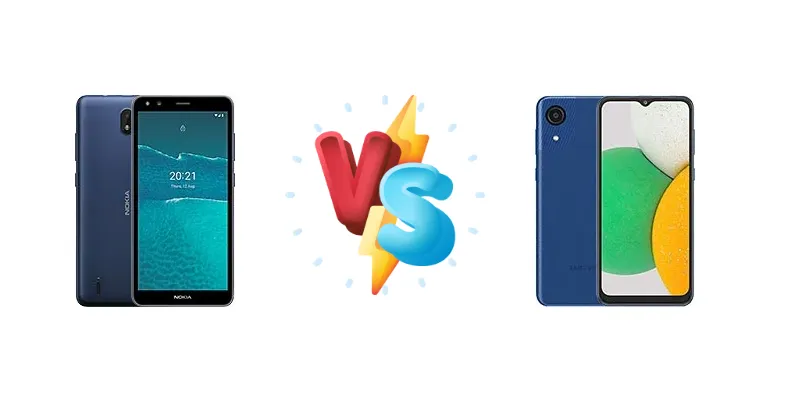
The Nokia C1 2nd Edition and Samsung Galaxy A03 Core represent the absolute entry point into smartphone ownership. Both devices target users prioritizing affordability, but significant differences in their underlying hardware dictate vastly different user experiences. This comparison dissects those differences, focusing on real-world performance implications rather than raw specifications.
🏆 Quick Verdict
For the average user needing a basic smartphone for calls, messaging, and light social media, the Samsung Galaxy A03 Core is the better choice. Its octa-core processor and more modern architecture provide a noticeably smoother experience than the Nokia C1 2nd Edition’s quad-core setup, justifying the slight price premium.
| Network |
|---|
| 2G bands | GSM 850 / 900 / 1800 / 1900 | GSM 850 / 900 / 1800 / 1900 |
| 3G bands | HSDPA 850 / 900 / 1900 / 2100 | HSDPA 850 / 900 / 2100 |
| 4G bands | - | 1, 3, 5, 7, 8, 20, 28, 38, 40, 41 |
| Speed | HSPA 21.1/5.76 Mbps | HSPA 21.1/5.76 Mbps, LTE |
| Technology | GSM / HSPA | GSM / HSPA / LTE |
| | eMMC 5.1 | - |
| Launch |
|---|
| Announced | 2021, July 05 | 2021, November 15 |
| Status | Available. Released 2021, August 27 | Available. Released 2021, December 06 |
| Body |
|---|
| Build | Glass front, plastic back, plastic frame | Plastic back, plastic frame |
| Dimensions | 148 x 71.8 x 9.3 mm (5.83 x 2.83 x 0.37 in) | 164.2 x 75.9 x 9.1 mm (6.46 x 2.99 x 0.36 in) |
| SIM | Nano-SIM + Nano-SIM | · Nano-SIM· Nano-SIM + Nano-SIM |
| Weight | 154 g (5.43 oz) | 211 g (7.44 oz) |
| Display |
|---|
| Resolution | 720 x 1440 pixels, 18:9 ratio (~295 ppi density) | 720 x 1600 pixels, 20:9 ratio (~270 ppi density) |
| Size | 5.45 inches, 76.7 cm2 (~72.1% screen-to-body ratio) | 6.5 inches, 102.0 cm2 (~81.8% screen-to-body ratio) |
| Type | TFT LCD | PLS LCD |
| Platform |
|---|
| CPU | Quad-core 1.3 GHz Cortex-A7 | Octa-core (4x1.6 GHz Cortex-A55 & 4x1.2 GHz Cortex-A55) |
| Chipset | Unisoc SC7731e | Unisoc SC9863A (28 nm) |
| GPU | Mali-400 MP2 | IMG8322 |
| OS | Android 11 (Go edition) | Android 11 (Go edition) |
| Memory |
|---|
| Card slot | microSDXC | microSDXC (dedicated slot) |
| Internal | 16GB 1GB RAM | 32GB 2GB RAM |
| | - | eMMC 5.1 |
| Main Camera |
|---|
| Features | LED flash | LED flash |
| Single | 5 MP | 8 MP, f/2.0, AF |
| Video | 720p@30fps | 1080p@30fps |
| Selfie camera |
|---|
| Features | LED flash | - |
| Single | 5 MP | 5 MP, f/2.2 |
| Video | 720p@30fps | - |
| Sound |
|---|
| 3.5mm jack | Yes | Yes |
| 35mm jack | Yes | Yes |
| Loudspeaker | Yes | Yes |
| Comms |
|---|
| Bluetooth | 4.2, A2DP, LE | 4.2, A2DP |
| NFC | No | No |
| Positioning | GPS | GPS, GLONASS |
| Radio | FM radio | Unspecified |
| USB | microUSB 2.0 | microUSB 2.0, OTG |
| WLAN | Wi-Fi 802.11 b/g/n | Wi-Fi 802.11 b/g/n, Wi-Fi Direct |
| Features |
|---|
| Sensors | Accelerometer, proximity | Accelerometer, proximity |
| Battery |
|---|
| Type | Li-Ion 2500 mAh, removable | Li-Ion 5000 mAh |
| Misc |
|---|
| Colors | Blue, Purple | Black, Blue |
| Models | TA-1380 | SM-A032F, SM-A032F/DS, SM-A032M |
| Price | About 50 EUR | £ 74.99 |
| SAR | - | 0.30 W/kg (head) |
| SAR EU | 0.60 W/kg (head) 1.44 W/kg (body) | 0.24 W/kg (head) 1.39 W/kg (body) |
Nokia C1 2nd Edition
- Lowest possible price point
- Compact size for easy one-handed use
- Runs Android Go Edition for optimized performance on limited hardware
- Significantly slower performance
- Outdated processor architecture
- Likely poor camera quality
Samsung Galaxy A03 Core
- Faster and more responsive performance
- More modern processor architecture
- Larger display for better media consumption
- Slightly higher price
- Still limited performance for demanding tasks
- Camera quality remains basic
Display Comparison
Neither device boasts a standout display. Both likely utilize LCD panels, and specific details like resolution and brightness are not provided. However, the A03 Core’s larger 6.6-inch display (versus the C1’s 6.08-inch) offers more screen real estate. The lack of information on color accuracy or viewing angles suggests both displays are geared towards basic functionality rather than media consumption. Expect washed-out colors and limited visibility in direct sunlight on both.
Camera Comparison
Camera performance on both devices is expected to be basic. Details are scarce, but both likely feature a primary camera and potentially a secondary depth sensor. The A03 Core’s camera system, while likely still low-resolution, benefits from the more capable image signal processor (ISP) within the SC9863A chipset. This allows for better image processing, potentially resulting in slightly more detailed and vibrant photos. The Nokia C1 2nd Edition’s camera will likely struggle in low-light conditions and produce noticeably softer images. Any 2MP macro or depth sensors on either device should be considered marketing fluff rather than genuine photographic tools.
Performance
The performance gap is the most significant differentiator. The Samsung Galaxy A03 Core’s Unisoc SC9863A, with its octa-core configuration (4x1.6 GHz Cortex-A55 & 4x1.2 GHz Cortex-A55), represents a substantial upgrade over the Nokia C1 2nd Edition’s Unisoc SC7731e quad-core 1.3 GHz Cortex-A7. The Cortex-A55 cores in the A03 Core are architecturally superior to the older Cortex-A7, offering improved instructions per clock cycle. This translates to faster app loading times, smoother scrolling, and a more responsive overall experience. While neither chip is a powerhouse, the A03 Core will handle multitasking and basic gaming far more effectively. The 28nm process node of the SC9863A, while not cutting-edge, is more efficient than whatever process is used in the SC7731e, potentially leading to slightly better battery life under load.
Battery Life
Battery capacity is not specified for either device, but both likely house batteries in the 3000-4000 mAh range. The Samsung Galaxy A03 Core’s more efficient chipset and larger display (requiring more power, but offset by efficiency gains) will likely result in comparable, if not slightly better, battery life. Charging wattage is also unknown, but both devices likely support slow charging speeds, meaning a full charge will take several hours.
Buying Guide
Buy the Nokia C1 2nd Edition if you absolutely need the lowest possible price point and are willing to tolerate significant performance limitations. It’s suitable for first-time smartphone users with minimal expectations. Buy the Samsung Galaxy A03 Core if you prioritize a more responsive user interface, smoother multitasking, and a slightly better experience with modern apps, even if it means spending a bit more.
Frequently Asked Questions
❓ Will the Samsung Galaxy A03 Core struggle with popular apps like WhatsApp and Facebook?
While the A03 Core won't offer a flagship-level experience, its octa-core processor and more modern architecture should handle WhatsApp and Facebook without significant lag. However, running multiple apps simultaneously or using resource-intensive features within these apps may cause slowdowns. The Nokia C1 2nd Edition will struggle more noticeably with these apps.
❓ Is the Unisoc SC9863A chip known to overheat during prolonged use?
The Unisoc SC9863A is a low-power chip designed for entry-level smartphones. Overheating is unlikely during typical usage scenarios like browsing, calling, and messaging. However, extended gaming sessions or running demanding apps may cause the device to warm up, but it shouldn't reach critical temperatures. The Nokia C1 2nd Edition, with its less efficient processor, may exhibit similar thermal behavior with even less demanding tasks.
❓ Can either of these phones run PUBG Mobile?
Both phones will struggle to run PUBG Mobile smoothly, even on the lowest graphics settings. The Nokia C1 2nd Edition is unlikely to be playable due to its limited processing power. The Samsung Galaxy A03 Core *might* be able to run the game at very low settings with significant frame rate drops and lag, but it won't be an enjoyable experience.