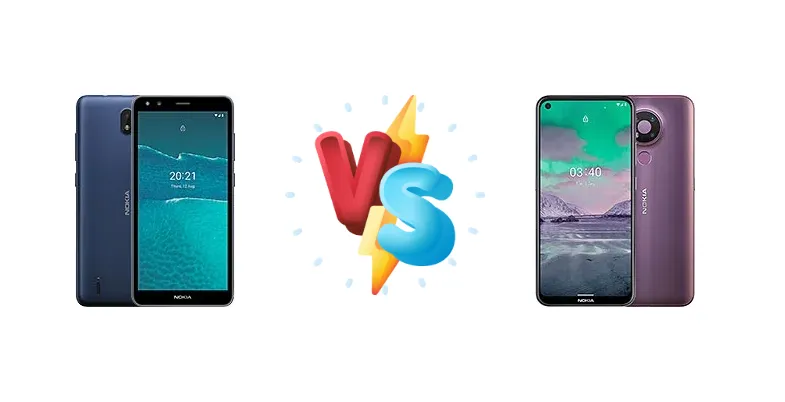
Looking for an affordable Nokia smartphone? The C1 2nd Edition and Nokia 3.4 are both contenders, but they cater to different needs. This comprehensive comparison will help you decide which one is the right fit for your budget and usage.
🏆 Quick Verdict
The Nokia 3.4 is the clear winner. Its Snapdragon 460 chipset offers significantly better performance, a more modern design, and a better camera experience compared to the C1 2nd Edition's entry-level Unisoc processor. While the C1 2nd Edition is cheaper, the 3.4 provides better value.
| Network |
|---|
| 2G bands | GSM 850 / 900 / 1800 / 1900 | GSM 850 / 900 / 1800 / 1900 |
| 3G bands | HSDPA 850 / 900 / 1900 / 2100 | HSDPA 850 / 900 / 1700(AWS) / 1900 / 2100 |
| 4G bands | - | 1, 2, 3, 4, 5, 7, 8, 12, 17, 13, 28, 66 |
| Speed | HSPA 21.1/5.76 Mbps | HSPA, LTE |
| Technology | GSM / HSPA | GSM / HSPA / LTE |
| | eMMC 5.1 | - |
| Launch |
|---|
| Announced | 2021, July 05 | 2020, September 22. Released 2020, October 26 |
| Status | Available. Released 2021, August 27 | Discontinued |
| Body |
|---|
| Build | Glass front, plastic back, plastic frame | - |
| Dimensions | 148 x 71.8 x 9.3 mm (5.83 x 2.83 x 0.37 in) | 161 x 76 x 8.7 mm (6.34 x 2.99 x 0.34 in) |
| SIM | Nano-SIM + Nano-SIM | · Nano-SIM· Nano-SIM + Nano-SIM |
| Weight | 154 g (5.43 oz) | 180 g (6.35 oz) |
| Display |
|---|
| Resolution | 720 x 1440 pixels, 18:9 ratio (~295 ppi density) | 720 x 1560 pixels, 19.5:9 ratio (~269 ppi density) |
| Size | 5.45 inches, 76.7 cm2 (~72.1% screen-to-body ratio) | 6.39 inches, 100.2 cm2 (~81.9% screen-to-body ratio) |
| Type | TFT LCD | IPS LCD, 400 nits (typ) |
| Platform |
|---|
| CPU | Quad-core 1.3 GHz Cortex-A7 | Octa-core (4x1.8 GHz Cortex-A73 & 4x1.8 GHz Cortex-A53) |
| Chipset | Unisoc SC7731e | Qualcomm SM4250 Snapdragon 460 (11 nm) |
| GPU | Mali-400 MP2 | Adreno 610 |
| OS | Android 11 (Go edition) | Android 10, upgradable to Android 11 |
| Memory |
|---|
| Card slot | microSDXC | microSDXC (dedicated slot) |
| Internal | 16GB 1GB RAM | 32GB 3GB RAM, 64GB 3GB RAM, 64GB 4GB RAM |
| | - | eMMC 5.1 |
| Main Camera |
|---|
| Features | LED flash | LED flash, HDR, panorama |
| Single | 5 MP | - |
| Triple | - | 13 MP, (wide), PDAF
5 MP, (ultrawide)
Auxiliary lens |
| Video | 720p@30fps | 1080p@30fps |
| Selfie camera |
|---|
| Features | LED flash | - |
| Single | 5 MP | 8 MP, (wide) |
| Video | 720p@30fps | 1080p@30fps |
| Sound |
|---|
| 3.5mm jack | Yes | Yes |
| 35mm jack | Yes | Yes |
| Loudspeaker | Yes | Yes |
| Comms |
|---|
| Bluetooth | 4.2, A2DP, LE | 4.2, A2DP, aptX |
| NFC | No | Yes (market/region dependent) |
| Positioning | GPS | GPS, GLONASS, GALILEO, BDS |
| Radio | FM radio | FM radio |
| USB | microUSB 2.0 | USB Type-C 2.0 |
| WLAN | Wi-Fi 802.11 b/g/n | Wi-Fi 802.11 b/g/n |
| Features |
|---|
| Sensors | Accelerometer, proximity | Fingerprint (rear-mounted), accelerometer, gyro, proximity |
| Battery |
|---|
| Charging | - | 10W wired |
| Type | Li-Ion 2500 mAh, removable | Li-Po 4000 mAh |
| Misc |
|---|
| Colors | Blue, Purple | Fjord, Dusk, Charcoal |
| Models | TA-1380 | TA-1288, TA-1285, TA-1283 |
| Price | About 50 EUR | About 100 EUR |
| SAR | - | 0.83 W/kg (head) 1.05 W/kg (body) |
| SAR EU | 0.60 W/kg (head) 1.44 W/kg (body) | 0.36 W/kg (head) 1.56 W/kg (body) |
Nokia C1 2nd Edition
- Extremely affordable
- Durable build quality (typical of Nokia)
- Android Go Edition (optimized for low-end hardware)
- Very limited performance
- Basic camera
- Small battery
- Outdated chipset
Nokia 3.4
- Better performance thanks to Snapdragon 460
- Improved camera system
- Larger display
- Modern design
- 10W charging
- Slightly more expensive than the C1 2nd Edition
- HD+ resolution may not appeal to everyone
Display Comparison
The Nokia 3.4 features a 6.39-inch HD+ display, offering a larger and more immersive viewing experience than the C1 2nd Edition's likely smaller display (estimated around 6.1 inches). While both are HD+, the 3.4's larger size provides a noticeable advantage for media consumption and browsing.
Camera Comparison
The Nokia 3.4 boasts a triple-camera setup (13MP main + 5MP ultrawide + 2MP depth sensor) offering more versatility. The C1 2nd Edition likely has a basic single camera setup (estimated 5MP). Image quality and features will be significantly better on the 3.4.
Performance
This is where the Nokia 3.4 shines. The Snapdragon 460 is a substantial upgrade over the Unisoc SC7731e. Expect smoother multitasking, faster app loading times, and a generally more responsive user experience on the 3.4. The C1 2nd Edition will likely struggle with more demanding apps and multitasking.
Battery Life
Both phones offer decent battery life, but the Nokia 3.4's 4000mAh battery, coupled with the more efficient Snapdragon 460, likely provides slightly longer usage times than the C1 2nd Edition's smaller battery (estimated 3000mAh).
Buying Guide
The Nokia C1 2nd Edition is ideal for users who prioritize the absolute lowest price and need basic functionality like calls, texts, and light app usage. The Nokia 3.4 is a better choice for those who want a smoother experience, a decent camera, and a more modern smartphone feel, even on a budget.
Frequently Asked Questions
❓ Is the Nokia C1 2nd Edition good for gaming?
No, the C1 2nd Edition's chipset is not powerful enough for demanding games. It can handle very basic games, but performance will be limited.
❓ Which Nokia phone has better software support?
Nokia generally provides good software updates. However, the Nokia 3.4 is likely to receive updates for a longer period due to its more modern hardware.