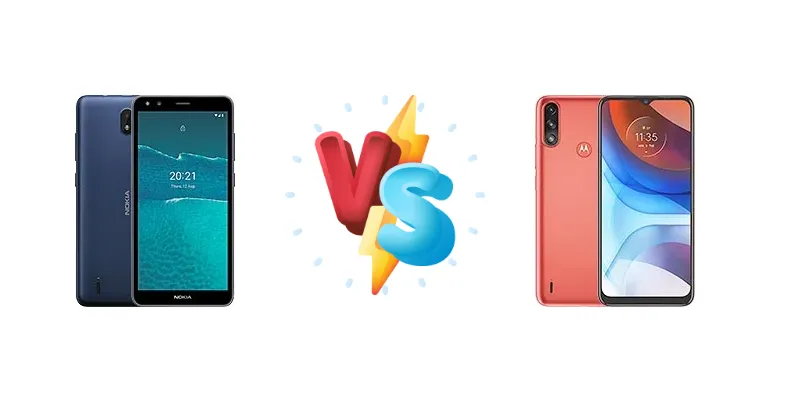
The sub-$100 smartphone market is fiercely competitive. Both the Nokia C1 2nd Edition and the Motorola Moto E7i Power aim to deliver essential smartphone functionality at an incredibly low price point. However, they take different approaches to achieving this, with the Motorola leveraging a more modern, albeit still entry-level, chipset while the Nokia opts for a simpler, older design. This comparison will break down the key differences to help you choose the best option for your needs.
🏆 Quick Verdict
For most users, the Motorola Moto E7i Power is the better choice. Its Unisoc SC9863A chipset, featuring an octa-core CPU, provides a significantly smoother and more responsive experience than the Nokia C1 2nd Edition’s quad-core Unisoc SC7731e. While both phones are limited, the Moto E7i Power offers a tangible performance advantage for everyday tasks.
| Network |
|---|
| 2G bands | GSM 850 / 900 / 1800 / 1900 | GSM 850 / 900 / 1800 / 1900 |
| 3G bands | HSDPA 850 / 900 / 1900 / 2100 | HSDPA 850 / 900 / 1700(AWS) / 1900 / 2100 |
| 4G bands | - | LTE |
| Speed | HSPA 21.1/5.76 Mbps | HSPA, LTE |
| Technology | GSM / HSPA | GSM / HSPA / LTE |
| | eMMC 5.1 | - |
| Launch |
|---|
| Announced | 2021, July 05 | 2021, February 23 |
| Status | Available. Released 2021, August 27 | Available. Released 2021, March 15 |
| Body |
|---|
| Build | Glass front, plastic back, plastic frame | Glass front, plastic back, plastic frame |
| Dimensions | 148 x 71.8 x 9.3 mm (5.83 x 2.83 x 0.37 in) | 165.1 x 75.9 x 9.2 mm (6.5 x 2.99 x 0.36 in) |
| SIM | Nano-SIM + Nano-SIM | Nano-SIM + Nano-SIM |
| Weight | 154 g (5.43 oz) | 200 g (7.05 oz) |
| | - | Water-repellent design |
| Display |
|---|
| Resolution | 720 x 1440 pixels, 18:9 ratio (~295 ppi density) | 720 x 1600 pixels, 20:9 ratio (~270 ppi density) |
| Size | 5.45 inches, 76.7 cm2 (~72.1% screen-to-body ratio) | 6.51 inches, 102.3 cm2 (~81.7% screen-to-body ratio) |
| Type | TFT LCD | IPS LCD, 380 nits (typ) |
| Platform |
|---|
| CPU | Quad-core 1.3 GHz Cortex-A7 | Octa-core (4x1.6 GHz Cortex-A55 & 4x1.2 GHz Cortex-A55) |
| Chipset | Unisoc SC7731e | Unisoc SC9863A (28 nm) |
| GPU | Mali-400 MP2 | IMG8322 |
| OS | Android 11 (Go edition) | Android 10 (Go edition) |
| Memory |
|---|
| Card slot | microSDXC | microSDXC (uses shared SIM slot) |
| Internal | 16GB 1GB RAM | 32GB 2GB RAM |
| | - | eMMC 5.1 |
| Main Camera |
|---|
| Dual | - | 13 MP, f/2.0, 26mm (wide), 1/3.1", 1.12µm, PDAF
2 MP (macro) |
| Features | LED flash | LED flash, HDR, panorama |
| Single | 5 MP | - |
| Video | 720p@30fps | 1080p@30fps |
| Selfie camera |
|---|
| Features | LED flash | HDR |
| Single | 5 MP | 5 MP, f/2.2, 27mm (wide), 1.12µm |
| Video | 720p@30fps | 1080p@30fps |
| Sound |
|---|
| 3.5mm jack | Yes | Yes |
| 35mm jack | Yes | Yes |
| Loudspeaker | Yes | Yes |
| Comms |
|---|
| Bluetooth | 4.2, A2DP, LE | 4.2, A2DP |
| NFC | No | No |
| Positioning | GPS | GPS, GLONASS, GALILEO |
| Radio | FM radio | Unspecified |
| USB | microUSB 2.0 | USB Type-C 2.0 |
| WLAN | Wi-Fi 802.11 b/g/n | Wi-Fi 802.11 b/g/n |
| Features |
|---|
| Sensors | Accelerometer, proximity | Fingerprint (rear-mounted), accelerometer, proximity |
| Battery |
|---|
| Charging | - | 10W wired |
| Type | Li-Ion 2500 mAh, removable | Li-Ion 5000 mAh |
| Misc |
|---|
| Colors | Blue, Purple | Tahiti Blue, Coral Red |
| Models | TA-1380 | XT2097-13 |
| Price | About 50 EUR | About 120 EUR |
| SAR EU | 0.60 W/kg (head) 1.44 W/kg (body) | - |
Nokia C1 2nd Edition
- Potentially longer software support from Nokia.
- Simpler user interface for tech novices.
- Likely better power efficiency due to the less powerful processor.
- Significantly slower performance.
- Outdated processor architecture.
- Limited multitasking capabilities.
Motorola Moto E7i Power
- Faster and more responsive performance.
- Octa-core processor for smoother multitasking.
- More efficient processor architecture (Cortex-A55).
- Potentially shorter software support lifecycle.
- 10W charging is relatively slow.
- May experience faster battery drain under heavy use.
Display Comparison
Neither device boasts a standout display. Both are likely to feature basic LCD panels with resolutions around 720p+, typical for this price bracket. However, the lack of detailed display specifications makes direct comparison difficult. We can assume both will prioritize power efficiency over brightness or color accuracy. Bezels are likely to be substantial on both devices, maximizing screen real estate within a compact form factor. The absence of features like high PWM dimming rates or Gorilla Glass suggests neither is optimized for prolonged viewing or durability.
Camera Comparison
Both phones likely feature basic camera setups. Given the price point, image quality will be limited. The Motorola Moto E7i Power likely has a slightly better sensor, but without specific megapixel counts or aperture information, it’s difficult to say definitively. It’s safe to assume both will struggle in low-light conditions. The inclusion of a 2MP macro camera on either device is largely a marketing gimmick, offering minimal practical benefit due to the low resolution and lack of optical image stabilization. Expect heavily processed images from both.
Performance
The Motorola Moto E7i Power’s Unisoc SC9863A is the clear winner here. Its octa-core configuration (4x1.6 GHz Cortex-A55 & 4x1.2 GHz Cortex-A55) offers a substantial advantage over the Nokia C1 2nd Edition’s quad-core 1.3 GHz Cortex-A7. The Cortex-A55 cores in the Motorola are more efficient and capable than the older Cortex-A7 cores in the Nokia. The 28nm process node of the SC9863A, while not cutting-edge, is still more efficient than whatever process node the SC7731e utilizes. This translates to smoother multitasking, faster app loading times, and a generally more fluid user experience on the Motorola. The Nokia will struggle with even moderately demanding tasks.
Battery Life
The Motorola Moto E7i Power includes 10W wired charging, a modest but functional feature. While battery capacity isn’t specified, the SC9863A’s improved efficiency may offset a potentially smaller battery compared to the Nokia. The Nokia C1 2nd Edition’s power efficiency will be higher due to the less powerful processor, but the overall user experience will be hampered by the slow processor. Expect both phones to offer all-day battery life with light usage, but the Motorola’s faster processor will drain the battery more quickly under load.
Buying Guide
Buy the Nokia C1 2nd Edition if you prioritize extreme simplicity and a potentially longer software support lifespan from Nokia, understanding that performance will be noticeably slower. Buy the Motorola Moto E7i Power if you prefer a more responsive user experience, even for basic tasks, and value the benefits of an octa-core processor, despite the potential for slightly shorter software updates. The Moto E7i Power is the better option for anyone who regularly uses apps or browses the web.
Frequently Asked Questions
❓ Will the Motorola Moto E7i Power struggle with popular social media apps like Facebook and Instagram?
While the Moto E7i Power won't offer a flagship-level experience, its octa-core processor should handle Facebook and Instagram reasonably well. Expect some occasional slowdowns when scrolling through image-heavy feeds, but it will be significantly smoother than the Nokia C1 2nd Edition, which will likely struggle with these apps.
❓ Is the Nokia C1 2nd Edition a good choice for a first smartphone for an elderly user?
The Nokia C1 2nd Edition's simplicity could be appealing to a first-time smartphone user, particularly an elderly individual. However, its slow performance may lead to frustration. The simpler interface is a benefit, but the lack of responsiveness could be a significant drawback. Consider if the user prioritizes ease of use over speed.
❓ Can either of these phones run popular mobile games like PUBG Mobile or Call of Duty Mobile?
Neither phone is suitable for playing demanding games like PUBG Mobile or Call of Duty Mobile. The processors lack the graphical power and RAM to provide a playable experience. You might be able to run very basic, older games, but don't expect anything beyond that.
❓ What kind of storage options are available on these devices?
Storage options are typically limited on phones in this price range. Both the Nokia C1 2nd Edition and Motorola Moto E7i Power likely come with 16GB or 32GB of internal storage, with microSD card support for expansion. However, the speed of the microSD card slot will likely be limited.