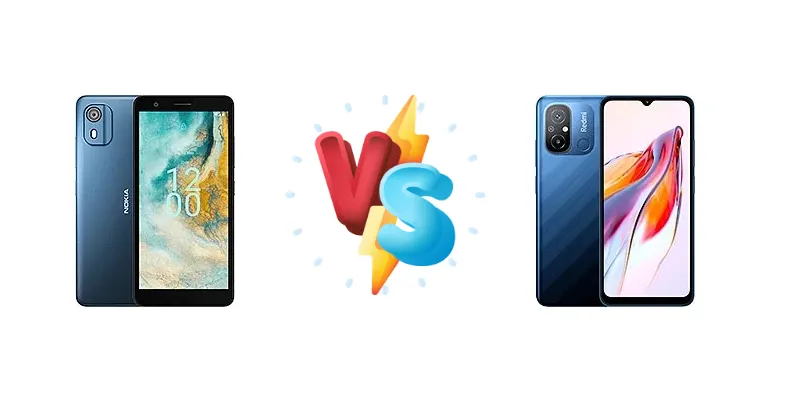
The sub-$150 smartphone market is fiercely competitive. The Nokia C02 represents a focus on essential functionality and affordability, while the Xiaomi Redmi 12C aims to deliver more performance for a similar price. This comparison dissects the core differences between these two devices, helping you determine which best suits your needs.
🏆 Quick Verdict
For most users, the Xiaomi Redmi 12C is the clear winner. Its Mediatek Helio G85 chipset provides a substantial performance uplift over the Nokia C02’s quad-core processor, making it significantly better for multitasking, gaming, and general responsiveness. While the Nokia C02 offers a simpler experience, the Redmi 12C’s extra power is worth the trade-off.
| Network |
|---|
| 2G bands | GSM 850 / 900 / 1800 / 1900 | GSM 850 / 900 / 1800 / 1900 |
| 3G bands | HSDPA 850 / 900 / 2100 | HSDPA 850 / 900 / 2100 |
| 4G bands | LTE | 1, 3, 5, 7, 8, 20, 28, 38, 40, 41 - International |
| Speed | HSPA, LTE | HSPA, LTE |
| Technology | GSM / HSPA / LTE | GSM / CDMA / HSPA / EVDO / LTE |
| | - | CDMA2000 1xEV-DO |
| Launch |
|---|
| Announced | 2023, February 23 | 2022, December 31 |
| Status | Available. Released 2023, May | Available. Released 2023, January 01 |
| Body |
|---|
| Build | Plastic back, plastic frame | - |
| Dimensions | 148.7 x 71.2 x 10 mm (5.85 x 2.80 x 0.39 in) | 168.8 x 76.4 x 8.8 mm (6.65 x 3.01 x 0.35 in) |
| SIM | Nano-SIM + Nano-SIM | Nano-SIM + Nano-SIM |
| Weight | 191 g (6.74 oz) | 192 g (6.77 oz) |
| | Splash and dust resistant | - |
| Display |
|---|
| Resolution | 720 x 1440 pixels, 18:9 ratio (~295 ppi density) | 720 x 1650 pixels (~268 ppi density) |
| Size | 5.45 inches, 76.7 cm2 (~72.4% screen-to-body ratio) | 6.71 inches, 106.5 cm2 (~82.6% screen-to-body ratio) |
| Type | IPS LCD | IPS LCD, 500 nits (typ) |
| Platform |
|---|
| CPU | Quad-core 1.4 GHz | Octa-core (2x2.0 GHz Cortex-A75 & 6x1.8 GHz Cortex-A55) |
| Chipset | - | Mediatek MT6769Z Helio G85 (12 nm) |
| GPU | - | Mali-G52 MC2 |
| OS | Android 12 (Go edition) | Android 12, MIUI 13 |
| Memory |
|---|
| Card slot | microSDXC | microSDXC (dedicated slot) |
| Internal | 32GB 2GB RAM | 32GB 2GB RAM, 32GB 3GB RAM, 32GB 4GB RAM, 64GB 3GB RAM, 64GB 4GB RAM, 128GB 3GB RAM, 128GB 4GB RAM, 128GB 6GB RAM |
| | eMMC 5.1 | eMMC 5.1 |
| Main Camera |
|---|
| Dual | - | 50 MP, (wide), PDAF
0.08 MP (depth) |
| Features | LED flash, HDR | LED flash, HDR |
| Single | 5 MP | 50 MP, f/1.8, (wide), 1/2.76", PDAF
Auxiliary lens |
| Video | 720p@30fps | 1080p@30fps |
| Selfie camera |
|---|
| Single | 2 MP | 5 MP, f/2.2, (wide) |
| Video | 720p@30fps | 1080p@30fps |
| Sound |
|---|
| 3.5mm jack | Yes | Yes |
| 35mm jack | Yes | Yes |
| Loudspeaker | Yes | Yes |
| Comms |
|---|
| Bluetooth | 4.2, A2DP, LE | 5.1, A2DP, LE |
| NFC | No | Yes (market/region dependent) |
| Positioning | GPS | GPS, GLONASS, BDS, GALILEO |
| Radio | Unspecified | FM radio |
| USB | microUSB 2.0 | microUSB 2.0 |
| WLAN | Wi-Fi 802.11 b/g/n | Wi-Fi 802.11 a/b/g/n/ac, dual-band, Wi-Fi Direct |
| Features |
|---|
| Sensors | Accelerometer | Fingerprint (rear-mounted), accelerometer |
| | - | Virtual proximity sensing |
| Battery |
|---|
| Charging | - | 10W wired |
| Type | Li-Ion 3000 mAh, removable | Li-Po 5000 mAh |
| Misc |
|---|
| Colors | Dark Cyan, Charcoal | Graphite Gray, Ocean Blue, Mint Green, Lavender Purple |
| Models | - | 22120RN86G, 22120RN86I, 22126RN91Y, 2212ARNC4L |
| Price | - | £ 132.99 / € 107.41 |
| SAR | - | 1.08 W/kg (head) 0.64 W/kg (body) |
| SAR EU | - | 0.98 W/kg (head) 0.99 W/kg (body) |
Nokia C02
- Potentially longer software support (Nokia brand reputation)
- Simpler user experience
- Focus on essential functionality
- Significantly slower performance
- Limited multitasking capabilities
- Basic camera system
Xiaomi Redmi 12C
- Much faster performance with Helio G85
- Larger display for media consumption
- Larger 5000mAh battery
- Slower 10W charging
- Potentially less frequent software updates
- Larger form factor may not suit all users
Display Comparison
Neither device boasts a standout display. The Nokia C02’s display specifications are not provided, suggesting a basic LCD panel. The Redmi 12C also utilizes an LCD, but its larger 6.71-inch size offers more screen real estate. While neither is expected to have high brightness or color accuracy, the Redmi 12C’s larger size is a practical advantage for media consumption. Both likely feature standard 60Hz refresh rates, prioritizing battery life over smooth scrolling.
Camera Comparison
Camera performance is likely to be similar on both devices, leaning towards basic functionality. Neither phone is expected to excel in image quality. The Redmi 12C’s camera specifications are not detailed enough to assess sensor size or aperture, but it’s reasonable to assume a standard configuration for this price point. The Nokia C02’s camera details are also missing. Users should expect acceptable photos in good lighting conditions, but limited performance in low light. Focusing on the primary sensor is key, as any additional sensors on either device are likely to be low-resolution and offer minimal benefit.
Performance
This is where the Redmi 12C truly shines. The Nokia C02’s quad-core 1.4 GHz processor is designed for minimal power consumption, resulting in limited performance. In contrast, the Redmi 12C’s Mediatek Helio G85 is an octa-core chipset (2x2.0 GHz Cortex-A75 & 6x1.8 GHz Cortex-A55) built on a more efficient 12nm process. The Helio G85’s architecture, with its higher clock speeds and more cores, delivers significantly faster processing speeds, making the Redmi 12C far more capable of handling demanding apps and multitasking. The Redmi 12C will offer a noticeably smoother and more responsive experience.
Battery Life
The Nokia C02’s battery capacity is not specified, but given its focus on simplicity, it’s likely a modest size. The Redmi 12C features a 5000mAh battery, providing ample capacity for all-day use with moderate usage. However, the Redmi 12C is limited to 10W wired charging, meaning a full charge will take a considerable amount of time. While the Nokia C02’s charging speed is also unknown, it’s unlikely to be significantly faster. The Redmi 12C’s larger battery capacity provides a clear advantage in longevity, despite the slower charging speed.
Buying Guide
Buy the Nokia C02 if you prioritize extreme simplicity, a potentially longer software support lifespan (based on Nokia’s brand promise), and need a phone for absolutely basic tasks like calls and texts. Buy the Xiaomi Redmi 12C if you want a phone capable of handling social media, light gaming, and everyday apps without significant lag, and appreciate a more responsive user experience.
Frequently Asked Questions
❓ Will the Redmi 12C struggle with popular apps like Facebook and WhatsApp?
No, the Helio G85 chipset in the Redmi 12C is more than capable of running Facebook, WhatsApp, and other common social media apps smoothly. While it won't offer a flagship-level experience, it will provide a responsive and usable experience for these everyday tasks.
❓ Is the Nokia C02 a good choice for someone who primarily uses their phone for calls and texts?
Yes, the Nokia C02 is well-suited for basic communication. Its focus on simplicity and potentially longer software support makes it a reliable option for users who prioritize calls and texts over advanced features or performance.
❓ Can the Redmi 12C handle light gaming?
The Redmi 12C can handle some light gaming, but don't expect to play demanding titles at high settings. The Helio G85 is a gaming-focused chipset, but it's still an entry-level processor. Games like PUBG Mobile will likely require lower graphics settings to maintain a playable frame rate.
❓ What about software updates? Which phone will get updates for longer?
Nokia has a reputation for providing relatively timely software updates, even on its budget devices. Xiaomi's update schedule can be less predictable. However, both phones are likely to receive security updates for a reasonable period, but the Nokia C02 *may* have a slight edge in long-term software support.