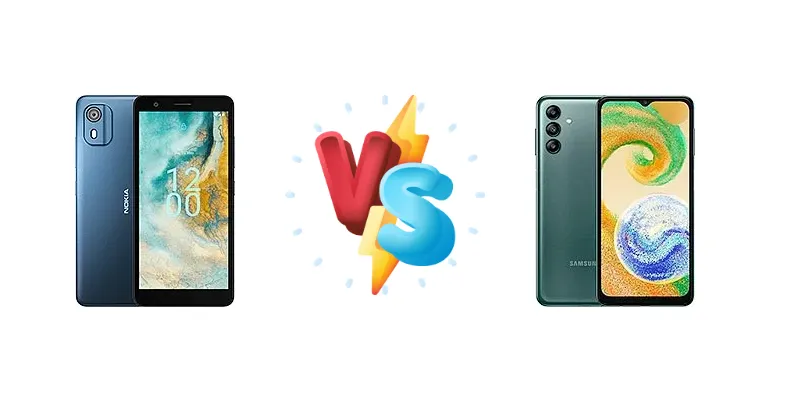
The Nokia C02 and Samsung Galaxy A04s represent the extreme end of the smartphone price spectrum. Both aim to deliver essential functionality at a minimal cost, but they take different approaches. The C02 focuses on simplicity, while the A04s attempts to offer a more well-rounded experience with a more powerful chipset and a brighter display.
🏆 Quick Verdict
For the vast majority of users, the Samsung Galaxy A04s is the better choice. Its Exynos 850 chipset provides significantly more processing power than the Nokia C02’s quad-core CPU, resulting in a smoother user experience. The A04s also boasts a brighter display and a comparable battery life, making it a more versatile device.
| Network |
|---|
| 2G bands | GSM 850 / 900 / 1800 / 1900 | GSM 850 / 900 / 1800 / 1900 |
| 3G bands | HSDPA 850 / 900 / 2100 | HSDPA 850 / 900 / 2100 |
| 4G bands | LTE | 1, 3, 5, 7, 8, 20, 28, 38, 40, 41 |
| Speed | HSPA, LTE | HSPA, LTE |
| Technology | GSM / HSPA / LTE | GSM / HSPA / LTE |
| Launch |
|---|
| Announced | 2023, February 23 | 2022, August 31 |
| Status | Available. Released 2023, May | Available. Released 2022, September 22 |
| Body |
|---|
| Build | Plastic back, plastic frame | Glass front, plastic back, plastic frame |
| Dimensions | 148.7 x 71.2 x 10 mm (5.85 x 2.80 x 0.39 in) | 164.7 x 76.7 x 9.1 mm (6.48 x 3.02 x 0.36 in) |
| SIM | Nano-SIM + Nano-SIM | Nano-SIM + Nano-SIM |
| Weight | 191 g (6.74 oz) | 195 g (6.88 oz) |
| | Splash and dust resistant | - |
| Display |
|---|
| Resolution | 720 x 1440 pixels, 18:9 ratio (~295 ppi density) | 720 x 1600 pixels, 20:9 ratio (~270 ppi density) |
| Size | 5.45 inches, 76.7 cm2 (~72.4% screen-to-body ratio) | 6.5 inches, 102.0 cm2 (~80.7% screen-to-body ratio) |
| Type | IPS LCD | PLS LCD, 90Hz, 400 nits (peak) |
| Platform |
|---|
| CPU | Quad-core 1.4 GHz | Octa-core (4x2.0 GHz Cortex-A55 & 4x2.0 GHz Cortex-A55) |
| Chipset | - | Exynos 850 (8 nm) |
| GPU | - | Mali-G52 |
| OS | Android 12 (Go edition) | Android 12, upgradable to Android 14, One UI 6.1 |
| Memory |
|---|
| Card slot | microSDXC | microSDXC (dedicated slot) |
| Internal | 32GB 2GB RAM | 32GB 3GB RAM, 32GB 4GB RAM, 64GB 3GB RAM, 64GB 4GB RAM, 128GB 3GB RAM, 128GB 4GB RAM |
| | eMMC 5.1 | eMMC 5.1 |
| Main Camera |
|---|
| Features | LED flash, HDR | LED flash, panorama, HDR |
| Single | 5 MP | - |
| Triple | - | 50 MP, f/1.8, 26mm (wide), 1/2.76", 0.64µm, PDAF
2 MP (macro)
Auxiliary lens |
| Video | 720p@30fps | 1080p@30fps |
| Selfie camera |
|---|
| Single | 2 MP | 5 MP, f/2.2, (wide) |
| Video | 720p@30fps | 720p@30fps |
| Sound |
|---|
| 3.5mm jack | Yes | Yes |
| 35mm jack | Yes | Yes |
| Loudspeaker | Yes | Yes |
| Comms |
|---|
| Bluetooth | 4.2, A2DP, LE | 5.0, A2DP, LE |
| NFC | No | Yes (market/region dependent) |
| Positioning | GPS | GPS, GLONASS, BDS, GALILEO, QZSS |
| Radio | Unspecified | No |
| USB | microUSB 2.0 | USB Type-C 2.0 |
| WLAN | Wi-Fi 802.11 b/g/n | Wi-Fi 802.11 a/b/g/n/ac, dual-band, Wi-Fi Direct |
| Features |
|---|
| Sensors | Accelerometer | Fingerprint (side-mounted), accelerometer |
| | - | Virtual Proximity Sensing |
| Battery |
|---|
| Charging | - | 15W wired |
| Type | Li-Ion 3000 mAh, removable | Li-Po 5000 mAh |
| Misc |
|---|
| Colors | Dark Cyan, Charcoal | Black, Green, White, Copper |
| Models | - | SM-A047F, SM-A047F/DS, SM-A047F/DSN, SM-A047M |
| Price | - | € 133.89 |
| SAR EU | - | 0.52 W/kg (head) 1.23 W/kg (body) |
| Tests |
|---|
| Battery life | - |
Endurance rating 114h
|
| Camera | - |
Photo / Video |
| Display | - |
Contrast ratio: 1614:1 |
| Loudspeaker | - |
-30.3 LUFS (Below average)
|
| Performance | - |
AnTuTu: 145123(v9)
GeekBench: 1100 (v5.1)
GFXBench: 11fps (ES 3.1 onscreen) |
Nokia C02
- Extremely affordable
- Simple and easy to use
- Potentially long battery life due to low power CPU
- Very limited performance
- Likely low-quality display
- Basic camera capabilities
Samsung Galaxy A04s
- Significantly faster performance with Exynos 850
- Brighter and more visible display
- Good battery life with 114h endurance
- Still a budget device with limitations
- Camera quality likely average
- May experience some software bloat
Display Comparison
The Samsung Galaxy A04s features a display with a measured peak brightness of 389 nits and a contrast ratio of 1614:1. While not exceptional, this brightness level is considerably better than what is typically found on phones in the C02’s price bracket. The Nokia C02’s display specifications are not provided, suggesting a lower brightness and potentially poorer viewing experience, especially outdoors. Both share the same contrast ratio, indicating similar panel characteristics beyond brightness.
Camera Comparison
Both phones list 'Photo / Video' capabilities, but lack specific details. Given the price points, image quality will likely be basic on both. The absence of sensor size or aperture information makes a direct comparison impossible. However, the A04s’ more powerful chipset likely allows for more sophisticated image processing, potentially resulting in slightly better photos. It's safe to assume neither phone will excel in low-light conditions.
Performance
The performance gap between these two devices is substantial. The Samsung Galaxy A04s is powered by the Exynos 850, an octa-core chipset built on an 8nm process. This means it has eight processing cores (4x2.0 GHz Cortex-A55 & 4x2.0 GHz Cortex-A55) capable of handling more demanding tasks. In contrast, the Nokia C02 utilizes a quad-core 1.4 GHz CPU. The 8nm fabrication process of the Exynos 850 also contributes to better power efficiency and potentially less thermal throttling compared to the likely larger process node used in the C02’s chipset. This translates to a noticeably faster and more responsive experience on the A04s.
Battery Life
The Samsung Galaxy A04s boasts an endurance rating of 114 hours, indicating excellent battery life. While the Nokia C02’s battery capacity is unknown, the less power-hungry processor *could* result in comparable longevity. However, the A04s also supports 15W wired charging, allowing for faster replenishment of the battery compared to the likely slower charging speeds of the C02. The A04s’ efficiency advantage from the 8nm chipset also contributes to its strong endurance rating.
Buying Guide
Buy the Nokia C02 if you need an incredibly basic phone for calls, texts, and light app usage, and prioritize extreme affordability above all else. It's a good option for first-time smartphone users or as a temporary device. Buy the Samsung Galaxy A04s if you prefer a phone that can handle multitasking, streaming video, and occasional gaming without significant lag, and value a brighter, more visible display.
Frequently Asked Questions
❓ Does the Exynos 850 chip in the Samsung Galaxy A04s get hot during extended use, like gaming?
The Exynos 850, built on an 8nm process, is relatively efficient. While it will warm up during prolonged gaming sessions, it's unlikely to experience significant thermal throttling that severely impacts performance. It's designed for sustained, moderate workloads, making it suitable for casual gaming.
❓ Is the 2MP macro camera on the Samsung Galaxy A04s actually useful for taking detailed close-up photos?
Generally, 2MP macro cameras on budget phones are limited in their usefulness. The low resolution results in images lacking detail and sharpness. It can be fun to experiment with, but don't expect professional-quality macro photography. The primary camera will deliver far better results in most scenarios.
❓ Can the Samsung Galaxy A04s handle popular games like PUBG Mobile at acceptable frame rates?
The Samsung Galaxy A04s can run PUBG Mobile, but you'll likely need to use lower graphics settings to achieve a stable frame rate. Expect around 30-40 FPS on medium settings. It's not a gaming powerhouse, but it's capable of providing a playable experience for casual gamers.
❓ What kind of storage does the Samsung Galaxy A04s use, and is it expandable?
While not specified in the provided data, Samsung typically uses eMMC storage in this price range. It is highly likely the A04s supports microSD card expansion, allowing you to increase storage capacity beyond the internal memory. Check the specific model's specifications for the maximum supported microSD card size.