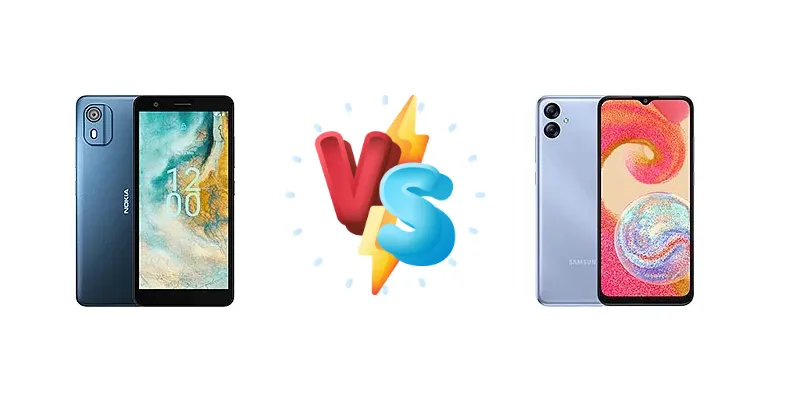
The sub-$150 smartphone market is fiercely competitive, demanding compromises. Both the Nokia C02 and Samsung Galaxy A04e aim to deliver essential smartphone functionality at rock-bottom prices. However, they take different approaches to achieving this, with the Nokia prioritizing simplicity and the Samsung opting for a more powerful, albeit older, chipset. This comparison dissects their key differences to help you choose the right device.
🏆 Quick Verdict
For most users, the Samsung Galaxy A04e is the better choice. Its Mediatek Helio P35 chipset, with its octa-core configuration, provides a significantly more responsive experience than the Nokia C02’s quad-core processor, making everyday tasks and light multitasking noticeably smoother. While the Nokia C02 offers a clean Android Go experience, the performance gap is too substantial to ignore.
| Network |
|---|
| 2G bands | GSM 850 / 900 / 1800 / 1900 | GSM 850 / 900 / 1800 / 1900 |
| 3G bands | HSDPA 850 / 900 / 2100 | HSDPA 850 / 900 / 2100 |
| 4G bands | LTE | 1, 3, 5, 7, 8, 20, 28, 38, 40, 41 |
| Speed | HSPA, LTE | HSPA, LTE |
| Technology | GSM / HSPA / LTE | GSM / HSPA / LTE |
| Launch |
|---|
| Announced | 2023, February 23 | 2022, October 21 |
| Status | Available. Released 2023, May | Available. Released 2022, November 07 |
| Body |
|---|
| Build | Plastic back, plastic frame | Glass front, plastic back, plastic frame |
| Dimensions | 148.7 x 71.2 x 10 mm (5.85 x 2.80 x 0.39 in) | 164.2 x 75.9 x 9.1 mm (6.46 x 2.99 x 0.36 in) |
| SIM | Nano-SIM + Nano-SIM | · Nano-SIM· Nano-SIM + Nano-SIM |
| Weight | 191 g (6.74 oz) | 188 g (6.63 oz) |
| | Splash and dust resistant | - |
| Display |
|---|
| Resolution | 720 x 1440 pixels, 18:9 ratio (~295 ppi density) | 720 x 1600 pixels, 20:9 ratio (~270 ppi density) |
| Size | 5.45 inches, 76.7 cm2 (~72.4% screen-to-body ratio) | 6.5 inches, 102.0 cm2 (~81.8% screen-to-body ratio) |
| Type | IPS LCD | PLS LCD |
| Platform |
|---|
| CPU | Quad-core 1.4 GHz | Octa-core (4x2.3 GHz Cortex-A53 & 4x1.8 GHz Cortex-A53) |
| Chipset | - | Mediatek MT6765 Helio P35 (12 nm) |
| GPU | - | PowerVR GE8320 |
| OS | Android 12 (Go edition) | Android 12, One UI Core 4.1 |
| Memory |
|---|
| Card slot | microSDXC | microSDXC (dedicated slot) |
| Internal | 32GB 2GB RAM | 32GB 2GB RAM, 32GB 3GB RAM, 32GB 4GB RAM, 64GB 2GB RAM, 64GB 3GB RAM, 64GB 4GB RAM, 128GB 4GB RAM |
| | eMMC 5.1 | - |
| Main Camera |
|---|
| Dual | - | 13 MP, f/2.2, (wide), AF
Auxiliary lens |
| Features | LED flash, HDR | LED flash |
| Single | 5 MP | 5 MP, f/2.2 |
| Video | 720p@30fps | 1080p@30fps |
| Selfie camera |
|---|
| Single | 2 MP | 5 MP, f/2.2 |
| Video | 720p@30fps | Yes |
| Sound |
|---|
| 3.5mm jack | Yes | Yes |
| 35mm jack | Yes | Yes |
| Loudspeaker | Yes | Yes |
| Comms |
|---|
| Bluetooth | 4.2, A2DP, LE | 5.0, A2DP, LE |
| NFC | No | No |
| Positioning | GPS | GPS, GLONASS, GALILEO, BDS |
| Radio | Unspecified | Unspecified |
| USB | microUSB 2.0 | USB Type-C 2.0, OTG |
| WLAN | Wi-Fi 802.11 b/g/n | Wi-Fi 802.11 b/g/n, Wi-Fi Direct |
| Features |
|---|
| Sensors | Accelerometer | Accelerometer, proximity |
| Battery |
|---|
| Type | Li-Ion 3000 mAh, removable | Li-Po 5000 mAh |
| Misc |
|---|
| Colors | Dark Cyan, Charcoal | Black, Copper, Light Blue |
| Models | - | SM-A042F, SM-A042F/DS, SM-A042M, SM-A042M/DS |
| Price | - | ₹ 7,999 |
| SAR EU | - | 0.29 W/kg (head) 1.11 W/kg (body) |
Nokia C02
- Clean Android Go Edition experience
- Potentially lower price point
- Simple and easy to use
- Significantly slower performance
- Limited multitasking capabilities
- Basic camera system
Samsung Galaxy A04e
- Faster and more responsive performance
- Larger display
- More versatile camera system
- Software may include bloatware
- Potentially slightly shorter battery life (despite efficient chipset)
- Older chipset architecture
Display Comparison
Neither device boasts a standout display. Details regarding the Nokia C02’s panel are scarce, suggesting a basic LCD. The Samsung Galaxy A04e also utilizes an LCD, but its larger 6.5-inch size offers more screen real estate. While neither is expected to have high brightness or color accuracy, the larger display of the A04e is a practical advantage for media consumption. Bezels are likely to be substantial on both, reflecting their budget positioning.
Camera Comparison
Camera performance on both devices will be limited. Details on the Nokia C02’s camera are minimal, suggesting a basic sensor. The Samsung Galaxy A04e typically features a 13MP main sensor, which, while not exceptional, will outperform the Nokia’s likely lower-resolution offering in most lighting conditions. Both will likely include lower-resolution secondary cameras (often 2MP) for depth sensing or macro photography, which offer limited practical benefit. Image processing will be basic on both, prioritizing speed over detail.
Performance
This is where the most significant difference lies. The Nokia C02’s quad-core 1.4 GHz processor is a basic configuration, suitable only for the most rudimentary tasks. In contrast, the Samsung Galaxy A04e’s Mediatek Helio P35 (12nm) features an octa-core setup with a split configuration of 4x2.3 GHz Cortex-A53 and 4x1.8 GHz Cortex-A53 cores. The 12nm fabrication process also contributes to better efficiency compared to the likely larger node used in the Nokia. This translates to faster app loading times, smoother multitasking, and a more responsive overall user experience on the A04e. The A04e’s GPU will also handle basic games with greater ease.
Battery Life
Battery life is a key consideration in this segment. While specific mAh ratings are not provided, both devices likely feature batteries in the 4000-5000 mAh range. The Samsung Galaxy A04e’s more efficient Helio P35 chipset, however, will likely translate to longer real-world battery life despite potentially having a similar capacity to the Nokia C02. Charging speeds are expected to be slow on both, likely limited to 10W or 15W, resulting in several hours for a full charge.
Buying Guide
Buy the Nokia C02 if you absolutely prioritize a streamlined, bloatware-free Android experience and are willing to accept significantly slower performance for basic tasks like web browsing and messaging. It’s ideal for first-time smartphone users or those needing a very simple device. Buy the Samsung Galaxy A04e if you value responsiveness and the ability to run more apps concurrently, even if it means a slightly less pristine software experience. This is the better option for users who want a phone that can handle more than just the bare minimum.
Frequently Asked Questions
❓ Is the Mediatek Helio P35 in the Samsung Galaxy A04e powerful enough for casual gaming?
The Helio P35 can handle basic 2D games and some less demanding 3D titles at lower settings. However, it's not designed for graphically intensive games like PUBG or Fortnite. Expect frame rate drops and limited graphical fidelity. It's suitable for casual gaming, but not for serious mobile gamers.
❓ Does the Nokia C02 benefit from the Android Go edition in terms of performance?
While Android Go is designed to run smoothly on low-end hardware, it can only mitigate the limitations of the quad-core processor to a certain extent. The reduced bloatware and optimized apps help, but the C02’s processor is still significantly less powerful than the A04e’s Helio P35, resulting in a slower overall experience.
❓ How much storage does each phone typically offer, and is it expandable?
Both phones typically come with 32GB of internal storage, which is quite limited. Fortunately, both the Nokia C02 and Samsung Galaxy A04e support microSD card expansion, allowing you to add up to 512GB or 1TB of additional storage, depending on the model.
❓ What kind of charging port do these phones use?
Both the Nokia C02 and Samsung Galaxy A04e utilize a micro-USB port for charging and data transfer. This is a legacy standard and is slower than USB-C, but it's common in this price range.