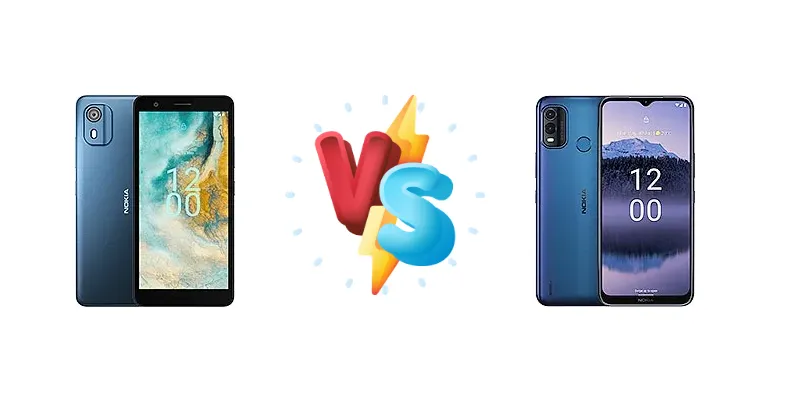
Nokia's C-series and G-series represent their entry-level and mainstream budget offerings, respectively. The C02 and G11 Plus both aim to deliver affordability, but they take distinctly different approaches to achieving it. The C02 prioritizes extreme cost-effectiveness, while the G11 Plus attempts to offer a more rounded experience with a more powerful chipset. This comparison will dissect the key differences to help you determine which phone best suits your needs.
🏆 Quick Verdict
For most users, the Nokia G11 Plus is the better choice. Its Unisoc T606 chipset provides a significantly more responsive experience than the C02’s quad-core processor, making everyday tasks and even light multitasking noticeably smoother. While the C02 is cheaper, the performance trade-off is substantial.
| Network |
|---|
| 2G bands | GSM 850 / 900 / 1800 / 1900 | GSM 850 / 900 / 1800 / 1900 |
| 3G bands | HSDPA 850 / 900 / 2100 | HSDPA 850 / 900 / 2100 - International |
| 4G bands | LTE | 1, 3, 5, 7, 8, 20, 28, 38, 40, 41 - International |
| Speed | HSPA, LTE | HSPA 42.2/5.76 Mbps, LTE Cat4 150/50 Mbps |
| Technology | GSM / HSPA / LTE | GSM / HSPA / LTE |
| | - | 1, 3, 5, 8, 40, 41 - India |
| Launch |
|---|
| Announced | 2023, February 23 | 2022, June 29 |
| Status | Available. Released 2023, May | Available. Released 2022, July 20 |
| Body |
|---|
| Build | Plastic back, plastic frame | Glass front, plastic frame, plastic back |
| Dimensions | 148.7 x 71.2 x 10 mm (5.85 x 2.80 x 0.39 in) | 164.8 x 75.9 x 8.6 mm (6.49 x 2.99 x 0.34 in) |
| SIM | Nano-SIM + Nano-SIM | · Nano-SIM· Nano-SIM + Nano-SIM |
| Weight | 191 g (6.74 oz) | 192 g (6.77 oz) |
| | Splash and dust resistant | Splash protection |
| Display |
|---|
| Resolution | 720 x 1440 pixels, 18:9 ratio (~295 ppi density) | 720 x 1600 pixels, 20:9 ratio (~269 ppi density) |
| Size | 5.45 inches, 76.7 cm2 (~72.4% screen-to-body ratio) | 6.52 inches, 102.6 cm2 (~82.1% screen-to-body ratio) |
| Type | IPS LCD | IPS LCD, 90Hz, 400 nits (typ) |
| Platform |
|---|
| CPU | Quad-core 1.4 GHz | Octa-core (2x1.6 GHz Cortex-A75 & 6x1.6 GHz Cortex-A55) |
| Chipset | - | Unisoc T606 (12 nm) |
| GPU | - | Mali-G57 MP1 |
| OS | Android 12 (Go edition) | Android 12, upgradable to Android 13 |
| Memory |
|---|
| Card slot | microSDXC | microSDXC (dedicated slot) |
| Internal | 32GB 2GB RAM | 32GB 3GB RAM, 64GB 3GB RAM, 64GB 4GB RAM, 128GB 3GB RAM |
| | eMMC 5.1 | eMMC 5.1 |
| Main Camera |
|---|
| Dual | - | 50 MP, f/1.8, (wide), 1/2.67", PDAF
Auxiliary lens |
| Features | LED flash, HDR | LED flash |
| Single | 5 MP | 8 MP, f/2.0, (wide), 1/4.0" |
| Video | 720p@30fps | 1080p@30fps |
| Selfie camera |
|---|
| Single | 2 MP | 8 MP, f/2.0, (wide), 1/4.0" |
| Video | 720p@30fps | 1080p@30fps |
| Sound |
|---|
| 3.5mm jack | Yes | Yes |
| 35mm jack | Yes | Yes |
| Loudspeaker | Yes | Yes |
| Comms |
|---|
| Bluetooth | 4.2, A2DP, LE | 5.0, A2DP, LE |
| NFC | No | No |
| Positioning | GPS | GPS |
| Radio | Unspecified | FM radio |
| USB | microUSB 2.0 | USB Type-C 2.0, OTG |
| WLAN | Wi-Fi 802.11 b/g/n | Wi-Fi 802.11 a/b/g/n/ac, dual-band, Wi-Fi Direct |
| Features |
|---|
| Sensors | Accelerometer | Fingerprint (rear-mounted), accelerometer, proximity |
| Battery |
|---|
| Charging | - | 10W wired |
| Type | Li-Ion 3000 mAh, removable | Li-Ion 5000 mAh |
| Misc |
|---|
| Colors | Dark Cyan, Charcoal | Lake Blue, Charcoal Grey |
| Price | - | About 130 EUR |
Nokia C02
- Lowest possible price point
- Simple and easy to use
- Potentially longer standby time due to less powerful processor
- Extremely limited performance
- Poor multitasking capabilities
- Likely outdated software support
Nokia G11 Plus
- Significantly better performance with Unisoc T606
- More responsive user experience
- Better multitasking capabilities
- Slower charging speed (10W)
- Higher price than Nokia C02
- Basic display quality
Display Comparison
Neither device boasts a particularly impressive display. The Nokia C02’s display specifications are not provided, suggesting a basic LCD panel. The Nokia G11 Plus also utilizes an LCD, but the focus here is on the chipset’s impact on UI responsiveness rather than display quality. Given the price points, expect limited color accuracy and narrow viewing angles on both. Bezels are likely to be substantial on both devices, maximizing screen real estate within their respective budgets.
Camera Comparison
Camera performance is likely to be similar on both devices, leaning towards basic functionality. Neither phone is expected to excel in photography. Details on camera sensors are limited, but given the price bracket, expect low-resolution sensors and limited dynamic range. The Nokia G11 Plus may have a slight edge due to the processing power of the Unisoc T606, potentially enabling slightly better image processing, but don't expect flagship-level results from either.
Performance
The performance gap is the most significant differentiator. The Nokia C02’s quad-core 1.4 GHz CPU is a basic configuration, suitable only for the most rudimentary tasks. In contrast, the Nokia G11 Plus features the Unisoc T606, an octa-core processor built on a 12nm process. This chipset comprises two Cortex-A75 cores clocked at 1.6 GHz for performance and six Cortex-A55 cores for efficiency. This architecture provides a substantial boost in multi-tasking and app loading times compared to the C02. The 12nm fabrication process, while not cutting-edge, offers a reasonable balance between performance and power consumption. The G11 Plus will handle social media, web browsing, and light gaming far more comfortably.
Battery Life
Battery life will depend heavily on usage patterns. While the mAh capacity of the C02 is not specified, it's likely to be comparable to the G11 Plus’s. However, the G11 Plus’s more efficient chipset and 12nm process will likely translate to longer real-world battery life, especially during demanding tasks. The G11 Plus supports 10W wired charging, which is slow by modern standards, but adequate for a budget device. The C02’s charging speed is not specified, but is likely similar or slower.
Buying Guide
Buy the Nokia C02 if you absolutely need the lowest possible price point and your usage is limited to basic communication – calls, texts, and very light app use. It’s a suitable option for first-time smartphone users or as a simple backup device. Buy the Nokia G11 Plus if you value a more fluid user experience, want to run more apps simultaneously, and appreciate the benefits of a more modern chipset, even if it means spending a bit more.
Frequently Asked Questions
❓ Will the Nokia G11 Plus struggle with popular apps like Facebook or WhatsApp?
While the Unisoc T606 isn't a powerhouse, it's more than capable of running apps like Facebook and WhatsApp smoothly. You'll experience significantly less lag and stuttering compared to the Nokia C02, making for a more enjoyable social media experience. However, demanding games or heavily graphic-intensive apps may still present challenges.
❓ Is the Nokia C02 suitable for an elderly person who primarily makes calls and sends texts?
Yes, the Nokia C02 is a perfectly adequate choice for someone with very basic smartphone needs. Its simplicity and low price make it ideal for users who primarily use their phone for calls, texts, and perhaps a simple camera. The limited performance won't be a hindrance for these core functions.
❓ How long will it take to fully charge the Nokia G11 Plus with the 10W charger?
With the included 10W charger, expect a full charge from 0% to 100% to take approximately 2.5 to 3.5 hours. While this is slower than modern fast-charging solutions, it's typical for phones in this price range. Overnight charging is recommended.