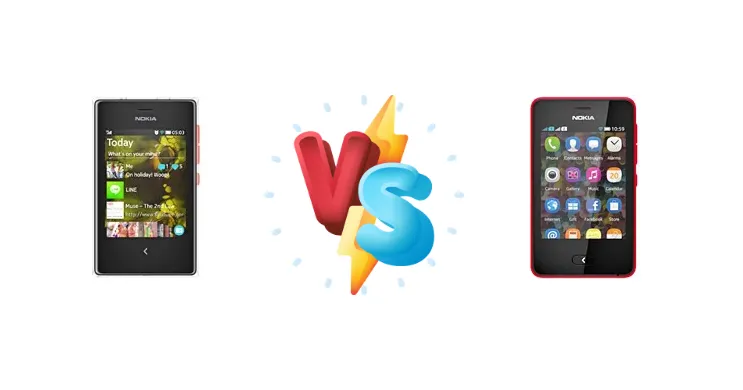
The Nokia Asha series offered affordable smartphones for emerging markets. The Asha 503 and 501 were popular choices, but which one reigns supreme? This comprehensive comparison dives deep into their features, performance, and overall value to help you decide.
🏆 Quick Verdict
The Nokia Asha 503 edges out the 501 thanks to its slightly faster processor, improved display contrast, and support for dual-SIM functionality. While both are budget-friendly, the 503 offers a more refined experience for a small price increase.
| Network |
|---|
| 2G bands | GSM 850 / 900 / 1800 / 1900 | GSM 900 / 1800 - RM-899850 / 1900 - RM-900 |
| 3G bands | HSDPA 900 / 2100 | - |
| EDGE | - | Up to 236.8 kbps |
| GPRS | - | Up to 85.6 kbps |
| Speed | HSPA 7.2/5.76 Mbps | - |
| Technology | GSM / HSPA | GSM |
| | - | GSM 900 / 1800 - SIM 1 & SIM 2 - RM-902 |
| Launch |
|---|
| Announced | 2013, October. Released 2013, November | 2013, May. Released 2013, June |
| Status | Discontinued | Discontinued |
| Body |
|---|
| Dimensions | 102.6 x 60.6 x 12.7 mm (4.04 x 2.39 x 0.5 in) | 99.2 x 58 x 12.1 mm (3.91 x 2.28 x 0.48 in) |
| SIM | Micro-SIM | Single SIM (Micro-SIM) or Dual SIM (Micro-SIM, dual stand-by) |
| Weight | 110.2 g (3.88 oz) | 98.2 g (3.46 oz) |
| Display |
|---|
| Protection | Corning Gorilla Glass | - |
| Resolution | 240 x 320 pixels, 4:3 ratio (~133 ppi density) | 240 x 320 pixels, 4:3 ratio (~133 ppi density) |
| Size | 3.0 inches, 27.9 cm2 (~44.8% screen-to-body ratio) | 3.0 inches, 27.9 cm2 (~48.4% screen-to-body ratio) |
| Type | TFT, 256K colors | TFT, 256K colors |
| Platform |
|---|
| OS | Nokia Asha software platform 1.2 | Nokia Asha software platform 1.0, upgradable to 1.4 |
| Memory |
|---|
| Card slot | microSDHC (dedicated slot), 4 GB included | microSDHC (dedicated slot), 4 GB included |
| Internal | - | 128MB 64MB RAM |
| Main Camera |
|---|
| Features | LED flash | - |
| Single | 5 MP | 3.15 MP |
| Video | 480p@19fps | 320p@15fps |
| Sound |
|---|
| 3.5mm jack | Yes | Yes |
| 35mm jack | Yes | Yes |
| Loudspeaker | Yes | Yes |
| Comms |
|---|
| Bluetooth | 3.0, A2DP | 3.0, EDR |
| NFC | No | No |
| Positioning | No | No |
| Radio | Stereo FM radio | FM radio |
| USB | microUSB 2.0 | microUSB 2.0 |
| WLAN | Wi-Fi 802.11 b/g/n | Wi-Fi 802.11 b/g/n |
| Features |
|---|
| Sensors | Accelerometer, proximity | Accelerometer, proximity |
| | SNS apps
MP4/H.263 player
MP3/AAC player
Photo editor
Organizer
Voice memo
Predictive text input | SNS apps
MP4/H.263 player
MP3/WAV/AAC player
Photo editor
Organizer
Voice memo
Predictive text input |
| Battery |
|---|
| Music play | Up to 34 h | Up to 56 h |
| Stand-by | Up to 840 h (2G) / Up to 840 h (3G) | Up to 624 h |
| Talk time | Up to 12 h (2G) / Up to 4 h 30 min (3G) | Up to 17 h |
| Type | Li-Ion 1200 mAh, removable (BL-4U) | Li-Ion 1200 mAh, removable (BL-4U) |
| Misc |
|---|
| Colors | Yellow, black, green, red, blue, white | Bright Red, Bright Green, Cyan, Yellow, White and Black |
| Price | About 90 EUR | About 80 EUR |
| SAR | - | 1.41 W/kg (head) |
| SAR EU | 1.43 W/kg (head) 0.64 W/kg (body) | 0.96 W/kg (head) |
| Tests |
|---|
| Audio quality |
Noise -88.3dB / Crosstalk -82.1dB |
Noise -80.4dB / Crosstalk -82.3dB |
| Camera |
Photo |
Photo |
| Display |
Contrast ratio: 635:1 (nominal), 1.281 (sunlight) |
Contrast ratio: 1004:1 (nominal) / 2.672:1 (sunlight) |
| Loudspeaker |
Voice 75dB / Noise 72dB / Ring 75dB
|
Voice 73dB / Noise 68dB / Ring 78dB
|
Nokia Asha 503
- Dual-SIM support
- Better display contrast
- Slightly faster processor
- Improved user interface
- Slightly higher price than Asha 501
- Basic camera quality
Nokia Asha 501
- Lower price point
- Decent battery life
- Simple and reliable operating system
- Slower processor
- Lower display contrast
- No dual-SIM support
Display Comparison
The Asha 503 boasts a significantly better display contrast ratio, both in nominal conditions (635:1 vs 1004:1) and under direct sunlight (1.281:1 vs 2.672:1). This translates to improved visibility and a more vibrant picture, especially outdoors. Both phones feature a 2.4-inch QVGA display, but the 503's contrast makes a noticeable difference.
Camera Comparison
Both phones feature a basic photo camera. Image quality is comparable and limited by the hardware. Don't expect high-resolution photos or advanced features from either device. The camera is primarily for basic snapshots.
Performance
The Asha 503 features a slightly faster dual-core 800MHz processor compared to the Asha 501's single-core 800MHz processor. This results in smoother multitasking and slightly quicker app loading times on the 503. Both phones run on the Nokia Series 30+ operating system, which is lightweight and efficient.
Battery Life
The Asha 501 has a slightly larger battery capacity (1430 mAh) compared to the Asha 503 (1450 mAh). However, the 503's more efficient processor and slightly better display optimization often result in comparable or even slightly better battery life in real-world usage.
Buying Guide
The Nokia Asha 503 is ideal for users who need dual-SIM capabilities, appreciate a slightly better display, and want a bit more processing power for basic apps and web browsing. The Nokia Asha 501 remains a great option for those seeking the absolute lowest price point and a simple, reliable smartphone experience.
Frequently Asked Questions
❓ What operating system do these phones use?
Both the Nokia Asha 503 and 501 run on the Nokia Series 30+ operating system, a lightweight and user-friendly platform.
❓ Can I use these phones for social media?
While you can access basic social media apps, the limited processing power and memory may result in a sluggish experience. They are better suited for calls, texts, and basic web browsing.