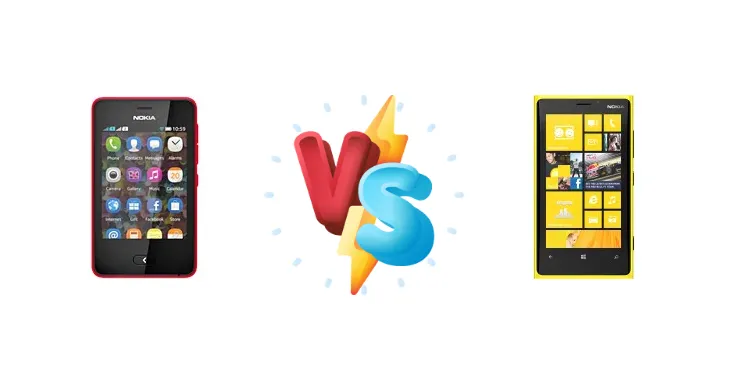
Nokia, a name synonymous with mobile innovation, produced a diverse range of devices. Today, we pit two distinct models against each other: the budget-friendly Asha 501 and the flagship Lumia 920. This comparison will help you understand which phone best suits your needs, considering their vastly different target audiences and capabilities.
🏆 Quick Verdict
The Nokia Lumia 920 is the clear winner. While the Asha 501 offers incredible value for its price, the Lumia 920’s superior performance, camera, and features like wireless charging make it a more compelling choice for users seeking a modern smartphone experience.
| Network |
|---|
| 2G bands | GSM 900 / 1800 - RM-899850 / 1900 - RM-900 | GSM 850 / 900 / 1800 / 1900 - RM-821, RM-820 |
| 3G bands | - | HSDPA 850 / 900 / 1900 / 2100 - RM-821, RM-820 |
| 4G bands | - | 1, 3, 7, 8, 20 - RM-821 |
| EDGE | Up to 236.8 kbps | No |
| GPRS | Up to 85.6 kbps | No |
| Speed | - | HSPA 42.2/5.76 Mbps, LTE Cat3 100/50 Mbps |
| Technology | GSM | GSM / HSPA / LTE |
| | GSM 900 / 1800 - SIM 1 & SIM 2 - RM-902 | 4, 17 - RM-820 (AT&T) |
| Launch |
|---|
| Announced | 2013, May. Released 2013, June | 2012, September. Released 2012, November |
| Status | Discontinued | Discontinued |
| Body |
|---|
| Dimensions | 99.2 x 58 x 12.1 mm (3.91 x 2.28 x 0.48 in) | 130.3 x 70.8 x 10.7 mm, 99 cc (5.13 x 2.79 x 0.42 in) |
| SIM | Single SIM (Micro-SIM) or Dual SIM (Micro-SIM, dual stand-by) | Micro-SIM |
| Weight | 98.2 g (3.46 oz) | 185 g (6.53 oz) |
| Display |
|---|
| Protection | - | Corning Gorilla Glass 2 |
| Resolution | 240 x 320 pixels, 4:3 ratio (~133 ppi density) | 768 x 1280 pixels, 5:3 ratio (~332 ppi density) |
| Size | 3.0 inches, 27.9 cm2 (~48.4% screen-to-body ratio) | 4.5 inches, 57.6 cm2 (~62.5% screen-to-body ratio) |
| Type | TFT, 256K colors | IPS LCD |
| | - | PureMotion HD+ ClearBlack display |
| Platform |
|---|
| CPU | - | Dual-core 1.5 GHz Krait |
| Chipset | - | Qualcomm MSM8960 Snapdragon S4 Plus |
| GPU | - | Adreno 225 |
| OS | Nokia Asha software platform 1.0, upgradable to 1.4 | Microsoft Windows Phone 8, upgradable to 8.1 |
| Memory |
|---|
| Call records | - | Yes |
| Card slot | microSDHC (dedicated slot), 4 GB included | No |
| Internal | 128MB 64MB RAM | 32GB 1GB RAM |
| Phonebook | - | Yes |
| Main Camera |
|---|
| Features | - | Carl Zeiss optics, dual-LED flash |
| Single | 3.15 MP | 8 MP, f/2.0, 26mm (wide), 1/3.0", AF, OIS |
| Video | 320p@15fps | 1080p@30fps |
| Selfie camera |
|---|
| Single | - | 1.3 MP |
| Video | - | 720p@30fps |
| | No | - |
| Sound |
|---|
| 3.5mm jack | Yes | Yes |
| 35mm jack | Yes | Yes |
| Loudspeaker | Yes | Yes |
| Comms |
|---|
| Bluetooth | 3.0, EDR | 4.0, A2DP, EDR, LE/ aptX after WP8 Denim update |
| NFC | No | Yes |
| Positioning | No | GPS, A-GPS, GLONASS |
| Radio | FM radio | FM radio |
| USB | microUSB 2.0 | microUSB 2.0 |
| WLAN | Wi-Fi 802.11 b/g/n | Wi-Fi 802.11 a/b/g/n, dual-band, DLNA, hotspot |
| Features |
|---|
| Browser | - | No |
| Games | - | No |
| Java | - | No |
| Messaging | - | SMS |
| Sensors | Accelerometer, proximity | Accelerometer, gyro, proximity, compass |
| | SNS apps
MP4/H.263 player
MP3/WAV/AAC player
Photo editor
Organizer
Voice memo
Predictive text input | - |
| Battery |
|---|
| Charging | - | Wireless (Qi) |
| Music play | Up to 56 h | Up to 67 h |
| Stand-by | Up to 624 h | Up to 400 h (2G) / Up to 400 h (3G) |
| Talk time | Up to 17 h | Up to 17 h (2G) / Up to 10 h (3G) |
| Type | Li-Ion 1200 mAh, removable (BL-4U) | Non-removable Li-Ion 2000 mAh battery (BP-4GW) |
| Misc |
|---|
| Colors | Bright Red, Bright Green, Cyan, Yellow, White and Black | Black, Gray, Red, Yellow, White |
| Price | About 80 EUR | About 210 EUR |
| SAR | 1.41 W/kg (head) | 1.08 W/kg (head) 0.91 W/kg (body) |
| SAR EU | 0.96 W/kg (head) | 0.70 W/kg (head) |
| Tests |
|---|
| Audio quality |
Noise -80.4dB / Crosstalk -82.3dB |
Noise -78.9dB / Crosstalk -75.0dB |
| Battery life | - |
Endurance rating 44h
|
| Camera |
Photo |
Photo / Video |
| Display |
Contrast ratio: 1004:1 (nominal) / 2.672:1 (sunlight) |
Contrast ratio: 1065:1 (nominal) / 2.107:1 (sunlight) |
| Loudspeaker |
Voice 73dB / Noise 68dB / Ring 78dB
|
Voice 61dB / Noise 64dB / Ring 65dB
|
Nokia Asha 501
- Extremely affordable
- Good sunlight readability
- Simple and easy to use
- Decent battery life
- Limited functionality
- Basic camera
- No video recording
- Slow performance
- Low resolution display
Nokia Lumia 920
- Powerful processor
- Excellent camera with video recording
- Wireless charging
- Larger, higher resolution display
- Windows Phone OS
- Older operating system
- Can be expensive (when originally released)
- Bulky design
Display Comparison
Both phones boast a respectable contrast ratio of around 1000:1, with the Lumia 920 slightly edging out the Asha 501 in nominal contrast (1065:1 vs 1004:1). However, sunlight readability favors the Asha 501 with a 2.672:1 ratio compared to the Lumia 920's 2.107:1. The Asha 501 has a smaller, lower resolution display, while the Lumia 920 features a larger, higher resolution screen, offering a more immersive viewing experience.
Camera Comparison
The Lumia 920’s camera is a major advantage. It features both photo and video capabilities, offering higher resolution images and video recording. The Asha 501 has a basic photo camera, lacking video recording functionality. The Lumia 920 also benefits from Nokia's PureView technology, delivering superior image quality, especially in low-light conditions.
Performance
The Lumia 920’s Qualcomm MSM8960 Snapdragon S4 Plus chipset and dual-core 1.5 GHz Krait processor provide significantly better performance than the Asha 501's proprietary processor. Expect smoother multitasking, faster app loading times, and a more responsive user interface on the Lumia 920. The Asha 501 is adequate for basic tasks but struggles with demanding applications.
Battery Life
Both phones are rated for 44 hours of endurance, suggesting comparable battery life under typical usage. However, the Lumia 920's larger battery capacity likely contributes to its longevity, especially considering its more demanding processor and display. The Lumia 920 also includes wireless charging (Qi), a feature absent in the Asha 501.
Buying Guide
The Nokia Asha 501 is ideal for first-time smartphone users, those on a tight budget, or individuals primarily needing basic communication and entertainment features. The Nokia Lumia 920 is suited for users wanting a capable smartphone with a good camera, solid performance, and Windows Phone OS.
Frequently Asked Questions
❓ What operating system does each phone use?
The Nokia Asha 501 runs Nokia's Series 40 operating system, a feature phone OS. The Nokia Lumia 920 runs Windows Phone 8.
❓ Is the Asha 501 a smartphone?
No, the Asha 501 is considered a feature phone, offering basic smartphone-like features but lacking the full capabilities of a smartphone.