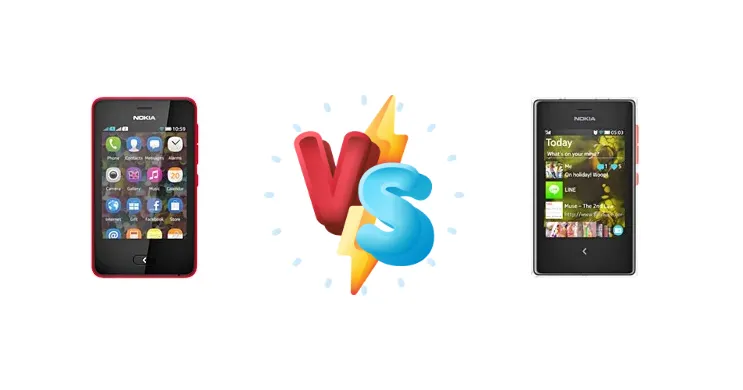
The Nokia Asha series offered affordable smartphones for emerging markets. The Asha 501 and 503 were popular choices, but which one reigns supreme? This comprehensive comparison dives deep into their features to help you decide which phone is right for you.
🏆 Quick Verdict
The Nokia Asha 501 boasts a significantly better contrast ratio, especially in sunlight. However, the Asha 503 offers a slightly more modern design and potentially better software experience. For pure display quality, the 501 wins, but the 503 provides a more rounded package.
| Network |
|---|
| 2G bands | GSM 900 / 1800 - RM-899850 / 1900 - RM-900 | GSM 850 / 900 / 1800 / 1900 |
| 3G bands | - | HSDPA 900 / 2100 |
| EDGE | Up to 236.8 kbps | - |
| GPRS | Up to 85.6 kbps | - |
| Speed | - | HSPA 7.2/5.76 Mbps |
| Technology | GSM | GSM / HSPA |
| | GSM 900 / 1800 - SIM 1 & SIM 2 - RM-902 | - |
| Launch |
|---|
| Announced | 2013, May. Released 2013, June | 2013, October. Released 2013, November |
| Status | Discontinued | Discontinued |
| Body |
|---|
| Dimensions | 99.2 x 58 x 12.1 mm (3.91 x 2.28 x 0.48 in) | 102.6 x 60.6 x 12.7 mm (4.04 x 2.39 x 0.5 in) |
| SIM | Single SIM (Micro-SIM) or Dual SIM (Micro-SIM, dual stand-by) | Micro-SIM |
| Weight | 98.2 g (3.46 oz) | 110.2 g (3.88 oz) |
| Display |
|---|
| Protection | - | Corning Gorilla Glass |
| Resolution | 240 x 320 pixels, 4:3 ratio (~133 ppi density) | 240 x 320 pixels, 4:3 ratio (~133 ppi density) |
| Size | 3.0 inches, 27.9 cm2 (~48.4% screen-to-body ratio) | 3.0 inches, 27.9 cm2 (~44.8% screen-to-body ratio) |
| Type | TFT, 256K colors | TFT, 256K colors |
| Platform |
|---|
| OS | Nokia Asha software platform 1.0, upgradable to 1.4 | Nokia Asha software platform 1.2 |
| Memory |
|---|
| Card slot | microSDHC (dedicated slot), 4 GB included | microSDHC (dedicated slot), 4 GB included |
| Internal | 128MB 64MB RAM | - |
| Main Camera |
|---|
| Features | - | LED flash |
| Single | 3.15 MP | 5 MP |
| Video | 320p@15fps | 480p@19fps |
| Sound |
|---|
| 3.5mm jack | Yes | Yes |
| 35mm jack | Yes | Yes |
| Loudspeaker | Yes | Yes |
| Comms |
|---|
| Bluetooth | 3.0, EDR | 3.0, A2DP |
| NFC | No | No |
| Positioning | No | No |
| Radio | FM radio | Stereo FM radio |
| USB | microUSB 2.0 | microUSB 2.0 |
| WLAN | Wi-Fi 802.11 b/g/n | Wi-Fi 802.11 b/g/n |
| Features |
|---|
| Sensors | Accelerometer, proximity | Accelerometer, proximity |
| | SNS apps
MP4/H.263 player
MP3/WAV/AAC player
Photo editor
Organizer
Voice memo
Predictive text input | SNS apps
MP4/H.263 player
MP3/AAC player
Photo editor
Organizer
Voice memo
Predictive text input |
| Battery |
|---|
| Music play | Up to 56 h | Up to 34 h |
| Stand-by | Up to 624 h | Up to 840 h (2G) / Up to 840 h (3G) |
| Talk time | Up to 17 h | Up to 12 h (2G) / Up to 4 h 30 min (3G) |
| Type | Li-Ion 1200 mAh, removable (BL-4U) | Li-Ion 1200 mAh, removable (BL-4U) |
| Misc |
|---|
| Colors | Bright Red, Bright Green, Cyan, Yellow, White and Black | Yellow, black, green, red, blue, white |
| Price | About 80 EUR | About 90 EUR |
| SAR | 1.41 W/kg (head) | - |
| SAR EU | 0.96 W/kg (head) | 1.43 W/kg (head) 0.64 W/kg (body) |
| Tests |
|---|
| Audio quality |
Noise -80.4dB / Crosstalk -82.3dB |
Noise -88.3dB / Crosstalk -82.1dB |
| Camera |
Photo |
Photo |
| Display |
Contrast ratio: 1004:1 (nominal) / 2.672:1 (sunlight) |
Contrast ratio: 635:1 (nominal), 1.281 (sunlight) |
| Loudspeaker |
Voice 73dB / Noise 68dB / Ring 78dB
|
Voice 75dB / Noise 72dB / Ring 75dB
|
Nokia Asha 501
- Superior sunlight display contrast
- Excellent battery life
- Simple and streamlined software
- Basic camera quality
- Limited app support
- Older design
Nokia Asha 503
- Slightly more modern design
- Potentially improved software features
- Decent battery life
- Lower sunlight display contrast
- Basic camera quality
- Limited app support
Display Comparison
The Asha 501's standout feature is its impressive contrast ratio of 1004:1 in nominal conditions and a remarkable 2.672:1 in sunlight. This translates to vibrant colors and excellent readability even under bright conditions. The Asha 503, while still decent, has a contrast ratio of 635:1 (nominal) and 1.281 (sunlight), making it less impressive outdoors. Both phones feature a 2.4-inch QVGA display.
Camera Comparison
Both phones feature a basic VGA camera for photo capture. Image quality is limited, and these cameras are primarily for basic snapshots. Don't expect high-resolution or detailed images from either device. The Asha 503 might have slightly improved image processing due to its newer hardware.
Performance
Both devices run on Nokia's Series 40 operating system. While specific processor details are scarce, the Asha 503 generally offered slightly improved performance due to minor hardware upgrades. Expect basic functionality and responsiveness for everyday tasks like calling, texting, and light browsing. Don't expect demanding app performance.
Battery Life
The Asha 501 typically offered a longer battery life, often lasting for several days on a single charge with moderate usage. The Asha 503, while still offering good battery life, might consume slightly more power due to its more modern components. Both phones feature a 1200mAh battery.
Buying Guide
The Nokia Asha 501 is ideal for users prioritizing excellent outdoor visibility and a simple, streamlined experience. The Asha 503 is better suited for those wanting a slightly more modern look, potentially improved software features, and a more versatile experience.
Frequently Asked Questions
❓ What operating system do these phones use?
Both the Nokia Asha 501 and 503 run on Nokia's Series 40 operating system.
❓ Are these phones 4G compatible?
No, neither the Asha 501 nor the Asha 503 support 4G connectivity. They are primarily 2G devices.