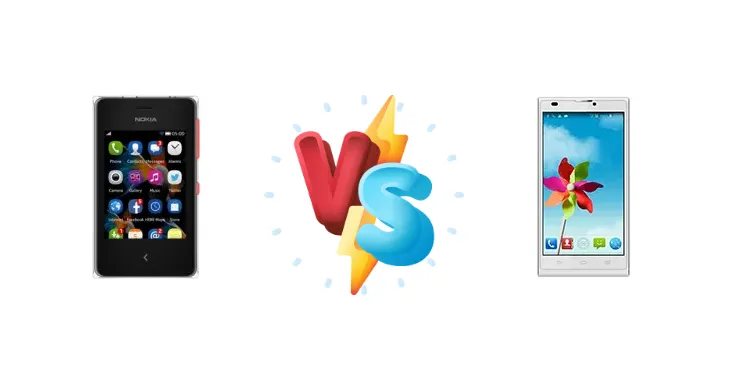
The Nokia Asha 500 and ZTE Blade L2 represent distinct approaches to the ultra-budget smartphone market. The Asha 500, a product of Nokia’s Series 40 lineage, likely prioritizes simplicity and battery life. Conversely, the ZTE Blade L2, powered by a Mediatek chipset, aims to deliver a more modern Android experience, albeit at the entry-level. This comparison dissects their strengths and weaknesses to help you choose.
🏆 Quick Verdict
For users prioritizing a basic, reliable phone with potentially exceptional battery life, the Nokia Asha 500 is a viable option. However, the ZTE Blade L2, with its quad-core processor and Android operating system, is the better choice for those needing more than just calls and texts, offering a more versatile experience.
| Network |
|---|
| 2G bands | GSM 850 / 900 / 1800 / 1900 | GSM 900 / 1800 / 1900 - SIM 1 & SIM 2 (dual-SIM model only) |
| 3G bands | - | HSDPA 900 / 2100 |
| EDGE | Up to 236.8 kbps | - |
| GPRS | Up to 42.8 kbps | - |
| Speed | - | HSPA 21.1/5.76 Mbps |
| Technology | GSM | GSM / HSPA |
| Launch |
|---|
| Announced | 2013, October. Released 2013, December | 2014, May. Released 2014, May |
| Status | Discontinued | Discontinued |
| Body |
|---|
| Dimensions | 100.3 x 58.1 x 12.8 mm, 70.9 cc (3.95 x 2.29 x 0.50 in) | 142.5 x 72.2 x 9 mm (5.61 x 2.84 x 0.35 in) |
| SIM | Micro-SIM | Single SIM (Micro-SIM) or Dual SIM (Micro-SIM, dual stand-by) |
| Weight | 101 g (3.56 oz) | 166 g (5.86 oz) |
| Display |
|---|
| Resolution | 240 x 320 pixels, 4:3 ratio (~143 ppi density) | 480 x 854 pixels, 16:9 ratio (~196 ppi density) |
| Size | 2.8 inches, 24.3 cm2 (~41.7% screen-to-body ratio) | 5.0 inches, 68.9 cm2 (~67.0% screen-to-body ratio) |
| Type | TFT, 256K colors | TFT |
| Platform |
|---|
| CPU | - | Quad-core 1.3 GHz Cortex-A7 |
| Chipset | - | Mediatek MT6582M (28 nm) |
| GPU | - | Mali-400MP2 |
| OS | Nokia Asha software platform 1.1.1, upgradable to 1.4 | Android 4.2 (Jelly Bean) |
| Memory |
|---|
| Card slot | microSDHC (dedicated slot), 4 GB included | microSDHC (dedicated slot) |
| Internal | 64MB RAM | 4GB 1GB RAM |
| Main Camera |
|---|
| Features | - | LED flash |
| Single | 2 MP | 5 MP or 8 MP, AF |
| Video | 320p@13fps | Yes |
| Selfie camera |
|---|
| Single | - | VGA/ 1 MP, market dependant |
| | No | - |
| Sound |
|---|
| 3.5mm jack | Yes | Yes |
| 35mm jack | Yes | Yes |
| Loudspeaker | Yes | Yes |
| Comms |
|---|
| Bluetooth | 3.0, A2DP | 3.0, A2DP, EDR |
| NFC | No | No |
| Positioning | No | GPS |
| Radio | Stereo FM radio | FM radio |
| USB | microUSB 2.0 | microUSB 2.0 |
| WLAN | Wi-Fi 802.11 b/g/n | Wi-Fi 802.11 b/g/n, hotspot |
| Features |
|---|
| Sensors | Accelerometer, proximity | Accelerometer, proximity |
| | SNS apps
MP4/H.263 player
MP3/WAV/AAC player
Photo editor
Organizer
Voice memo
Predictive text input | Analog/digital TV |
| Battery |
|---|
| Music play | Up to 46 h | - |
| Stand-by | Up to 840 h | - |
| Talk time | Up to 14 h | - |
| Type | Li-Ion 1200 mAh, removable (BL-4U) | Li-Ion 2000 mAh, removable |
| Misc |
|---|
| Colors | Bright Red, Bright Green, Cyan, Yellow, White and Black | White |
| Price | About 60 EUR | About 130 EUR |
| SAR | 1.47 W/kg (head) 1.38 W/kg (body) | - |
| SAR EU | 1.28 W/kg (head) 0.94 W/kg (body) | - |
Nokia Asha 500
- Potentially exceptional battery life
- Extreme affordability
- Durable build quality (typical of Nokia Series 40)
- Limited functionality
- Outdated operating system
- Poor app support
ZTE Blade L2
- Android operating system
- Quad-core processor for better performance
- Access to a wider range of apps
- Shorter battery life compared to Asha 500
- Lower build quality compared to Nokia's Series 40
- Limited storage space
Display Comparison
Given the Asha 500’s position in the market, it likely features a resistive touchscreen, prioritizing durability over visual fidelity. The Blade L2, while still budget-focused, benefits from an IPS LCD panel, offering wider viewing angles and better color reproduction. The absence of specific display specs for the Asha 500 makes a direct comparison difficult, but the Blade L2’s panel technology represents a clear advantage for media consumption and general usability. Expect the Blade L2 to have a higher resolution, contributing to sharper text and images.
Camera Comparison
Without specific camera details for the Asha 500, it’s safe to assume a low-resolution sensor focused on basic image capture. The Blade L2, while not a photography powerhouse, likely features a more capable camera system. The image processing capabilities of the Mediatek chipset will also contribute to better image quality compared to the Asha 500’s likely limited processing power. Focusing on sensor size and aperture would be speculative without further data.
Performance
The ZTE Blade L2’s Mediatek MT6582M chipset, fabricated on a 28nm process, is the defining performance differentiator. Its quad-core 1.3 GHz Cortex-A7 CPU provides a significant advantage over the Asha 500, which likely relies on a much simpler processor designed for basic tasks. The 28nm node allows for reasonable power efficiency, though it’s older technology. This translates to smoother app launches, faster web browsing, and the ability to handle multiple apps (within limits) on the Blade L2. The Asha 500 will struggle with anything beyond basic operations.
Battery Life
The Nokia Asha 500, due to its simpler hardware and likely smaller screen, likely boasts superior battery life. The Mediatek MT6582M in the Blade L2, while relatively efficient, consumes more power than the Asha 500’s processor. However, the Blade L2’s larger screen and Android OS will also contribute to faster battery drain. Without specific battery capacities, it’s difficult to quantify the difference, but the Asha 500 is expected to last significantly longer on a single charge.
Buying Guide
Buy the Nokia Asha 500 if you need a durable, extremely affordable phone primarily for calls, texts, and basic functionality, and value long battery life above all else. It’s ideal for first-time smartphone users or as a secondary device. Buy the ZTE Blade L2 if you prefer a smartphone running Android, enabling access to a wider range of apps and services, and require a degree of multitasking capability, even if it’s limited.
Frequently Asked Questions
❓ Is the Mediatek MT6582M chipset in the ZTE Blade L2 capable of running popular social media apps like Facebook and WhatsApp?
Yes, the Mediatek MT6582M is sufficient to run lightweight apps like Facebook and WhatsApp, though performance may be sluggish with multiple apps open simultaneously. It's designed for basic Android functionality and will handle these core social media tasks.
❓ Can I expand the storage on the ZTE Blade L2 with a microSD card?
While not explicitly stated in the provided data, most ZTE Blade L2 models include a microSD card slot for storage expansion. This is crucial given the limited internal storage typically found in devices at this price point.
❓ What kind of apps can I expect to run smoothly on the Nokia Asha 500?
The Nokia Asha 500 is best suited for basic applications like calls, texts, and the pre-installed apps. Expect limited performance with third-party apps, and avoid demanding applications altogether. It's designed for core communication functions.