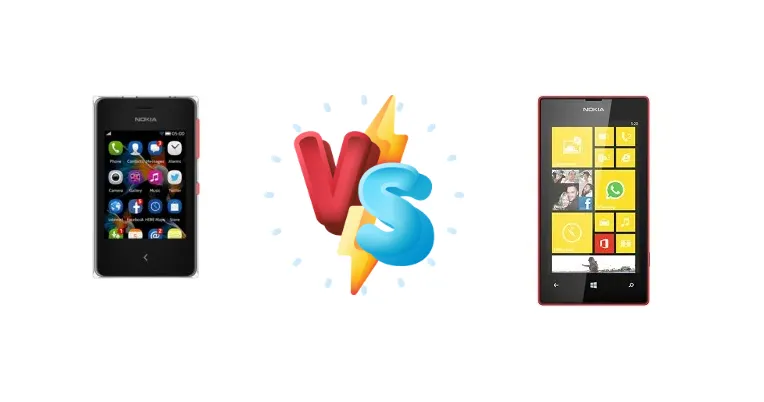
In the early 2010s, Nokia offered a diverse range of smartphones and feature phones. The Asha 500 and Lumia 520 represent two distinct approaches to affordable mobile technology. The Asha 500, running on the Series 30+ platform, aimed for simplicity and affordability, while the Lumia 520 brought Windows Phone 8 to a wider audience. This comparison dissects their differences to help you understand which device better suited the needs of a budget-conscious consumer.
🏆 Quick Verdict
For the average user seeking a smartphone experience, the Nokia Lumia 520 is the clear winner. Its Qualcomm MSM8227 chipset and Windows Phone 8 operating system offer a significantly more versatile and capable experience than the Asha 500’s Series 30+ platform, despite similar battery endurance.
| Network |
|---|
| 2G bands | GSM 850 / 900 / 1800 / 1900 | GSM 850 / 900 / 1800 / 1900 - all versions |
| 3G bands | - | HSDPA 900 / 2100 - RM-914 |
| EDGE | Up to 236.8 kbps | - |
| GPRS | Up to 42.8 kbps | - |
| Speed | - | HSPA 21.1/5.76 Mbps |
| Technology | GSM | GSM / HSPA |
| | - | HSDPA 850 / 1700 / 1900 / 2100 - RM-917 |
| Launch |
|---|
| Announced | 2013, October. Released 2013, December | 2013, February. Released 2013, April |
| Status | Discontinued | Discontinued |
| Body |
|---|
| Build | - | Glass front, plastic back, plastic frame |
| Dimensions | 100.3 x 58.1 x 12.8 mm, 70.9 cc (3.95 x 2.29 x 0.50 in) | 119.9 x 64 x 9.9 mm, 75.7 cc (4.72 x 2.52 x 0.39 in) |
| SIM | Micro-SIM | Micro-SIM |
| Weight | 101 g (3.56 oz) | 124 g (4.37 oz) |
| Display |
|---|
| Protection | - | Scratch-resistant glass |
| Resolution | 240 x 320 pixels, 4:3 ratio (~143 ppi density) | 480 x 800 pixels, 5:3 ratio (~233 ppi density) |
| Size | 2.8 inches, 24.3 cm2 (~41.7% screen-to-body ratio) | 4.0 inches, 45.5 cm2 (~59.3% screen-to-body ratio) |
| Type | TFT, 256K colors | IPS LCD |
| Platform |
|---|
| CPU | - | Dual-core 1.0 GHz |
| Chipset | - | Qualcomm MSM8227 |
| GPU | - | Adreno 305 |
| OS | Nokia Asha software platform 1.1.1, upgradable to 1.4 | Microsoft Windows Phone 8, upgradable to 8.1 |
| Memory |
|---|
| Card slot | microSDHC (dedicated slot), 4 GB included | microSDXC (dedicated slot) |
| Internal | 64MB RAM | 8GB 512MB RAM |
| Main Camera |
|---|
| Single | 2 MP | 5 MP, f/2.4, 28mm (wide), 1/4.0", AF |
| Video | 320p@13fps | 720p@30fps |
| Sound |
|---|
| 3.5mm jack | Yes | Yes |
| 35mm jack | Yes | Yes |
| Loudspeaker | Yes | Yes |
| Comms |
|---|
| Bluetooth | 3.0, A2DP | 4.0, A2DP, LE/ aptX after WP8 Denim update |
| NFC | No | No |
| Positioning | No | GPS, GLONASS |
| Radio | Stereo FM radio | FM Radio |
| USB | microUSB 2.0 | microUSB 2.0 |
| WLAN | Wi-Fi 802.11 b/g/n | Wi-Fi 802.11 b/g/n, hotspot |
| Features |
|---|
| Sensors | Accelerometer, proximity | Accelerometer, proximity |
| | SNS apps
MP4/H.263 player
MP3/WAV/AAC player
Photo editor
Organizer
Voice memo
Predictive text input | - |
| Battery |
|---|
| Music play | Up to 46 h | Up to 61 h |
| Stand-by | Up to 840 h | Up to 360 h (3G) |
| Talk time | Up to 14 h | Up to 14 h 40 min (2G) / Up to 9 h 40 min (3G) |
| Type | Li-Ion 1200 mAh, removable (BL-4U) | Li-Ion 1430 mAh, removable (BL-5J) |
| Misc |
|---|
| Colors | Bright Red, Bright Green, Cyan, Yellow, White and Black | Yellow, red, cyan, white/black |
| Price | About 60 EUR | About 70 EUR |
| SAR | 1.47 W/kg (head) 1.38 W/kg (body) | 0.77 W/kg (head) |
| SAR EU | 1.28 W/kg (head) 0.94 W/kg (body) | 1.09 W/kg (head) |
| Tests |
|---|
| Audio quality | - |
Noise -82.3dB / Crosstalk -81.8dB |
| Battery life | - |
Endurance rating 49h
|
| Camera | - |
Photo / Video |
| Display | - |
Contrast ratio: 834:1 (nominal) / 1.161:1 (sunlight) |
| Loudspeaker | - |
Voice 68dB / Noise 69dB / Ring 66dB
|
Nokia Asha 500
- Extremely affordable price point
- Long standby time due to simple OS
- Durable build quality (typical of Nokia Asha series)
- Limited functionality compared to smartphones
- Series 30+ platform lacks app ecosystem
- Inferior display quality (likely)
Nokia Lumia 520
- Full smartphone experience with Windows Phone 8
- Access to a wider range of apps
- More powerful processor for smoother performance
- Slightly higher price than the Asha 500
- Battery life marginally shorter than Asha 500 (potentially)
- Windows Phone 8 ecosystem less mature than Android/iOS
Display Comparison
The Nokia Lumia 520 boasts a display with a contrast ratio of 834:1 (nominal) and 1.161:1 in sunlight, suggesting reasonable visibility even outdoors. While the Asha 500’s display specifications are unavailable, its position in the market suggests a lower-quality panel. The Lumia 520’s display, though modest by today’s standards, provides a more vibrant and readable experience, crucial for app usage and web browsing. The contrast ratio indicates better black levels on the Lumia 520, enhancing image clarity.
Camera Comparison
Both devices feature photo and video capabilities, but the Lumia 520’s camera benefits from the processing power of the MSM8227 chipset. While specific sensor details are missing for both, the Lumia 520’s camera app offered features and image processing algorithms unavailable on the Asha 500. The Asha 500’s camera was likely a basic module intended for casual snapshots, while the Lumia 520 offered a more versatile photographic experience.
Performance
The Lumia 520 is powered by a Qualcomm MSM8227 chipset with a dual-core 1.0 GHz CPU. This provides a significantly more powerful processing capability than the Asha 500, which likely utilized a simpler, single-core processor typical of Series 30+ devices. The MSM8227 allowed for smoother multitasking and a more responsive user experience, enabling the execution of Windows Phone 8 apps. The Asha 500, constrained by its platform, was primarily suited for basic tasks.
Battery Life
Both the Nokia Asha 500 and Lumia 520 achieve an endurance rating of 49 hours. This suggests similar real-world battery performance despite the Lumia 520’s more powerful processor. The Asha 500 likely benefits from its simpler operating system and less demanding hardware, while the Lumia 520’s power efficiency compensates for its increased processing load. Both devices were designed to provide all-day battery life under typical usage.
Buying Guide
Buy the Nokia Asha 500 if you prioritize extreme simplicity, long standby times, and a very low price point, needing only basic calling and texting functionality. Buy the Nokia Lumia 520 if you prefer a smartphone experience with access to apps, social media, and a more modern user interface, even if it means slightly less battery life and a higher initial cost.
Frequently Asked Questions
❓ Is the Qualcomm MSM8227 in the Lumia 520 powerful enough for modern apps?
While the MSM8227 was a capable processor for its time, it's important to remember these phones are over a decade old. Modern apps would likely be too demanding, but it handled Windows Phone 8 apps reasonably well. It's sufficient for basic tasks like calling, texting, and social media.
❓ What kind of apps are available on the Nokia Lumia 520 compared to the Asha 500?
The Lumia 520, running Windows Phone 8, had access to the Windows Phone Store, offering a wide range of apps for social media, navigation, entertainment, and productivity. The Asha 500, with its Series 30+ platform, was limited to pre-installed apps and a small selection of Java-based applications.
❓ How does the Series 30+ operating system on the Asha 500 differ from Windows Phone 8 on the Lumia 520?
Series 30+ is a feature phone operating system focused on simplicity and efficiency. It lacks the multitasking capabilities, app ecosystem, and advanced features of a smartphone OS like Windows Phone 8. Windows Phone 8 offered a tile-based interface, deeper integration with Microsoft services, and a more modern user experience.