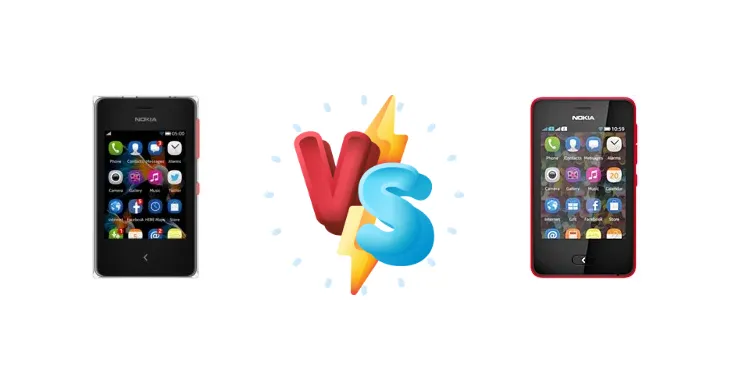
The Nokia Asha 500 and 501 represent Nokia's attempt to bridge the gap between basic feature phones and smartphones in the early 2010s. While both devices target the entry-level market, subtle differences in display technology and camera functionality exist, potentially influencing the user experience. This comparison aims to dissect these nuances to determine which Asha model offers the best value.
🏆 Quick Verdict
For the average user prioritizing a slightly improved viewing experience in various lighting conditions, the Nokia Asha 501 is the better choice. Its significantly higher sunlight contrast ratio (2.672:1 vs. the Asha 500’s unknown value) suggests superior readability outdoors, a crucial factor for users in brighter environments.
| Network |
|---|
| 2G bands | GSM 850 / 900 / 1800 / 1900 | GSM 900 / 1800 - RM-899850 / 1900 - RM-900 |
| EDGE | Up to 236.8 kbps | Up to 236.8 kbps |
| GPRS | Up to 42.8 kbps | Up to 85.6 kbps |
| Technology | GSM | GSM |
| | - | GSM 900 / 1800 - SIM 1 & SIM 2 - RM-902 |
| Launch |
|---|
| Announced | 2013, October. Released 2013, December | 2013, May. Released 2013, June |
| Status | Discontinued | Discontinued |
| Body |
|---|
| Dimensions | 100.3 x 58.1 x 12.8 mm, 70.9 cc (3.95 x 2.29 x 0.50 in) | 99.2 x 58 x 12.1 mm (3.91 x 2.28 x 0.48 in) |
| SIM | Micro-SIM | Single SIM (Micro-SIM) or Dual SIM (Micro-SIM, dual stand-by) |
| Weight | 101 g (3.56 oz) | 98.2 g (3.46 oz) |
| Display |
|---|
| Resolution | 240 x 320 pixels, 4:3 ratio (~143 ppi density) | 240 x 320 pixels, 4:3 ratio (~133 ppi density) |
| Size | 2.8 inches, 24.3 cm2 (~41.7% screen-to-body ratio) | 3.0 inches, 27.9 cm2 (~48.4% screen-to-body ratio) |
| Type | TFT, 256K colors | TFT, 256K colors |
| Platform |
|---|
| OS | Nokia Asha software platform 1.1.1, upgradable to 1.4 | Nokia Asha software platform 1.0, upgradable to 1.4 |
| Memory |
|---|
| Card slot | microSDHC (dedicated slot), 4 GB included | microSDHC (dedicated slot), 4 GB included |
| Internal | 64MB RAM | 128MB 64MB RAM |
| Main Camera |
|---|
| Single | 2 MP | 3.15 MP |
| Video | 320p@13fps | 320p@15fps |
| Sound |
|---|
| 3.5mm jack | Yes | Yes |
| 35mm jack | Yes | Yes |
| Loudspeaker | Yes | Yes |
| Comms |
|---|
| Bluetooth | 3.0, A2DP | 3.0, EDR |
| NFC | No | No |
| Positioning | No | No |
| Radio | Stereo FM radio | FM radio |
| USB | microUSB 2.0 | microUSB 2.0 |
| WLAN | Wi-Fi 802.11 b/g/n | Wi-Fi 802.11 b/g/n |
| Features |
|---|
| Sensors | Accelerometer, proximity | Accelerometer, proximity |
| | SNS apps
MP4/H.263 player
MP3/WAV/AAC player
Photo editor
Organizer
Voice memo
Predictive text input | SNS apps
MP4/H.263 player
MP3/WAV/AAC player
Photo editor
Organizer
Voice memo
Predictive text input |
| Battery |
|---|
| Music play | Up to 46 h | Up to 56 h |
| Stand-by | Up to 840 h | Up to 624 h |
| Talk time | Up to 14 h | Up to 17 h |
| Type | Li-Ion 1200 mAh, removable (BL-4U) | Li-Ion 1200 mAh, removable (BL-4U) |
| Misc |
|---|
| Colors | Bright Red, Bright Green, Cyan, Yellow, White and Black | Bright Red, Bright Green, Cyan, Yellow, White and Black |
| Price | About 60 EUR | About 80 EUR |
| SAR | 1.47 W/kg (head) 1.38 W/kg (body) | 1.41 W/kg (head) |
| SAR EU | 1.28 W/kg (head) 0.94 W/kg (body) | 0.96 W/kg (head) |
| Tests |
|---|
| Audio quality | - |
Noise -80.4dB / Crosstalk -82.3dB |
| Camera | - |
Photo |
| Display | - |
Contrast ratio: 1004:1 (nominal) / 2.672:1 (sunlight) |
| Loudspeaker | - |
Voice 73dB / Noise 68dB / Ring 78dB
|
Nokia Asha 500
- Likely lower price point (based on market positioning)
- Basic functionality for essential communication
- Long battery life (typical of feature phones)
- Unknown display contrast ratio, potentially poor outdoor visibility
- Limited camera capabilities
- Lack of advanced features
Nokia Asha 501
- Superior display contrast ratio (1004:1 nominal, 2.672:1 sunlight)
- Improved outdoor visibility
- Simple and reliable operation
- Potentially slightly higher price than the Asha 500
- Limited camera capabilities
- Still a basic feature phone with limited functionality
Display Comparison
The most significant documented difference between the Asha 500 and 501 lies in their display contrast ratios. The Asha 501 boasts a nominal contrast ratio of 1004:1, increasing to 2.672:1 in direct sunlight. The Asha 500’s contrast ratio is not specified, implying it’s likely lower. This difference is critical; a higher sunlight contrast ratio means the screen remains more readable when used outdoors, a common scenario for users in many regions. While both likely utilize similar LCD technology, the Asha 501’s panel is demonstrably optimized for outdoor visibility.
Camera Comparison
Both the Nokia Asha 500 and 501 feature a camera described simply as 'Photo'. Without further specification (resolution, sensor size, aperture), it’s difficult to assess any meaningful difference in image quality. Given the target market, both cameras likely prioritize simplicity and ease of use over advanced photographic capabilities. Users should expect basic image capture suitable for casual snapshots, but not comparable to smartphone cameras.
Performance
Given the limited data, a direct performance comparison is challenging. Both devices likely utilize a similar Series 40 platform, optimized for basic functionality rather than demanding applications. The Asha 500 and 501 were positioned as entry-level devices, so processing power was not a primary focus. Any performance differences would likely be negligible for typical feature phone tasks like calling, texting, and basic organizer functions.
Battery Life
Battery life is a crucial consideration for feature phones, but specific mAh ratings for either the Asha 500 or 501 are unavailable. However, both devices were designed for extended standby times and several days of typical use on a single charge. The lack of power-hungry features like large displays or complex operating systems contributes to their efficient power consumption. Charging times would have been similarly modest, likely several hours via micro-USB.
Buying Guide
Buy the Nokia Asha 500 if you need a basic, functional feature phone and are primarily concerned with voice calls and text messaging, and price is the absolute deciding factor. Buy the Nokia Asha 501 if you value a more visible display in sunlight and appreciate a slightly enhanced visual experience, even within the limitations of a feature phone screen. The Asha 501’s improved contrast ratio caters to users who spend time outdoors or in brightly lit spaces.
Frequently Asked Questions
❓ Is the Nokia Asha 501's improved contrast ratio noticeable in everyday use?
Yes, the higher contrast ratio of the Asha 501 will be most noticeable when viewing the screen in bright sunlight or outdoors. Text and images will appear clearer and more defined compared to a display with a lower contrast ratio. Indoors, the difference may be less pronounced, but still present.
❓ Can either the Asha 500 or 501 be used for basic internet browsing?
Both phones support basic internet browsing through a pre-installed browser, but the experience will be limited. The small screen size and slow data speeds (likely 2G) will make browsing cumbersome. These phones are not designed for extensive web use; they are best suited for calls, texts, and simple tasks.
❓ What type of memory card does the Asha 501 support for expanding storage?
While not explicitly stated in the provided data, Nokia Asha phones of this era typically supported microSD cards for storage expansion. The maximum supported capacity would likely be 32GB, but it's best to consult the user manual for confirmation.